

The Mecca Joint Defence Agreement between Saudi Arabia, Pakistan and Turkey has barely been signed, but it has already highlighted an emerging fault line between two of the Gulf's most influential powers: Saudi Arabia and the UAE.
The agreement, signed in Mecca on August 7, commits the three countries to treating an armed attack against one member as an attack against all. Saudi Arabia and Pakistan have also indicated that the grouping could eventually expand to include additional countries.
But the pact has triggered criticism from prominent Emirati voices, who have questioned why Saudi Arabia needed a new security arrangement involving Turkey and Pakistan when the Gulf Cooperation Council (GCC) already has a collective defence framework.
Saudi commentators have responded by turning the criticism back on the UAE, pointing to Abu Dhabi's expanding security and defence cooperation with India and Israel.
The resulting exchange has exposed deeper differences in the foreign-policy priorities of Riyadh and Abu Dhabi.
WHAT IS THE MECCA DEFENCE AGREEMENT?
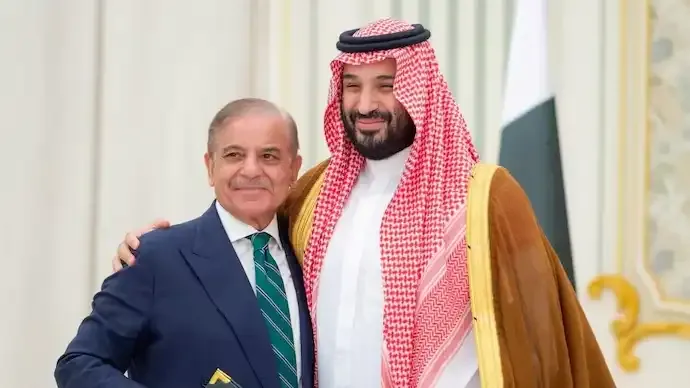
The agreement was signed in Mecca by Saudi Crown Prince Mohammed bin Salman, Turkish President Recep Tayyip Erdogan and Pakistan Prime Minister Shehbaz Sharif.
It brings together three strategically important countries:
- Saudi Arabia, the Gulf's largest economy and a major oil producer
- Pakistan, a nuclear-armed South Asian power
- Turkey, a NATO member with one of the alliance's largest militaries
The agreement is designed to establish a collective response to security threats, with an attack on one signatory considered an attack on all three.
Some analysts have described the emerging arrangement as an “Islamic NATO”, although it does not replicate NATO's institutional structure.
Reports have suggested that countries including Egypt, Qatar, Kuwait, Jordan, Azerbaijan and Syria could potentially be considered for broader participation.
WHY IS THE UAE QUESTIONING THE PACT?
The criticism from Abu Dhabi has centred on the existence of the Gulf Cooperation Council, which already brings together Saudi Arabia, the UAE, Qatar, Kuwait, Bahrain and Oman.
The GCC was established in 1981 to coordinate political, economic and security policies among the six Gulf monarchies.
Its members also have a joint defence framework under which an attack on one member is treated as a threat to the wider group.
Against this backdrop, Emirati political analyst and former aide to UAE President Mohammed bin Zayed, Abdulkhaleq Abdulla, questioned why Riyadh was prioritising a new arrangement involving non-Gulf powers.
He argued that strengthening Gulf cooperation and improving unity within the GCC should be the priority.
The comments effectively raised a fundamental question: if the GCC already has a collective security structure, why does Saudi Arabia need a separate defence pact with Pakistan and Turkey?
SAUDI ARABIA HITS BACK
Saudi voices quickly rejected the criticism.
Saudi Prince Abdulrahman bin Musaid defended Riyadh's right to establish security partnerships according to its own strategic interests.
He questioned why the Mecca agreement should conflict with efforts to strengthen the GCC.
Fahad al-Arabi al-Harthi, chairman of the Riyadh-based Asbar Centre for Studies and Research, similarly argued that the pact was not directed against a specific country.
Instead, he described it as an effort to build collective deterrence and defence capabilities against potential threats.
The exchange demonstrated that the disagreement is not necessarily about whether the GCC should remain relevant. Rather, it reflects different views about how Gulf states should build security partnerships in an increasingly fragmented Middle East.
INDIA AND ISRAEL ENTER THE ARGUMENT
The Saudi response became more pointed when commentators highlighted the UAE's own partnerships beyond the Gulf.
In particular, they pointed to Abu Dhabi's growing defence and strategic cooperation with India and Israel.
Saudi commentator Abdulaziz al-Tuwaijri, a former head of the Islamic World Educational, Scientific and Cultural Organisation, questioned why the UAE could establish security partnerships outside the GCC while criticising Saudi Arabia for doing the same.
His comments specifically targeted the UAE's relationship with Israel as well as its growing defence cooperation with India.
The argument effectively became one of strategic consistency: if Abu Dhabi can pursue security partnerships with external powers, why should Riyadh be criticised for strengthening ties with Turkey and Pakistan?
WHAT IS INDIA'S DEFENCE RELATIONSHIP WITH THE UAE?
There is an important distinction here.
India does not have a joint defence treaty with the UAE.
However, the two countries have steadily expanded defence cooperation since a 2003 memorandum of understanding.
Their relationship now includes military exchanges, joint exercises and cooperation in areas such as defence technology and maritime security.
The two countries also signed a broader Strategic Defence Partnership framework in January 2026, covering areas including military technology, co-production, maritime security and counter-terrorism.
This growing relationship has made India an increasingly important strategic partner for Abu Dhabi.
UAE-ISRAEL SECURITY TIES ADD ANOTHER LAYER
The UAE's relationship with Israel is even more politically sensitive.
Abu Dhabi formally established diplomatic relations with Israel through the 2020 Abraham Accords.
The partnership has since expanded into multiple areas, including security and defence cooperation.
In April, Israel reportedly deployed an Iron Dome air-defence battery and military personnel to the UAE after the country came under Iranian drone and missile attacks.
For Saudi commentators, these arrangements provided an obvious counterargument to Emirati criticism of the Mecca pact.
The underlying message was clear: Gulf states have increasingly been building their own external security networks, and Saudi Arabia is now doing the same.
THE SAUDI-UAE RIFT GOES BEYOND THE MECCA PACT
The latest war of words is part of a broader divergence between Riyadh and Abu Dhabi.
Saudi Arabia and the UAE remain important partners, but their strategic priorities have increasingly moved in different directions.
Riyadh has been strengthening relationships with Turkey and Pakistan, while Abu Dhabi has developed closer strategic and security links with India and Israel.
The difference is particularly visible in Yemen.
Saudi Arabia has supported the internationally recognised Yemeni government, while the UAE has backed the Southern Transitional Council (STC), a separatist movement seeking greater autonomy or independence for southern Yemen.
The disagreement illustrates how the two Gulf powers can remain allies while pursuing competing interests in regional conflicts.
A NEW REGIONAL ALIGNMENT?
The Mecca pact therefore represents more than a new defence agreement.
It comes at a time when traditional regional alliances are being supplemented by increasingly flexible partnerships.
Saudi Arabia appears interested in building a wider network involving Turkey and Pakistan, while the UAE has invested heavily in its relationships with India, Israel and other external powers.
The dispute also shows that the concept of a unified Gulf security architecture is becoming increasingly complicated.
The central question may no longer be whether Saudi Arabia and the UAE remain allies, but how far their strategic priorities can diverge before those differences begin reshaping the wider Gulf order.
For India, the debate is significant because New Delhi's growing strategic partnership with Abu Dhabi is now being discussed alongside the emerging Saudi-Pakistan-Turkey security framework.
If the Mecca pact expands, and if Saudi-UAE differences continue to sharpen, the Gulf could see the emergence of competing networks of strategic partnerships — with India, Israel, Pakistan and Turkey occupying increasingly important positions in the region's evolving security architecture.



Conversation
Be kind and stay on topic. Comments are moderated; abuse, spam and personal attacks are removed. Report a problem