

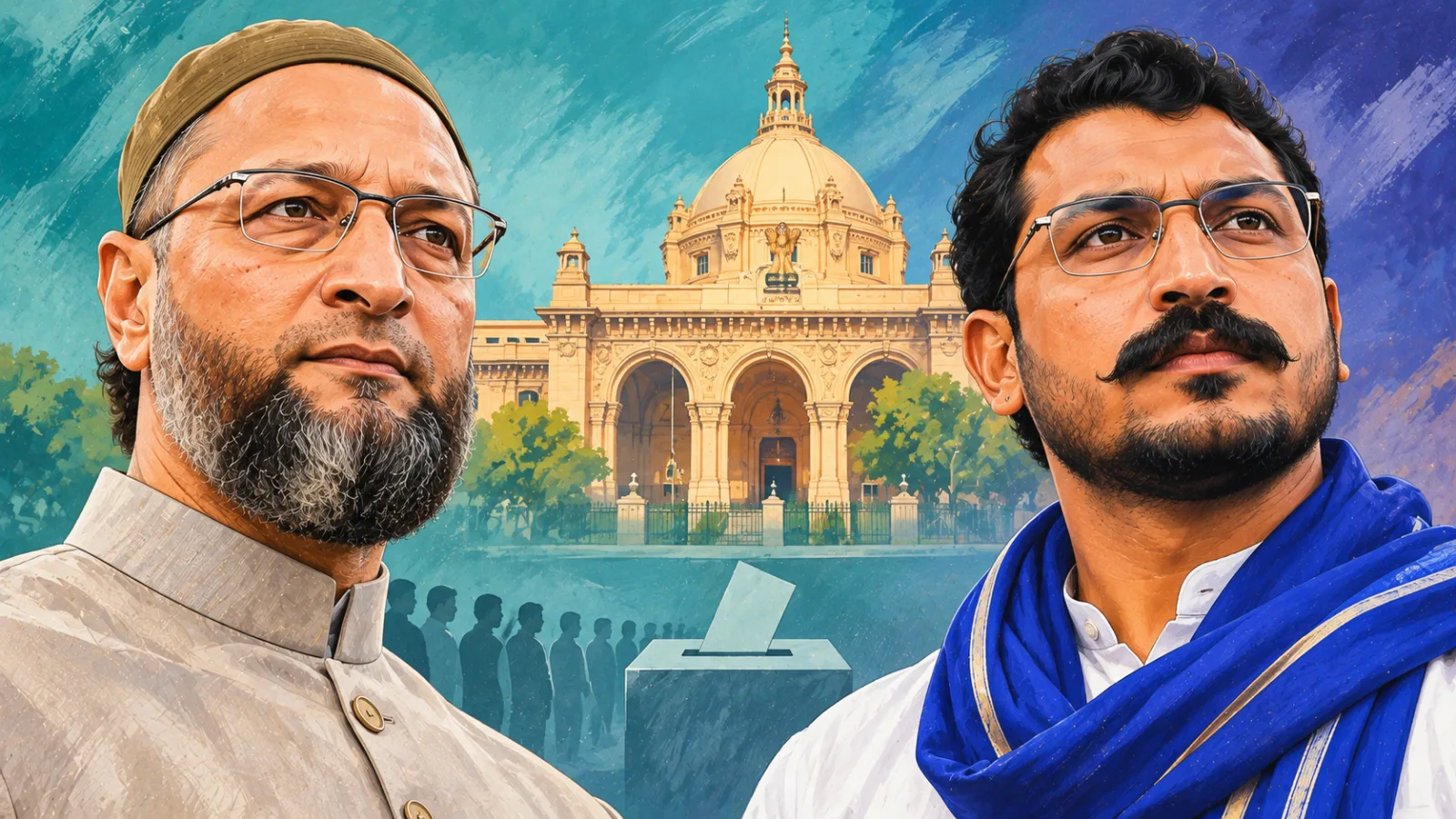

LUCKNOW, November 12, 2026: The political contest ahead of the 2027 Uttar Pradesh Assembly elections has taken a new turn, with Asaduddin Owaisi's All India Majlis-e-Ittehadul Muslimeen (AIMIM) and Chandrashekhar Azad's Azad Samaj Party (Kanshi Ram) announcing a formal electoral alliance on Thursday.
The two parties have named their partnership the Samajik Parivartan Morcha (SPM) and declared Chandrashekhar Azad as its chief ministerial candidate.
The announcement was made during a joint press conference in Lucknow, where Owaisi said the alliance would work towards preventing the Bharatiya Janata Party (BJP) from securing a third consecutive term in Uttar Pradesh.

Both leaders said the new political formation would contest all 403 Assembly constituencies, with an emphasis on the representation of Dalits, minorities, backward classes and economically disadvantaged communities.
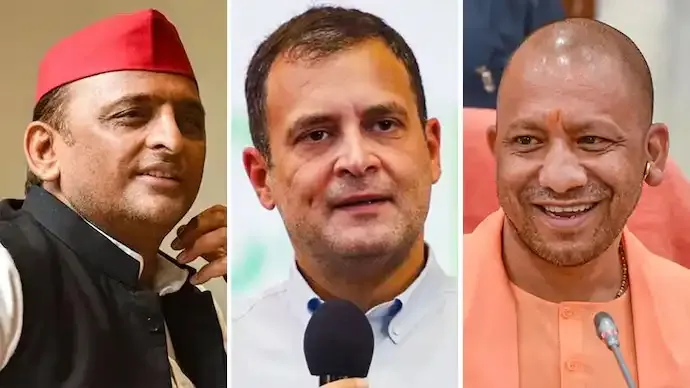
The development introduces another political force into an electoral contest already expected to feature the BJP-led National Democratic Alliance (NDA), the Samajwadi Party, Congress and the Bahujan Samaj Party (BSP).
Owaisi Names Chandrashekhar Azad as Chief Ministerial Candidate
Addressing reporters in Lucknow, AIMIM president Asaduddin Owaisi formally announced that Chandrashekhar Azad would lead the alliance into the Assembly elections.
Azad, who represents the Nagina constituency in the Lok Sabha, will also serve as the principal leader of the newly formed front.
Owaisi expressed confidence that the partnership could emerge as a strong alternative to the established political parties in Uttar Pradesh.
He said both organisations would work together to build an electoral platform focused on communities that, according to him, have not received adequate political representation.
The AIMIM chief also criticised successive governments for treating marginalised groups primarily as electoral vote banks.
He identified education, unemployment, farmers' problems and the welfare of disadvantaged communities as important priorities for the alliance.
The decision to announce a chief ministerial candidate months before the election gives SPM a recognisable leadership figure as it begins its campaign.
However, the announcement does not mean that the alliance has secured sufficient support to form a government.
What Is Samajik Parivartan Morcha?
The Samajik Parivartan Morcha is a new electoral alliance between AIMIM and the Azad Samaj Party (Kanshi Ram).
It brings together two organisations that have sought to represent different sections of Uttar Pradesh's electorate.
AIMIM, led by Hyderabad MP Asaduddin Owaisi, has attempted to expand its political presence beyond Telangana by contesting elections in several states.
The Azad Samaj Party, founded by Chandrashekhar Azad, has concentrated on issues concerning Dalit rights, constitutional protections and political representation.
The partnership brings these political priorities into a common electoral platform.
The leaders have outlined several objectives for the alliance:
- Improving access to education and opportunities for young people.
- Raising concerns about unemployment and the availability of government jobs.
- Addressing problems faced by farmers.
- Strengthening the political representation of Dalits, minorities and other marginalised communities.
- Challenging the BJP government in the 2027 Assembly elections.
The leaders have described the partnership as an effort to bring social and political change.
The detailed election manifesto, constituency-wise candidates and final seat-sharing arrangements between the parties have not yet been announced.
Alliance Plans to Contest All 403 Seats in UP Elections
Chandrashekhar Azad said the new alliance intends to contest all 403 constituencies in the Uttar Pradesh Legislative Assembly.
He indicated that the two parties were prepared to coordinate their electoral campaigns and candidate selection.
However, the announcement that the alliance will contest every constituency does not mean each party will independently field candidates in all 403 seats.
The distribution of constituencies between AIMIM and the Azad Samaj Party will depend on their internal seat-sharing agreement.
Uttar Pradesh has 403 elected Assembly seats, and a party or coalition requires at least 202 seats for a simple majority.
The election is due in 2027, although the detailed polling schedule has not yet been announced by the Election Commission.
The alliance has also announced plans for a public meeting on November 26 as part of its effort to build support across the state.
Owaisi appealed to supporters to participate in the programme, describing it as an important beginning for the new political formation.
Chandrashekhar Azad Says Alliance Is About Social Change
Chandrashekhar Azad rejected the idea that the partnership should be viewed merely as another conventional third front.
He argued that the initiative was intended to bring together people who have remained socially and economically disadvantaged despite changes in government.
The Azad Samaj Party leader accused previous administrations of failing to deliver on promises concerning poverty, caste discrimination, social justice and access to basic services.
He said the alliance would seek to give greater political influence to communities that have historically struggled for representation.
Azad also expressed confidence that the front could expand if other organisations and political leaders supported its objectives.
His remarks indicate that the alliance intends to position itself around broader questions of governance and social justice rather than solely around opposition to the BJP.
However, its ability to translate that agenda into votes will depend on its organisation, local candidates and support across individual constituencies.
Why the AIMIM and Azad Samaj Party Alliance Matters
The new political partnership could influence the electoral calculations of several established parties in Uttar Pradesh.
AIMIM has sought support among sections of Muslim voters, while Chandrashekhar Azad has built his political identity around Dalit representation and social justice.
Bringing these organisations together could create a platform appealing to voters who feel inadequately represented by the existing parties.
However, social identity does not automatically translate into electoral support.
Muslim and Dalit voters are not uniform political groups, and their preferences differ across regions, constituencies and local issues.
The alliance may face particular competition from the Samajwadi Party, Congress and Bahujan Samaj Party, which also seek support from overlapping sections of the electorate.
The BJP, meanwhile, has maintained a strong statewide electoral organisation and successfully formed governments following the 2017 and 2022 Assembly elections.
For SPM, the challenge will be turning its political message into a competitive constituency-level campaign.
What Happened to AIMIM and ASP in the 2022 UP Elections?
The previous Assembly election provides an important measure of the challenge facing the new alliance.
In 2022, both AIMIM and the Azad Samaj Party contested a large number of constituencies but failed to win a seat.
According to election records:
- BJP: Won 255 seats with 41.29% of the statewide vote.
- Samajwadi Party: Won 111 seats with 32.06%.
- Congress: Won two seats with 2.33%.
- Bahujan Samaj Party: Won one seat with 12.88%.
- AIMIM: Contested 95 seats, secured approximately 0.49% of the statewide vote and won no seats.
- Azad Samaj Party (Kanshi Ram): Secured approximately 0.13% of the statewide vote and won no seats.
The BJP-led NDA, including its allies, won 273 seats with a combined vote share of approximately 43.82%.
These figures demonstrate the considerable gap between the established parties and the two new alliance partners during the previous Assembly election.
However, past performance does not necessarily determine future results.
Since 2022, Chandrashekhar Azad has strengthened his individual electoral position, particularly through his victory in the 2024 Lok Sabha elections.
Chandrashekhar Azad's Nagina Victory Strengthens His Political Profile
One of the significant developments since the previous Assembly election has been Chandrashekhar Azad's parliamentary victory from Nagina.
In the 2024 Lok Sabha election, Azad won the constituency with 5,12,552 votes.
He defeated BJP candidate Om Kumar, who received 3,61,079 votes, by a margin of 1,51,473.
The result established Azad as an elected Member of Parliament and demonstrated his ability to build substantial support in a parliamentary constituency.
It also gave the Azad Samaj Party greater visibility in Uttar Pradesh politics.
However, winning a Lok Sabha constituency and contesting an Assembly election across 403 seats require different organisational strengths.
SPM will need to establish candidates, local networks and campaign resources across the state to become a serious statewide contender.
SPM Invites Samajwadi Party and Congress to Join
Despite forming an independent alliance, Chandrashekhar Azad and Asaduddin Owaisi have kept the door open for cooperation with other opposition parties.
Azad publicly invited the Samajwadi Party and Congress to join their efforts against the BJP.
The invitation comes after earlier attempts by AIMIM to explore electoral cooperation with larger opposition parties did not result in a formal agreement.
The new front could therefore develop in different directions over the coming months.
It may contest independently, expand by adding smaller parties or seek a broader understanding with other opposition organisations.
However, no agreement involving the Samajwadi Party or Congress has been announced.
The two parties remain separate political organisations with their own electoral priorities and ongoing discussions.
Whether they respond positively to the invitation remains uncertain.
Can the New Alliance Change the 2027 Uttar Pradesh Election?
The formation of Samajik Parivartan Morcha adds another factor to an already competitive political environment.
Its leadership believes the alliance can build support among Dalits, Muslims, backward communities and young voters seeking an alternative to the existing political parties.
The BJP will be attempting to retain power for a third consecutive term, while the Samajwadi Party and other opposition organisations will also be seeking to strengthen their positions.
The new alliance could influence results in constituencies where relatively small shifts in voting patterns determine the winning candidate.
However, it could also face difficulties if opposition votes become divided among several competing parties.
There is insufficient evidence at present to conclude which major party would benefit or lose from SPM's participation.
That will depend on candidate selection, local alliances, regional voting patterns and the issues dominating the campaign.
The next important developments will include the November 26 public meeting, negotiations over seat allocation and the announcement of candidates.
For now, the confirmed political development is that AIMIM and the Azad Samaj Party have decided to contest the 2027 Uttar Pradesh election together, with Chandrashekhar Azad as their chief ministerial face.
Whether the Samajik Parivartan Morcha can transform that partnership into a significant electoral force will become clearer as the campaign develops.
Editorial note: This report is based on the November 12 Lucknow press conference as covered by PTI, Akashvani News and other publications. Historical election figures were cross-checked against Election Commission records. All India Story has not conducted an independent opinion poll or projected the election result.



Conversation
Be kind and stay on topic. Comments are moderated; abuse, spam and personal attacks are removed. Report a problem