

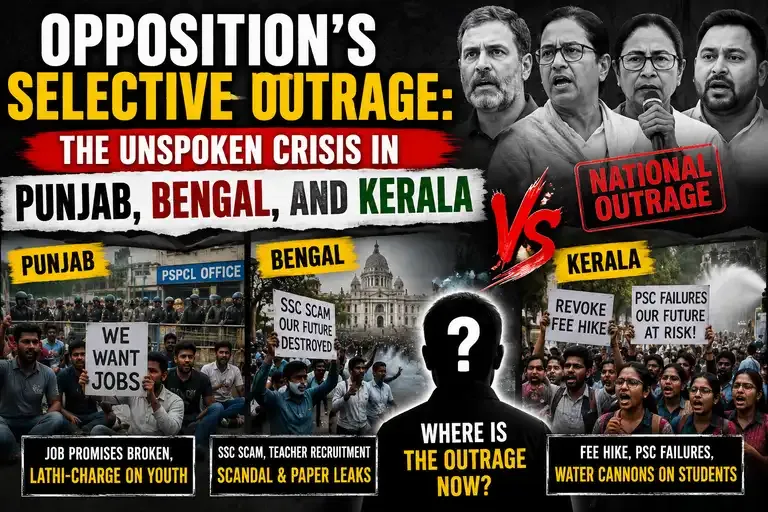

The political drama currently unfolding in New Delhi is unlike anything we’ve seen in recent years. For the first time, an exam controversy has sparked a massive, coordinated national campaign—from parliamentary walkouts to street marches—with opposition leaders collectively demanding the immediate resignation of Union Education Minister Dharmendra Pradhan. The rhetoric coming from the opposition is relentless: they claim to stand shoulder-to-shoulder with India’s youth, framing the central government as completely unaccountable to students.
It is a powerful narrative. But if you look past the headlines, the hypocrisy becomes impossible to ignore.
Why is this sudden passion for "ministerial resignation" and "student justice" nowhere to be found in the states these opposition parties actually govern?

Before pointing fingers at the Centre or using national student anger to score political points, these leaders need to answer for their own backyard. Where were these demands for accountability when paper leaks systematically ruined the futures of thousands of candidates in states like Jharkhand? Is this truly the first time a major exam paper has been compromised, and what about the recurring paper leaks that occurred during the opposition’s own rule? Why the deafening silence when technical graduates in Punjab waited years for job postings, only to face police lathi-charges when they protested outside state offices?
You cannot play the righteous champion of student rights in New Delhi while using police batons to crush student protests in your own state capital. This sudden surge in national outrage isn't about protecting students—it’s about political opportunity. If the opposition wants its critique of the Central Government to hold any real weight, it must first apply those exact same standards of accountability to itself.
It is easy to deliver rousing speeches about "student power" from the air-conditioned press rooms of New Delhi. But if you want to test a political party’s true commitment to educated youth, don’t look at what they say when they are in the opposition—look at what they do when they hold the reins of power.
Punjab Unemployed Technical Youth & Student Agitation
While opposition leaders were busy holding press conferences in the capital demanding national accountability, a heartbreakingly familiar tragedy was quietly playing out outside the headquarters of the Punjab State Power Corporation Limited (PSPCL) in Patiala.
These weren't political agitators. They were over 2,600 technical graduates—qualified ITI pass-outs who had completed mandatory six-month apprenticeships and cleared state-mandated language exams. They were promised that their hard-earned technical training would translate into regular employment as Assistant Linemen. Instead, they were met with endless delays, excuses about election codes of conduct, and eventually, a blunt declaration that the state had no room for them.

So, on June 1, 2026, these young technicians did what any desperate, unemployed youth would do: they sat down peacefully outside the PSPCL gates to ask for the jobs they were promised.
How did the state government respond?
On June 5, when the exhausted youth blocked the administrative gates in desperate protest, the state didn't send a minister to negotiate. It sent the police.
What followed was a brutal lathi-charge. Unarmed students were struck with batons, leaving over 20 young candidates injured and hospitalized. To add insult to injury, the administration registered FIRs against more than 160 protesters under rioting charges—effectively criminalizing their search for employment. Desperate for answers, nearly a dozen youth were forced to climb a high-voltage transmission tower in Bhedpura just to keep their grievances in the headlines.

The Southern Mirror: Fee Hikes and PSC Fiascos in Kerala

The rhetoric of national opposition parties assumes that administrative incompetence is strictly a central problem. But as you travel south to Kerala, governed by the Left Democratic Front (LDF), the exact same cracks appear in the higher education and public recruitment system.
While state leaders issue fiery press releases standing in solidarity with national exam reform movements, Kerala’s own students are taking to the streets to fight a two-front war: steep, unmanageable college fee hikes and a Kerala Public Service Commission (PSC) suffering from administrative lapses.
The crisis escalated in mid-June 2026, when the state government approved a near 50% fee hike across state-run technical and engineering institutes managed by the Co-operative Academy of Professional Education (CAPE) and the Institute of Human Resources Development (IHRD). Over 10,000 students were suddenly faced with an unsustainable financial burden.
At the same time, allegations of evaluation irregularities and paper leaks in the prestigious Kerala Administrative Service (KAS) and general PSC examinations began to spill over into public view. The situation reached a breaking point on July 18, 2026, when the PSC was forced to cancel a statewide recruitment exam for over 1.5 lakh candidates after invigilators mistakenly handed out afternoon question papers during the morning session at an Alappuzha test center.
How did the state handle student anger when these crises hit the streets?
June 24, 2026: When thousands of student activists marched toward the Kerala Secretariat in Thiruvananthapuram demanding a fee-hike rollback, police deployed high-pressure water cannons and launched a lathi-charge. Multiple student leaders suffered head and body injuries, and cases were slapped on student organizers for damaging public property.
July 9, 2026: Outraged by recruitment irregularities, Youth Congress activists stormed the PSC headquarters in Thiruvananthapuram, staging a sit-in outside the meeting rooms until police forcibly removed and detained them.
July 19–22, 2026: Under intense public pressure, the Chief Minister ordered a Crime Branch Special Investigation Team (SIT) probe into PSC evaluation lapses. In response to police actions against student demonstrators, the Kerala Students' Union (KSU) declared a statewide educational strike, shutting down campuses in Kochi, Kannur, and Thrissur.
The Selective Amnesia in Jharkhand: Paper Leaks and Political Theatre
If hypocrisy had a geographical hub in Eastern India, it would be Ranchi.
In New Delhi, leaders of the INDIA bloc—including the Congress and Jharkhand Mukti Morcha (JMM)—stand in solidarity with student marches, wave placards, and demand national resignations over competitive exam irregularities. They launch nationwide campaigns like ‘Chhatron Ki Goonj’ to posture as defenders of youth rights.
Yet, in their own home state of Jharkhand, the exact same political coalition presides over an exam system plagued by recurring scandals, police raids, and paper leak mafias.
The reality on the ground in Jharkhand is a nightmare for aspirants:
The April 2026 Tamar Racket: During the Jharkhand Excise Constable Competitive Examination (JECCE), police raided a location in Tamar and caught 159 candidates being coached on leaked, solved paper sets by an inter-state "solver gang" charging up to ₹15 lakh per seat.
The JSSC-CGL and JET Mismanagement: This wasn't an isolated glitch. Aspirants had already spent months protesting discrepancies in the Jharkhand Staff Selection Commission (JSSC) CGL exams, while test centers in Bokaro faced chaos over missing question booklets during the Jharkhand Eligibility Test (JET).
Secretariat Infiltration: Investigations by the CID revealed that paper leak networks extended deep into the state administration itself, leading to the arrest of officials who had confidential exam questions stored on their phones before tests were even conducted.
When student organizations, BJYM, and youth unions took to the streets across Ranchi, Bokaro, and Dhanbad demanding a independent CBI inquiry and a complete overhaul of corrupted exam boards, the state government offered lofty assurances instead of systemic fixes.
The Green Paradox: Silicon Dreams and Uprooted Groves in Karnataka
When national political figures travel across the country, they often preach about sustainable development, climate action, and protecting indigenous green cover. They accuse the Central Government of selling out the environment to private conglomerates.
Yet, in Karnataka—where the Congress-led government holds absolute power—that environmental morality vanishes the moment a lucrative real estate or tech project hits the drawing board.
The hypocrisy is on full display in Ramanagara district’s Bidadi area. To build a massive, 9,000-acre Greater Bidadi Integrated AI Township, the state government plans to acquire fertile agricultural land spanning multiple revenue villages. An official Right to Information (RTI) response recently exposed the staggering ecological cost: to construct this "AI City," the government plans to clear close to 2 lakh (200,000) trees.
This isn't barren wasteland. The trees marked for destruction include:
Over 87,000 coconut trees.
Over 83,000 arecanut trees.
Over 12,000 fruit-bearing mango trees.
More than 3 lakh banana plants and hundreds of acres of active ragi, paddy, and silk farms.
When local farmers—who have been protesting for over 400 days under the 'Save Bidadi' campaign—gheraoed surveying officials to protect their livelihoods, the state administration didn't pause the project. Instead, police filed criminal cases against protesting farmers, detaining local leaders to force the land acquisition through.
The Selective Silence in Bundelkhand: Displacement and Dammed Rights
If you listen to the opposition's national speeches, you would believe they are the sole guardians of indigenous tribes, forest rights, and eco-sensitive zones. They routinely accuse central infrastructure initiatives of "bulldozing" local rights and destroying green cover.
Yet, when the conversation shifts to central India—specifically the ₹44,605-crore Ken-Betwa River Linking Project (KBLP) spanning Madhya Pradesh and Uttar Pradesh—the political framing changes dramatically.
In the heart of the Panna Tiger Reserve, thousands of Gond and Kol Adivasis are facing displacement. The Daudhan Dam's massive reservoir threatens to submerge ten ancestral tribal villages and over 58 square kilometers of core forest land. Desperate to be heard, tribal women launched the heart-wrenching Chita Andolan (lying on symbolic funeral pyres) and Jal Satyagraha (standing in river waters for hours) under the banner of "Nyaya do, ya maar do" ("Give us justice, or kill us").

Leader of Opposition Umang Singhar made a brief photo-op visit to the protest site at Kupi village, raising serious allegations of a ₹400-crore compensation fraud and highlighting that mandatory Gram Sabha consent under the PESA Act was completely bypassed.
Yet, despite these glaring violations, why hasn't Bundelkhand become a major national battleground for the INDIA bloc?
Because the opposition faces a crippling ideological dilemma:
The Inter-State Paradox: The opposition-led Congress party cannot mount a full-scale national campaign against the project because its own state units in down-stream regions have historically advocated for inter-linking water security solutions.
The Crackdown Double Standard: On July 19, 2026, police forcibly cleared the tribal protest campsite at 5:00 AM, dragging away peaceful demonstrators and shifting hunger-striking leader Amit Bhatnagar to a hospital. Yet, national leaders who scream "authoritarianism" over Delhi police blockades barely uttered a whisper about this dawn police crackdown on Adivasi women in Chhatarpur.
When you connect the dots from the press rooms of New Delhi to the police blockades of Patiala, Thiruvananthapuram, Ranchi, Bidadi, and Bundelkhand, an uncomfortable reality emerges: India’s political class is operating on a double standard.
The Epicenter of Cash-for-Jobs: West Bengal’s SSC Disaster
If there is one state that completely shatters the opposition’s moral high ground on competitive exams, it is West Bengal.
While national opposition figures hold press conferences in New Delhi accusing the Central Government of compromising student futures, their key political ally—the Trinamool Congress (TMC) in West Bengal—presided over what is arguably the largest, most systemic recruitment fraud in modern Indian history: the School Service Commission (SSC) Teacher Recruitment Scam.
This wasn't a minor administrative leak or a one-off technical glitch. It was an organized "cash-for-jobs" racket where mountain loads of cash were recovered from the residences of state cabinet ministers, leading to the arrest of former Education Minister Partha Chatterjee and top education board officials.
The scale of systemic corruption reached a boiling point when courts annulled the appointments of over 25,000 teachers and non-teaching staff recruited through the 2016 panel due to widespread OMR-sheet tampering, blank answer scripts receiving top marks, and illegal rank manipulations.
The fallout for genuine, deserving candidates in Kolkata has been devastating:
The 1,300+ Day Sit-In: For nearly four years, qualified, untainted candidates ("Joggya Sikkhak Sikkhika") have been sitting on open-air dharnas under the statue of Mahatma Gandhi in Kolkata’s Esplanade, enduring heat, rains, and winter nights just demanding the legitimate teaching jobs they earned.
Police Action on Unpaid Aspirants: When deserving job seekers and ruined teachers marched toward administrative headquarters like Bikash Bhawan and SSC Bhawan to demand transparency and the separation of "tainted" vs. "untainted" candidates, state police responded with aggressive detentions, scuffles, and baton charges to clear the streets.
The 'Tainted' vs. 'Untainted' Chaos: Even as court-mandated processes unfolded, protesting teachers filed new complaints alleging that "tainted" candidates who paid bribes were still finding their way onto eligibility lists while honest candidates with full marks remained on the streets.
The opposition’s fiery campaign demanding ministerial resignations in New Delhi falls flat when tested against its own governance records. You cannot convincingly portray yourself as the champion of youth, farmers, and indigenous communities while ordering lathi-charges on unemployed graduates in Punjab, presiding over paper-leak mafias in Jharkhand, clear-cutting fruit groves in Karnataka, or turning a blind eye to police crackdowns in Kerala and Madhya Pradesh. When outrage is used only as a political weapon against rivals, it loses all moral authority.
However, pointing out opposition hypocrisy does not—and must not—grant a free pass to the Central Government.
Holding power in New Delhi comes with a non-negotiable responsibility to preserve institutional trust. Dismissing widespread student anxiety as mere opposition politicking or relying on bureaucratic stonewalling only deepens the crisis of confidence among millions of aspirants. When national competitive exams are compromised or institutional transparency falters, the Union Government owes the country swift, uncompromising action—not defensive deflection or political counter-accusations.
India’s youth, farmers, and citizens are exhausted by this endless cycle of partisan finger-pointing. They do not care which party banner a lathi-charge or paper leak hides behind—they care about their hard work, their dignity, and their futures.
True accountability isn't a political performance staged for news cameras, nor is it a privilege reserved only for state capitals you don't control. If India’s leaders—both in government and in opposition—want to earn the trust of the nation, they must stop treating public grievances as political leverage and start applying the exact same standard of integrity to themselves that they demand from their adversaries.





Conversation
Be kind and stay on topic. Comments are moderated; abuse, spam and personal attacks are removed. Report a problem