

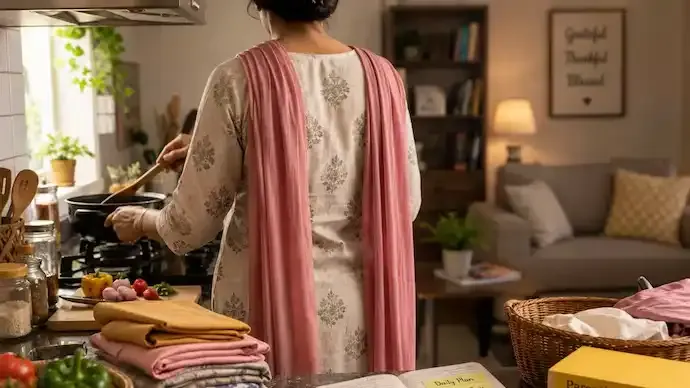

In a landmark observation that highlights the importance of unpaid domestic work, the Supreme Court has stated that women who manage households should not be viewed merely as homemakers. The court remarked that their contribution extends far beyond routine household responsibilities and plays a vital role in building families, nurturing future generations, and contributing to nation-building.
The ruling came while the court was considering issues related to compensation in accident cases, where the economic value of a homemaker's work often becomes a crucial factor in determining financial relief for affected families.
The judgment has been widely welcomed by legal experts, women's rights advocates, and social commentators, who see it as a significant step toward recognising the immense contribution of women within households.

Domestic Work Has Real Economic Value
A bench led by Justice Sanjay Karol emphasized that the work performed by homemakers cannot be dismissed as non-economic simply because it is unpaid.
The court noted that homemakers provide essential services such as childcare, elder care, household management, emotional support, and family welfare. These responsibilities, although often unpaid, have substantial economic and social value.
According to the court, the smooth functioning of countless households depends on the efforts of women who dedicate their time and energy to caring for family members and managing domestic responsibilities.
The judges observed that these contributions must be taken into account while assessing compensation in cases involving accidents or loss of life.
Court Says Marriage Does Not Erase Contribution
The Supreme Court also highlighted that a woman's identity and contribution should not be diminished because she is married or primarily engaged in household responsibilities.
The bench stressed that marriage does not erase the economic and social significance of the work performed by women within their homes. Their efforts contribute directly to the well-being and development of families, making them an essential pillar of society.
The court's observations reinforce the idea that unpaid labour should receive due recognition in legal and social frameworks.
Impact on Accident Compensation Cases
The ruling is particularly significant in accident compensation matters where courts often need to determine the financial value of services provided by a deceased or injured homemaker.
Historically, assessing compensation in such cases has been challenging because household work does not generate a conventional salary. The Supreme Court's observations strengthen the principle that domestic labour carries measurable value and should not be underestimated.
Legal experts believe the judgment could influence future compensation calculations and ensure fairer treatment for families affected by accidents.
Recognition for Millions of Women
India is home to millions of women who dedicate their lives to managing households, raising children, and supporting family members. While their contributions are rarely reflected in economic statistics, they form the foundation of social and family structures across the country.
Women's rights groups have long advocated for greater recognition of unpaid domestic labour, arguing that it contributes significantly to the nation's overall productivity and human development.
The Supreme Court's remarks are being viewed as an important acknowledgment of these efforts.
A Significant Social Message
Beyond its legal implications, the ruling sends a powerful social message about the value of caregiving and household management.
By describing homemakers as "nation builders," the Supreme Court has highlighted the broader impact of their work on society and future generations. The judgment reinforces the idea that domestic responsibilities are not lesser forms of work but essential contributions that sustain families and communities.
The observations are expected to influence future legal discussions on gender equality, economic recognition, and the value of unpaid labour in India.







Conversation
Be kind and stay on topic. Comments are moderated; abuse, spam and personal attacks are removed. Report a problem