

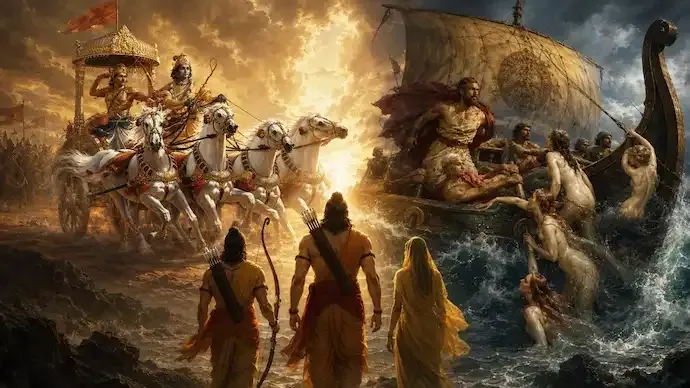

With the release of Christopher Nolan's The Odyssey, audiences across the world are rediscovering one of the greatest works of ancient literature. While Homer's Greek epic belongs to an entirely different civilisation, many Indian viewers have noticed that several of its themes echo those found in the Ramayana and the Mahabharata.
These similarities do not suggest that the stories are the same or that one inspired the other. Historians have found no conclusive evidence that Homer borrowed from Indian epics. The Ramayana and Mahabharata are sacred texts deeply rooted in India's spiritual and cultural traditions, while The Odyssey is a cornerstone of ancient Greek mythology and literature.
Even so, all three narratives explore timeless human experiences such as exile, duty, temptation, divine intervention and the longing to return home.

The Long Journey Home
At the heart of all three epics lies the emotional theme of separation from home.
In The Odyssey, Odysseus, King of Ithaca, spends ten years fighting the Trojan War before beginning another decade-long struggle to return to his wife Penelope and son Telemachus.
Similarly, in the Ramayana, Lord Rama is exiled from Ayodhya for fourteen years, a journey that eventually leads to a battle against Ravana after the abduction of Sita.
The Mahabharata presents another form of exile, with the Pandavas losing their kingdom after a game of dice and spending years in the forest before returning to reclaim their rightful place.
Although the circumstances differ, each story revolves around endurance, sacrifice and the hope of returning home.
Heroes Tested by the Supernatural
All three epics place their protagonists in worlds where supernatural beings shape their destiny.
Odysseus encounters the Cyclops, Sirens, Circe, Scylla, and Charybdis, each representing a different challenge on his journey.
The Ramayana features demons, magical illusions and powerful beings, including the deceptive golden deer, which ultimately leads to Sita's abduction.
The Mahabharata also includes encounters with rakshasas, celestial beings and divine weapons, illustrating that the Pandavas' journey extends beyond ordinary human conflicts.
In every epic, the supernatural is not merely spectacle—it becomes a test of wisdom, courage and character.
Temptation Shapes Destiny
Temptation is another recurring theme across these legendary stories.
Odysseus faces numerous temptations, including the Lotus-Eaters, whose fruit erases memory, the enchantress Circe, and the irresistible songs of the Sirens.
In the Ramayana, the illusion of the golden deer draws Rama away from Sita, setting in motion one of the epic's defining events.
Meanwhile, in the Mahabharata, temptation takes a more psychological form through greed, ambition and pride, culminating in the disastrous game of dice that changes the fate of the Kuru dynasty.
Though different in form, each temptation tests the hero's judgment and resilience.
The Role of Divine Intervention
Divine guidance plays a central role in all three narratives.
In Greek mythology, Athena repeatedly protects and advises Odysseus, while Poseidon becomes his greatest divine adversary.
In the Ramayana, Lord Rama's mission unfolds within a larger cosmic purpose involving divine forces.
The Mahabharata places Lord Krishna at the centre of its moral and philosophical teachings, particularly through the Bhagavad Gita, where he guides Arjuna before the Kurukshetra war.
Despite divine support, each hero must ultimately make difficult choices and face their consequences.
Families Waiting for Their Return
Beyond battles and adventures, all three epics tell deeply emotional stories about families separated by fate.
Penelope waits faithfully for Odysseus for twenty years while protecting her household from ambitious suitors.
In the Ramayana, the relationship between Rama and Sita is defined by exile, separation, conflict and eventual reunion.
The Mahabharata portrays the suffering endured by Draupadi, Kunti, and the entire Kuru family as the Pandavas remain away from their kingdom.
These stories remind readers that exile affects not only the hero but also those waiting at home.
The Missing King and the Kingdom in Crisis
Another striking similarity is the connection between the hero's absence and political instability.
Without Odysseus, Ithaca faces uncertainty as powerful suitors attempt to seize control of his household.
Lord Rama's exile leaves Ayodhya without its rightful ruler, while Bharata refuses to permanently occupy the throne, preserving it until Rama's return.
Likewise, the Pandavas' exile allows the Kauravas to consolidate power, eventually leading to the Kurukshetra war.
In each epic, restoring the rightful order becomes just as important as the hero's personal journey.
Different Heroes, Different Ideals
Despite their thematic similarities, the protagonists embody different ideals of heroism.
- Odysseus succeeds through intelligence, strategy and adaptability.
- Lord Rama represents righteousness, duty and moral integrity.
- The Pandavas, especially Yudhishthira, constantly struggle with complex questions of justice, ethics and responsibility.
Each epic reflects the philosophical and cultural values of its own civilisation.
Why These Ancient Stories Still Matter
The enduring popularity of these epics lies in the universal questions they ask.
How does one overcome exile?
How should duty be balanced with personal desire?
Can temptation be resisted?
What sacrifices are necessary before returning home?
These themes continue to resonate across cultures and generations.
As Christopher Nolan introduces The Odyssey to a new global audience, Indian viewers may recognise familiar emotional patterns—not because the stories are identical, but because the greatest epics often explore the same timeless truths through different traditions.
Key Highlights
- The Odyssey, the Ramayana and the Mahabharata share themes of exile, homecoming, temptation and divine intervention.
- There is no established historical evidence that Homer borrowed from Indian epics.
- The three stories emerged independently from different cultural traditions.
- Odysseus, Lord Rama and the Pandavas each represent distinct ideals of heroism.
- Christopher Nolan's The Odyssey has renewed interest in comparing these legendary narratives.
FAQs
Is The Odyssey based on the Ramayana or Mahabharata?
No. There is no established historical evidence that Homer's The Odyssey was based on or borrowed from the Ramayana or the Mahabharata. They originated independently in different civilisations.
What themes do The Odyssey, Ramayana and Mahabharata share?
All three epics explore themes such as exile, duty, temptation, divine intervention, family, sacrifice and the journey back home.
How is Odysseus different from Lord Rama?
Odysseus is celebrated for his intelligence and strategic thinking, while Lord Rama is revered as the embodiment of righteousness, duty and moral conduct.
Why are people comparing The Odyssey with Indian epics?
The comparison is based on shared narrative themes rather than historical connections. The stories address similar universal human experiences despite belonging to different cultures.
Why is Christopher Nolan's The Odyssey generating interest in these comparisons?
Nolan's adaptation has introduced Homer's epic to a wider audience, encouraging discussions about how great civilisations have explored similar ideas through their own legendary stories.








Conversation
Be kind and stay on topic. Comments are moderated; abuse, spam and personal attacks are removed. Report a problem