

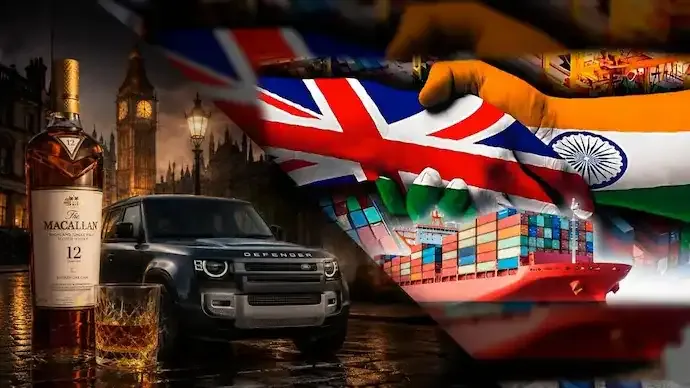

The India-UK Comprehensive Economic and Trade Agreement (CETA) officially came into force on July 15, 2026, marking one of India's most significant trade reforms in recent years.
Signed after 14 rounds of negotiations, the agreement is expected to transform trade between the two countries by lowering tariffs, expanding market access and creating new opportunities for exporters, businesses and skilled professionals.
While Indian consumers are likely to benefit from gradually cheaper British products such as Scotch whisky, premium cars and chocolates, the biggest winners are expected to be Indian exporters, manufacturers and professionals.

Here are the 10 biggest changes under the India-UK Free Trade Agreement.
1. Scotch whisky and gin will become cheaper
One of the most visible consumer benefits is the reduction in import duties on British alcoholic beverages.
Under the agreement:
- Import duty on Scotch whisky drops from 150% to 75% immediately
- The tariff will gradually reduce to 40% over the next 10 years
- Similar duty reductions apply to British gin
Retail prices may not fall immediately, but premium British spirits are expected to become more affordable over time.
2. British luxury cars will gradually become cheaper
The FTA also reduces import duties on UK-made automobiles.
Currently, import duties on fully built British vehicles can reach 110%. Under the agreement, tariffs will gradually decline to 10% over 10 years under a quota-based system.
Electric and hybrid vehicles will also receive preferential treatment while protecting India's domestic automobile industry.
3. Lower prices for chocolates, cosmetics and packaged foods
Several British consumer products will attract lower import duties, including:
- Chocolates
- Sweet biscuits
- Cosmetics
- Soft drinks
- Packaged food products
Consumers are expected to benefit gradually as businesses pass on tariff reductions.
4. Nearly all Indian exports to the UK become duty-free
The biggest advantage of the agreement lies in exports.
The UK will eliminate import duties on almost 99% of tariff lines, covering nearly the entire value of India's exports.
This gives Indian businesses easier access to one of their largest overseas markets while improving their competitiveness.
5. Major boost for labour-intensive industries
Several export-oriented sectors are expected to benefit immediately, including:
- Textiles and garments
- Leather products
- Footwear
- Marine products
- Sports goods
- Toys
- Gems and jewellery
- Engineering goods
- Auto components
- Organic chemicals
These industries employ millions of workers across India and could see stronger export growth.
6. Indian professionals save on social security contributions
Alongside the FTA, the India-UK Double Contribution Convention (DCC) has also taken effect.
Eligible Indian professionals on temporary assignments in the UK will no longer have to contribute simultaneously to both countries' social security systems.
Instead, they can continue contributing to India's Employees' Provident Fund (EPF), helping build long-term retirement savings while reducing employment costs.
7. Sensitive agricultural products remain protected
Not every sector has been opened under the agreement.
India has excluded several sensitive agricultural products from tariff concessions, including:
- Dairy products
- Apples
- Cheese
- Sugar
- Milled rice
- Pork
- Chicken
- Eggs
These items will continue to attract existing import duties to safeguard domestic producers.
8. The agreement extends beyond trade in goods
Unlike traditional free trade agreements, the India-UK CETA covers a broad range of modern economic sectors.
Its 30 chapters include provisions relating to:
- Digital trade
- Financial services
- Telecommunications
- Intellectual property
- Innovation
- Government procurement
- Small and Medium Enterprises (SMEs)
- Sustainability
- Rules of origin
- Temporary movement of professionals
- Trade and gender equality
The agreement also includes a dedicated innovation chapter aimed at strengthening technology collaboration and resilient supply chains.
9. India-UK trade is expected to grow significantly
Trade between the two countries has already been expanding.
According to official data:
- Bilateral merchandise trade reached $25.13 billion in FY26, up from $23.13 billion in FY25.
- India's exports to the UK stood at $13.44 billion.
- Imports from the UK increased more than 36% to $11.68 billion.
The UK estimates the agreement could increase bilateral trade by £25.5 billion annually over the long term.
10. MSMEs stand to gain the most
Industry experts believe India's Micro, Small and Medium Enterprises (MSMEs) could emerge as some of the biggest beneficiaries.
Lower tariffs, improved market access and simplified trade procedures are expected to help smaller exporters expand into the UK market.
The agreement is also expected to improve access to working capital, making it easier for MSMEs to scale operations and compete internationally.
A landmark agreement for India and the UK
The India-UK CETA is the sixth major trade agreement signed by the Modi government after similar pacts with:
- Mauritius
- United Arab Emirates (UAE)
- Australia
- European Free Trade Association (EFTA)
- Oman
Beyond lower prices on imported British products, the agreement is expected to deepen economic cooperation, strengthen supply chains, support exporters and create new opportunities for businesses and professionals in both countries.
Key Highlights
- India-UK Comprehensive Economic and Trade Agreement (CETA) came into force on July 15, 2026.
- UK grants duty-free access on nearly 99% of tariff lines for Indian exports.
- Import duty on Scotch whisky drops from 150% to 75%, eventually falling to 40%.
- British luxury cars will become cheaper through phased tariff reductions.
- Indian professionals benefit from the Double Contribution Convention (DCC).
- Sensitive agricultural products remain protected from tariff cuts.
- MSMEs are expected to benefit from better market access and lower trade barriers.
FAQs
What is the India-UK Comprehensive Economic and Trade Agreement (CETA)?
It is a bilateral free trade agreement that reduces tariffs, improves market access and strengthens trade and investment between India and the United Kingdom.
Which British products will become cheaper in India?
Products expected to become more affordable over time include Scotch whisky, gin, premium cars, chocolates, cosmetics, biscuits and soft drinks.
What benefits do Indian exporters receive?
Indian exporters gain duty-free access to nearly 99% of UK tariff lines, improving competitiveness across multiple sectors.
How does the agreement help Indian professionals?
The Double Contribution Convention exempts eligible professionals from paying dual social security contributions during temporary UK assignments while allowing continued EPF contributions in India.
Which sectors benefit the most from the FTA?
Textiles, garments, leather, engineering goods, gems and jewellery, marine products, footwear, auto components and MSMEs are expected to benefit significantly.




Conversation
Be kind and stay on topic. Comments are moderated; abuse, spam and personal attacks are removed. Report a problem