

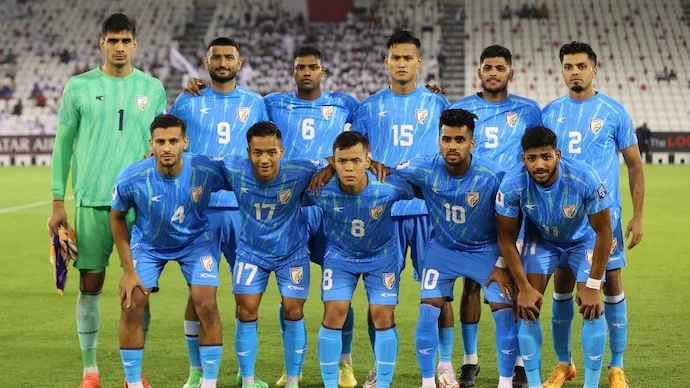

The proposed AFC Nations League could significantly change how Asian teams compete for the FIFA World Cup and Asian Cup. For India, the new system could mean more meaningful international matches, a clearer pathway to major tournaments and regular competitive exposure.
The Asian Football Confederation is considering a three-tier competition involving all 47 member associations. The first official edition is proposed for 2030, with a pilot competition in 2028-29 helping determine the initial divisions.
How the AFC Nations League Could Work
The proposed structure would feature three tiers. Tier 1 and Tier 2 would each have 18 teams, while Tier 3 would include 11 teams.

Tier 1 would be the most important for World Cup qualification. In the World Cup-linked edition proposed for 2032-33, teams would play 12 matches, split between six home and six away games.
The top six teams would qualify directly for the World Cup. Teams finishing seventh to 10th would enter a playoff, creating additional routes to qualification.
The top eight Tier 1 teams would also advance to the Nations League knockout stage.
Tier 2 would focus heavily on promotion and relegation, while its best-performing teams would also have a route towards Asian Cup qualification. Tier 3 would provide lower-ranked AFC nations with an opportunity to climb through the system.
What Does It Mean for India?
India's biggest question will be where the team starts.
The AFC is not expected to simply use current FIFA rankings to determine the initial tiers. Results from the transition competition could influence India's starting position.
If India begins outside Tier 1, the immediate objective would be promotion. That means the proposed system is not a shortcut to the World Cup. India would first need to establish itself among Asia's stronger teams.
The potential benefit is that performances would have consequences beyond a single qualifying campaign. Promotion, relegation and future tournament qualification would all be connected.
More Competitive Football, But More Travel
One major advantage could be the reduction in meaningless international friendlies. Teams would have promotion, relegation, Asian Cup qualification or World Cup qualification at stake.
For India, regular competitive games could help build consistency and provide stronger exposure against teams across Asia.
However, Asia's enormous geography creates a major challenge. Long journeys between East and West Asia could increase travel costs, player fatigue and logistical demands.
The international calendar is another concern. Adding more meaningful fixtures could put additional pressure on an already crowded schedule.
Could It Help India's World Cup Ambitions?
The AFC Nations League could make India's route to the World Cup more structured, but it would not necessarily make qualification easier.
The strongest Asian teams would compete in Tier 1, while teams below them would have to fight their way upward. For India, sustained improvement would therefore become even more important.
The proposal could ultimately give Indian football something it has often lacked: a consistent competitive pathway rather than a cycle that largely revolves around individual qualification campaigns.
But the new system will not remove the gap between India and Asia's elite. It could simply provide a clearer ladder to climb.







Conversation
Be kind and stay on topic. Comments are moderated; abuse, spam and personal attacks are removed. Report a problem