

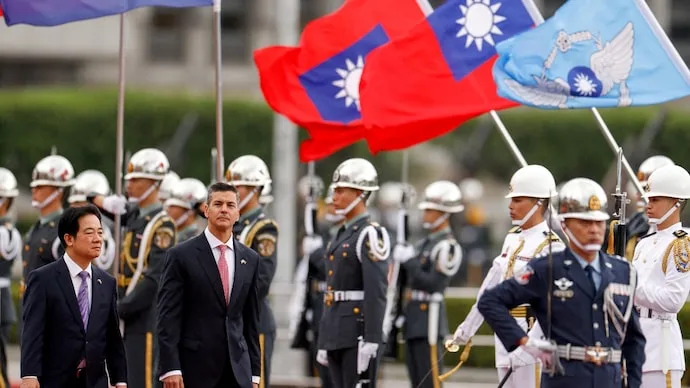

China has imposed sanctions on ministers from Paraguay and Belize over their countries’ continued diplomatic relations with Taiwan, escalating tensions over Beijing’s efforts to isolate the self-governing island internationally.
The measures, announced on Monday, target Paraguay’s Minister of Information and Communication Technologies, Gustavo Villate, and Belize’s Foreign Minister, Francis Fonseca. China accused the officials of interfering in its internal affairs and making statements it considers hostile to Beijing.
Paraguay and Belize are among the 12 countries that maintain formal diplomatic relations with Taiwan. China claims Taiwan as part of its territory, while Taiwan’s government rejects Beijing’s position and maintains its own democratic political system.

The sanctions include restrictions on entry into mainland China, Hong Kong and Macau, as well as prohibitions on Chinese organisations and individuals conducting transactions or cooperating with the sanctioned officials.
Paraguay and Belize Reject China’s Measures
Villate said Paraguay expected the sanctions given its ongoing cooperation with Taiwan, including plans involving a data centre. He indicated that the measures would not prevent the two sides from continuing their joint projects.
Belize’s Foreign Ministry also rejected the action against Fonseca, describing it as unwarranted because he was carrying out the lawful responsibilities of his office.
The ministry said the sanctions would not change Belize’s foreign policy or weaken its relationship with Taiwan.
Taiwan’s Foreign Ministry condemned Beijing’s decision, arguing that China had no right to interfere in the diplomatic relations of other countries. Taipei described the sanctions as interference in the sovereignty and foreign policy choices of independent nations.
Beijing Defends Sanctions as Taiwan Ties Face Scrutiny
Chinese Foreign Ministry spokesperson Mao Ning said the targeted politicians had acted as “pawns” for Taiwan and accused them of spreading false information about alleged Chinese cyberattacks and damaging Beijing’s international reputation.
China maintains that countries should not establish or strengthen official relations with Taiwan. Beijing has increasingly used diplomatic and economic pressure to persuade Taiwan’s remaining partners to switch recognition to China.
The dispute follows recent high-level contacts between Taiwan and the two countries. Fonseca met Taiwan’s foreign minister, Lin Chia-lung, in Belize in September, while Villate met Taiwan’s deputy foreign minister, Chen Ming-chi, in Paraguay in June.
The number of countries formally recognising Taiwan has declined in recent years. Nauru switched diplomatic recognition to Beijing in 2024, while Honduras ended its longstanding ties with Taipei in 2023.
The latest sanctions highlight the continuing diplomatic contest between China and Taiwan, with Paraguay and Belize signalling that their existing relationships with Taipei will remain unchanged.
For official information on China’s foreign policy, visit the Chinese Ministry of Foreign Affairs.





Conversation
Be kind and stay on topic. Comments are moderated; abuse, spam and personal attacks are removed. Report a problem