

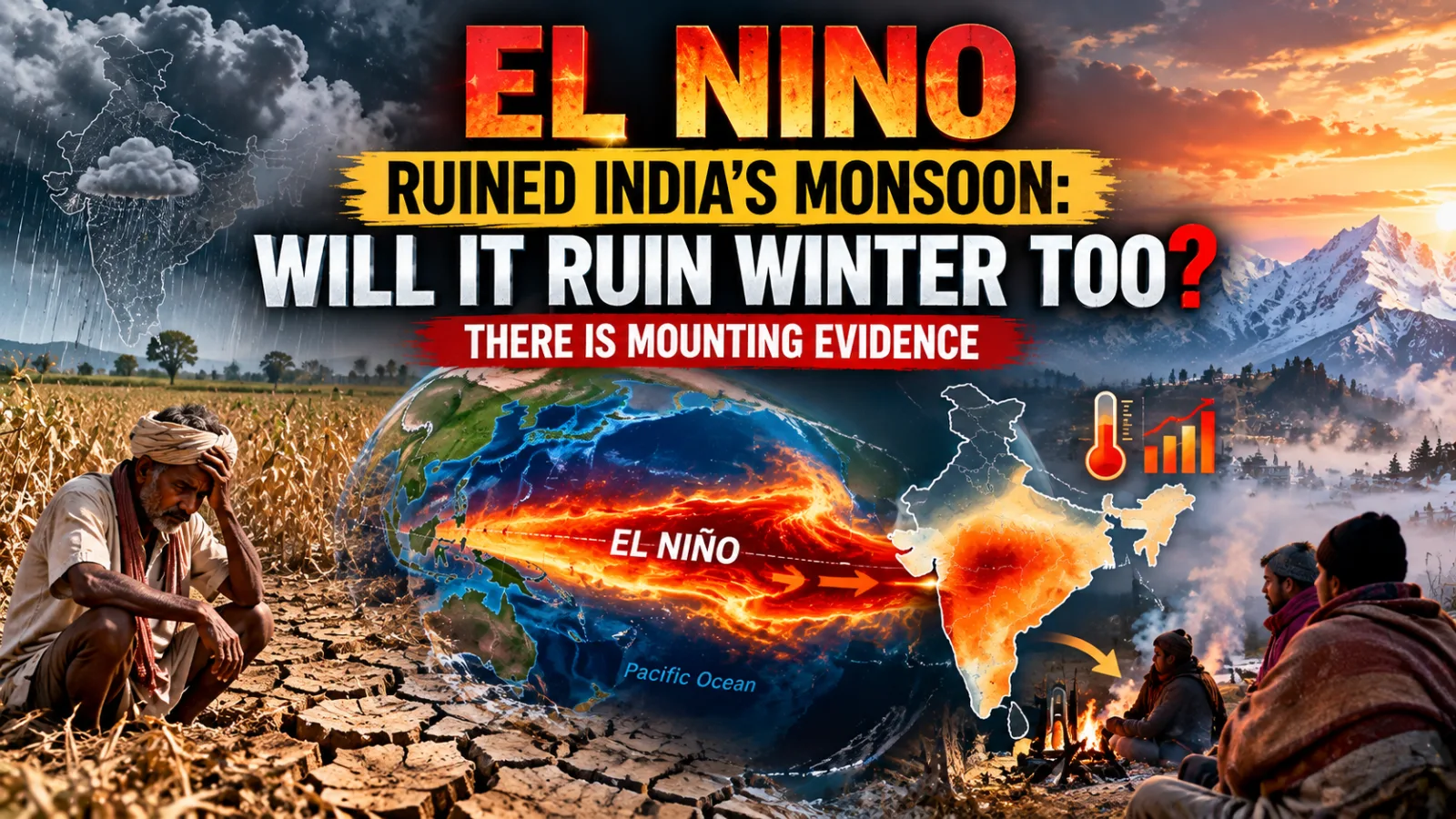

The El Nino India winter outlook is drawing attention after the country ended the 2026 southwest monsoon with a 13% rainfall deficit. With El Nino strengthening over the Pacific and expected to remain an important climate influence through winter, concerns are growing about what the phenomenon could mean for temperatures, rainfall and agriculture in the coming months.
However, a weak monsoon does not automatically mean India will experience a dry or harsh winter. El Nino’s influence varies by region and interacts with other atmospheric and oceanic conditions.
Could India See a Warmer Winter?
One of the clearest patterns associated with strong El Nino events is a tendency towards warmer winter conditions in parts of India.

El Nino changes large-scale atmospheric circulation, which can influence weather patterns thousands of kilometres away. The 2015-16 winter provides an example. Following a strong El Nino and a severely deficient monsoon, India experienced unusually warm conditions, with temperatures several degrees above normal in some areas during December and January.
Winter temperatures are particularly important for agriculture because the season is crucial for wheat and other Rabi crops.
El Nino Does Not Always Mean a Dry Winter
The relationship between El Nino and winter rainfall is more complicated.
Northwestern India receives much of its winter precipitation from western disturbances, weather systems that move eastward from the Mediterranean region and surrounding areas. They bring rain to the plains and snowfall to the Himalayas.
Research suggests El Nino can sometimes alter atmospheric circulation in ways that strengthen or modify western disturbances, potentially increasing winter precipitation over parts of northwestern India.
This means the same El Nino event can be associated with warmer conditions in some regions while potentially bringing more winter precipitation to others.
What Does History Tell Us?
Past El Nino events show why there is no simple formula.
The strong El Nino events of 1982 and 1987 coincided with severe Indian monsoon deficits. In contrast, the exceptionally strong 1997 El Nino produced an almost normal all-India monsoon, influenced by atmospheric circulation over the Indian Ocean.
The winter response has also varied across years, with regional rainfall, western disturbances and Indian Ocean conditions influencing the final outcome.
What Could Winter 2026-27 Look Like?
The current warning signal is significant because El Nino is still strengthening. The India Meteorological Department expects the event to strengthen towards the end of 2026, with forecasts suggesting it could persist into early 2027.
For India, this could mean warmer-than-normal conditions in several regions, uneven winter rainfall and greater weather variability. But it does not mean every part of the country will necessarily become warm or dry.
For farmers, the key issue will be whether India receives the right combination of cold, rain and snowfall at the right time, particularly after a monsoon that has already left some areas facing water stress.
El Nino may be setting the broader climate conditions, but India’s regional atmospheric patterns will ultimately determine how winter 2026-27 unfolds.
Relevant Link: India Meteorological Department





Conversation
Be kind and stay on topic. Comments are moderated; abuse, spam and personal attacks are removed. Report a problem