

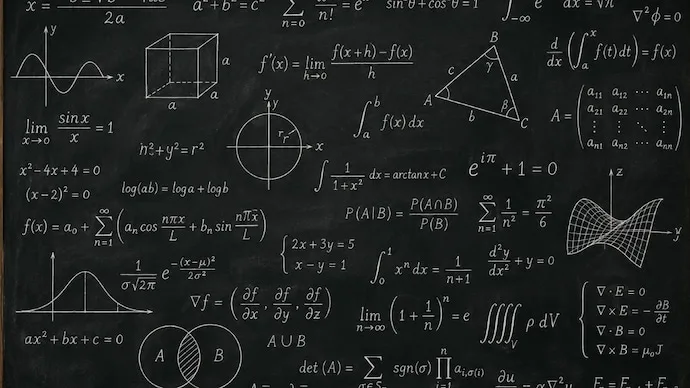

The AI mathematics challenge has entered a new phase as Epoch AI’s FrontierMath: Open Problems expands to 50 difficult research questions selected by mathematicians. Unlike conventional benchmarks that test calculation or familiar problem-solving, the initiative asks whether artificial intelligence can contribute genuinely new mathematical ideas.
The problems cover areas including number theory, topology and combinatorics, with proposed solutions designed to be checked using computer-based verification.
50 Problems That Have Stumped Mathematicians
The expanded FrontierMath list followed workshops held in London, Toronto, Los Angeles, New York, Berkeley and Boston, where mathematicians submitted problems considered meaningful to ongoing research.

The objective was not to create puzzles specifically designed to confuse AI. Instead, researchers selected questions where solving them would represent a genuine contribution to mathematical knowledge.
One example is the Sum of Three Cubes problem. Mathematicians seek integers that satisfy a particular cubic equation for a given number. The case of 42 was solved in 2019 after an enormous computational effort, while other cases, including 114, remain unresolved.
Another challenge involves proving the irrationality of higher odd zeta values, building on important work in number theory.
Can AI Discover New Mathematics?
The benchmark also includes the Lonely Runner Conjecture, a problem dating back to 1967 that asks whether runners moving around a track at different constant speeds will eventually become sufficiently separated from one another.
Epoch AI said three of the 50 problems had been solved by AI by July 31, while the benchmark continues to distinguish between human, AI and collaborative human-AI results.
The key innovation is verification. Rather than relying only on researchers or AI systems to judge whether an answer is correct, proposed solutions can be checked computationally.
That changes the central question surrounding AI and mathematics. The challenge is no longer simply whether machines can calculate faster than humans. It is whether they can help produce the kind of unexpected insight that drives mathematical discovery.
If AI systems begin solving more of these long-standing problems, mathematics could become one of the clearest fields for measuring whether machines are capable of contributing genuinely original knowledge.
Relevant Link: Epoch AI








Conversation
Be kind and stay on topic. Comments are moderated; abuse, spam and personal attacks are removed. Report a problem