
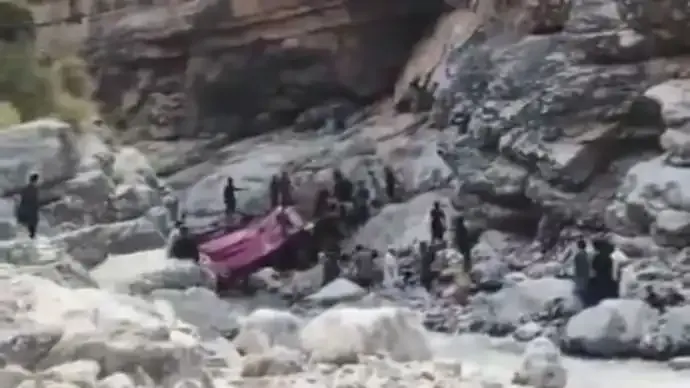
A devastating road accident in Pakistan's southwestern province of Balochistan has claimed the lives of at least 40 people after an overcrowded passenger bus veered off a highway and plunged into a deep rocky ravine during the early hours of Friday.
Eight other passengers sustained injuries and were rushed to a nearby trauma facility for treatment. Emergency teams launched a large-scale rescue operation immediately after the crash, recovering victims from the difficult terrain.
The incident is among the deadliest road accidents reported in Pakistan in recent years and has once again highlighted concerns over road safety, vehicle maintenance and overcrowded public transport.
Bus was travelling from Quetta to Islamabad
The passenger bus was travelling from Quetta, the capital of Balochistan province, to Islamabad, Pakistan's national capital.
Initial information indicates that 48 passengers were on board when the vehicle lost control and fell into the roadside ravine.
Authorities are continuing to verify passenger details as rescue and identification efforts progress.
Rescue operation launched immediately
Emergency response teams reached the accident site shortly after the crash was reported.
Rescuers recovered 40 bodies from the ravine while injured passengers were transported to the Trauma Centre in Zhob for medical treatment.
The large-scale emergency response included:
- Six ambulances.
- Twelve emergency medical technicians (EMTs).
- Ten light transport vehicles.
- Multiple rescue personnel.
Rescue operations were complicated by the difficult terrain surrounding the crash site, requiring coordinated efforts to retrieve victims and assist survivors.
Possible cause of the accident
Preliminary reports suggest the bus was travelling at high speed before it veered off the highway and plunged into the ravine.
The vehicle was also reported to be overcrowded, which may have affected its stability and handling. However, authorities have not yet announced the official cause of the crash.
Investigators are expected to examine several factors, including:
- Vehicle condition.
- Driver's actions.
- Speed at the time of the accident.
- Road conditions.
- Mechanical failures.
- Passenger load.
A formal investigation is underway.
Road accidents remain a major concern in Pakistan
Pakistan records thousands of road accidents every year due to a combination of factors such as speeding, inadequate road infrastructure, vehicle maintenance issues and violations of passenger capacity limits.
Mountainous regions and long-distance highways often present additional risks because of sharp turns, steep gradients and limited safety barriers.
Road safety experts have repeatedly called for stricter enforcement of traffic regulations and improved transport safety standards to reduce fatalities.
Authorities continue investigation
Officials are working to establish the exact sequence of events that led to the tragedy.
Investigators are expected to review:
Vehicle fitness records
Authorities will inspect whether the bus met required safety standards before departure.
Driver's condition
The driver's experience, working hours and possible fatigue may also be examined.
Passenger capacity
Investigators will verify whether the bus exceeded its legally permitted passenger limit.
Highway conditions
Road design, visibility and weather conditions will form part of the investigation.
Impact on families and local communities
The tragedy has left dozens of families grieving the sudden loss of loved ones.
Authorities are continuing efforts to identify victims, notify relatives and provide medical assistance to the injured survivors.
Emergency services remain at the site to complete recovery operations and support the ongoing investigation.
Road Safety: Preventing similar tragedies
Road safety experts recommend several measures to reduce the risk of fatal bus accidents:
- Strict enforcement of speed limits.
- Regular vehicle inspections.
- Preventing overcrowding on passenger buses.
- Improved driver training.
- Better highway safety infrastructure.
- Enhanced emergency response capabilities.
Such measures are considered essential for reducing fatalities on long-distance transport routes.
Featured Snippet
At least 40 people were killed and eight others injured after an overcrowded passenger bus travelling from Quetta to Islamabad plunged into a rocky ravine in Pakistan's Balochistan province. Authorities have launched an investigation into the cause of the deadly crash.
Key Highlights
- At least 40 people lost their lives in the bus crash.
- Eight passengers were injured and taken to hospital.
- The bus was travelling from Quetta to Islamabad.
- The accident occurred in Pakistan's Balochistan province.
- Rescue teams recovered victims from a deep ravine.
- Speeding and overcrowding are among the factors being investigated.
- Authorities have launched a formal inquiry into the incident.
Conclusion
The deadly bus accident in Pakistan's Balochistan province has once again drawn attention to road safety challenges facing long-distance public transport. As authorities investigate the exact cause of the crash, the focus remains on supporting survivors, assisting affected families and determining what measures can help prevent similar tragedies in the future.
FAQs
1. Where did the Pakistan bus accident occur?
The crash took place in Pakistan's southwestern province of Balochistan.
2. How many people died in the bus crash?
At least 40 people were killed in the accident.
3. How many passengers were injured?
Eight passengers were injured and taken to a trauma centre for treatment.
4. Where was the bus travelling?
The bus was travelling from Quetta to Islamabad.
5. What caused the accident?
Preliminary reports indicate the bus was speeding and overcrowded, but authorities are conducting a formal investigation to determine the exact cause.
6. What rescue efforts were launched?
Emergency teams deployed ambulances, EMTs and transport vehicles to rescue victims and assist survivors.
7. Why are bus accidents common in Pakistan?
Experts cite factors such as speeding, poor road infrastructure, inadequate vehicle maintenance and overcrowding as major contributors to road accidents.





Conversation
Be kind and stay on topic. Comments are moderated; abuse, spam and personal attacks are removed. Report a problem