

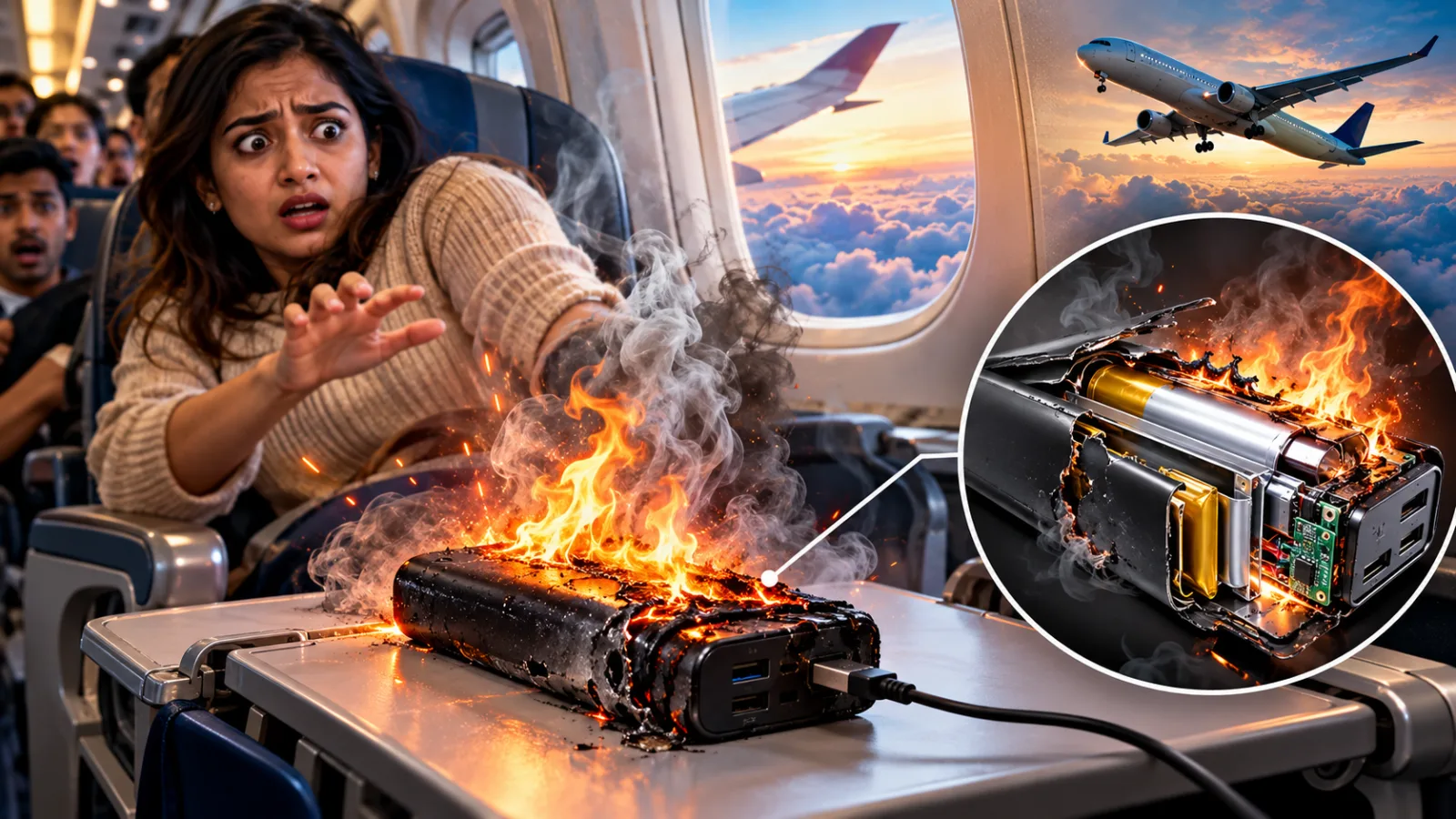

A recent power bank fire on a flight has renewed concerns about the safety of lithium-ion batteries during air travel. An IndiGo flight travelling from Delhi to Chennai was diverted to Hyderabad on October 11 after smoke was detected from a passenger’s personal electronic device. The aircraft landed safely at Rajiv Gandhi International Airport, and the airline said its cabin crew responded promptly.
Power banks are widely used to charge smartphones and other devices, but their batteries can pose a serious fire hazard if damaged, defective or overheated. This is why airlines generally prohibit power banks in checked baggage and impose specific restrictions on their carriage and use.
What Makes Power Banks Catch Fire?
Most modern power banks use lithium-ion or lithium-polymer battery cells. These batteries store substantial amounts of energy in a compact space through electrochemical reactions.

Under normal conditions, these reactions are controlled. However, manufacturing defects, physical damage, overcharging or an internal short circuit can trigger a dangerous process known as thermal runaway.
During thermal runaway, a battery generates heat faster than it can release it. The rising temperature accelerates chemical reactions inside the cell, potentially producing flammable gases, smoke and intense heat.
The battery may ignite, and the fire can spread to neighbouring cells. In some cases, the battery can reignite even after the initial flames appear to have been extinguished.
Manufacturing problems can include microscopic metal particles inside a cell, damaged separators between electrodes, poor-quality materials or flaws introduced during assembly. Such defects may remain undetected until the battery is charged, used or exposed to particular conditions.
Why Power Banks Are Banned From Checked Baggage
Power banks are generally prohibited in checked baggage because a battery fire inside an aircraft’s cargo hold could remain undetected for longer than an incident in the passenger cabin.
Aircraft have fire-detection and suppression systems, but lithium-battery fires can be difficult to control and may reignite. Keeping spare batteries in the cabin allows passengers and crew members to identify smoke or overheating more quickly and respond.
Smartphones also contain lithium-ion batteries, but they are integrated electronic devices with battery-management systems and protective circuitry. Their carriage is governed by applicable aviation rules, while spare power banks are subject to separate restrictions.
Passengers should always check their airline’s latest requirements, including any limits on battery capacity and rules concerning the use or charging of power banks during a flight.
Does Cabin Altitude Make Batteries More Dangerous?
Commercial aircraft cabins are pressurised, but cabin pressure is lower than at sea level. Lower pressure can influence heat transfer and the behaviour of gases released by a failing battery.
However, ordinary cabin altitude does not automatically make every lithium-ion battery more likely to catch fire. Internal defects, physical damage, overheating and electrical faults remain the primary concerns described in battery-fire incidents.
Reduced pressure may influence the consequences of a battery failure, but it should not be treated as the main cause of most lithium-battery fires.
How Passengers Can Reduce the Risk
Passengers can take several precautions when travelling with power banks:
- Carry power banks in cabin baggage, not checked luggage, in accordance with airline rules.
- Protect batteries from impact, crushing and other physical damage.
- Avoid using swollen, leaking, unusually hot or visibly damaged power banks.
- Use reputable products and chargers that meet applicable safety standards.
- Follow airline instructions on battery capacity, storage and charging during the flight.
If a power bank begins smoking or overheating onboard, passengers should immediately alert the cabin crew rather than attempting to handle the situation themselves.
The IndiGo diversion highlights why a small electronic accessory can become a serious aviation safety concern. Proper battery design, safe handling and compliance with airline restrictions are essential to reducing the risks associated with lithium-ion batteries in flight.








Conversation
Be kind and stay on topic. Comments are moderated; abuse, spam and personal attacks are removed. Report a problem