

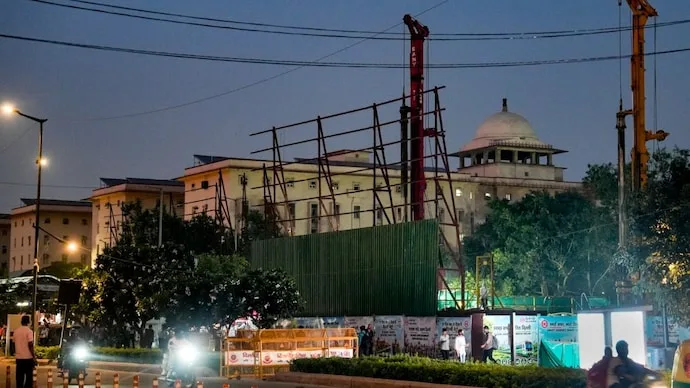

The Qadeemi Masjid inside New Delhi's Krishi Bhawan complex has become the focus of a legal dispute after the Centre told the Delhi High Court that the century-old religious structure must be removed to make way for new government buildings under the Central Vista redevelopment project.
The government argued that retaining a permanent religious structure within a government office complex is incompatible with the secular character of government property. The mosque stands on land earmarked for Common Central Secretariat Buildings 4 and 5.
However, the mosque's caretaking committee maintains that the structure existed long before Krishi Bhawan was constructed. Historical records and a government agreement dating back to 1940 have now become central to the dispute.

Was Qadeemi Masjid Built Before Independence?
In a petition filed before the Delhi High Court in September 2026, the mosque's caretaking committee claimed that Qadeemi Masjid is more than a century old and predates the present government complex.
According to the petitioners, historical records document the mosque's existence as far back as 1945. They also pointed out that the Delhi Waqf Board notified the property as Waqf property in 1970.
The September 17 court order recorded submissions by senior advocate Salman Khurshid, who argued that the mosque existed before the construction of Krishi Bhawan, Shastri Bhawan and neighbouring government offices during the 1950s and 1960s.
The committee acknowledged that the land belongs to the government but argued that the mosque has remained an established place of worship for employees of Krishi Bhawan and nearby central government offices. It also invoked Article 25 of the Constitution, which guarantees freedom of conscience and the right to practise religion, subject to constitutional restrictions.
What Does the 1940 Agreement Say?
The Centre has relied on an agreement dated November 8, 1940, between the then administration and the secretary of the Jama Masjid managing committee.
According to the government's status report filed through the Land and Development Office, the agreement permitted the committee to use the government-owned premises exclusively as a mosque.
However, the arrangement did not transfer ownership of the land. It also restricted alterations, repairs, construction of graves and the addition of new structures without prior written government approval.
The administration retained the right to take back possession if the committee violated the agreement's conditions.
The Centre has argued that the arrangement granted permission to use the premises but did not establish ownership rights or an unrestricted entitlement to retain the mosque.
How Did the Mosque Become Part of Krishi Bhawan?
The 1940 agreement establishes that Qadeemi Masjid existed before India's Independence and nearly 17 years before Krishi Bhawan was completed in 1957.
The mosque appears to have remained in place as the surrounding government complex expanded, with its continued use governed by the agreement between the administration and its managing committee.
New Delhi was developed after the British announced the transfer of India's capital from Calcutta to Delhi in 1911. Important administrative buildings, including Rashtrapati Bhavan and the North and South Blocks, were completed by 1931.
After Independence, the government expanded the Central Secretariat. Buildings such as Krishi Bhawan, Udyog Bhawan, Nirman Bhawan, Shastri Bhawan and Rail Bhawan came up between 1956 and 1968.
Other Historic Mosques Near Central Government Offices
Qadeemi Masjid is not the only older mosque in the Central Vista area. Zabta Ganj Masjid near India Gate and Sunehri Bagh Masjid near Udyog Bhawan also predate the government buildings surrounding them.
The Delhi Gazette dated April 16, 1970, recorded both mosques as being more than 100 years old.
The future of Qadeemi Masjid now depends on the legal questions surrounding its historical existence, the terms of the 1940 agreement and the government's redevelopment plans. While the agreement confirms permission to use the premises as a mosque, the dispute over whether the structure can remain on the site is yet to be resolved.







Conversation
Be kind and stay on topic. Comments are moderated; abuse, spam and personal attacks are removed. Report a problem