

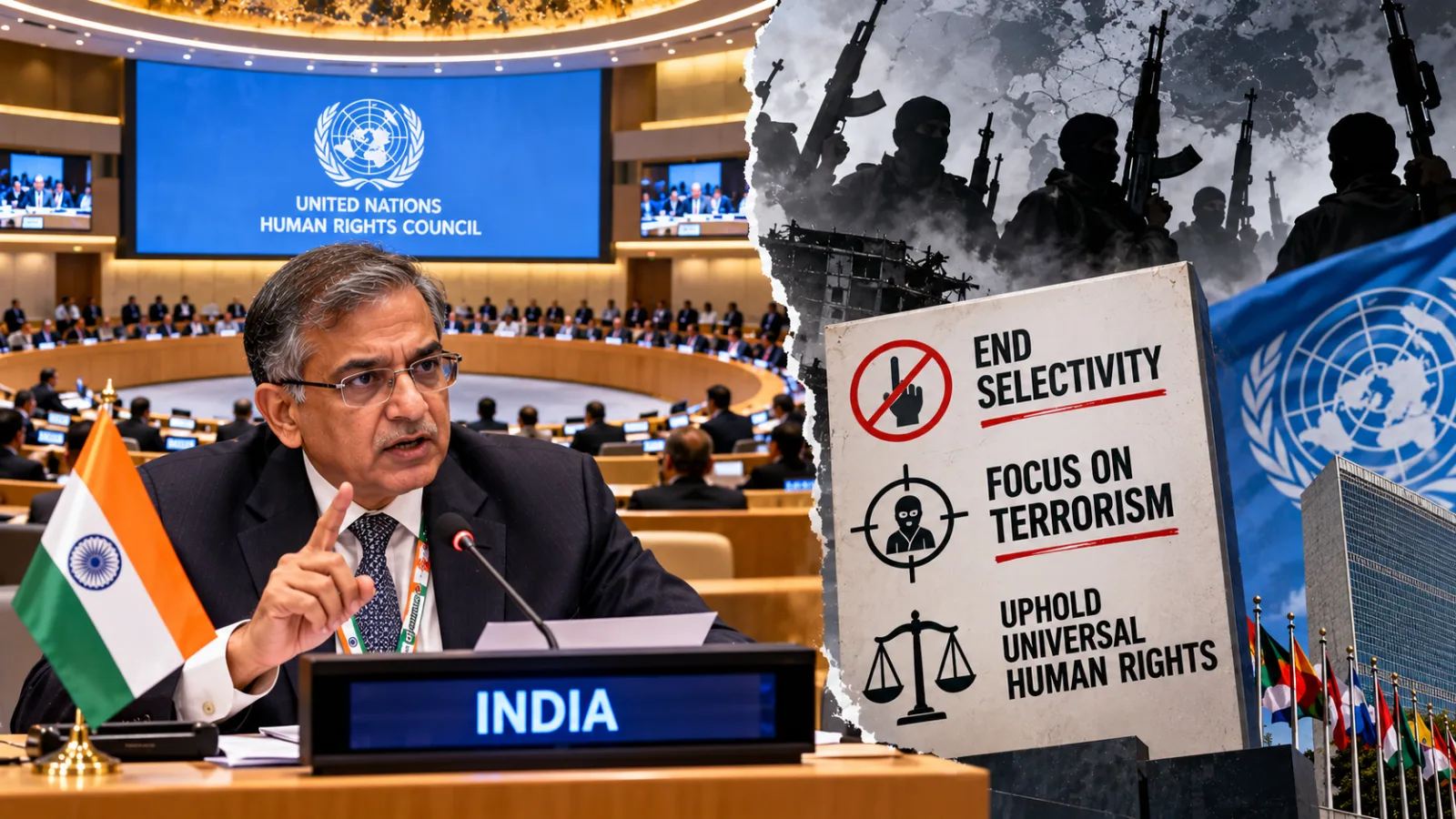

India at the UN Human Rights Council has called for an even-handed and cooperative approach to protecting human rights, warning that selective country-specific mandates and political divisions can undermine the institution's credibility. New Delhi also urged the council to give sustained attention to terrorism, poverty and the right to development.
Bhavika Mangalanandan, First Secretary at India's Permanent Mission to the United Nations, made the remarks during a UN General Assembly debate on the Human Rights Council's report on Friday.
She said the council's credibility depended on impartiality and engagement with the countries concerned. According to India's position, country-specific mandates pursued without such engagement rarely improve conditions on the ground and can deepen divisions among member states.

Mangalanandan recalled External Affairs Minister S Jaishankar's February remarks at the 61st Human Rights Council high-level segment, where he emphasised dialogue, capacity building and genuine partnerships instead of politicisation, selectivity and double standards.
India returned to the council this year for its seventh term, covering the 2026–28 period.
India Calls for Sustained Focus on Terrorism
During the debate, India described terrorism as one of the gravest threats to human rights, particularly the fundamental right to life.
Mangalanandan urged the council to address the threat consistently and adopt a zero-tolerance approach. India's intervention also stressed that human rights should receive equal attention regardless of their category.
She said economic, social and cultural rights, along with the right to development, deserved the same importance as civil and political rights.
India highlighted poverty, debt and limited access to finance and technology as major obstacles preventing people in developing countries from fully enjoying their rights. It argued that these challenges required international cooperation rather than coercive measures.
Concerns Over Selective Mandates and Funding
India also raised concerns about how the Human Rights Council allocates its resources and manages its responsibilities.
Mangalanandan said rationalisation of mandates should remain transparent and member-driven, warning against disproportionate cuts to initiatives addressing development and economic, social and cultural rights.
New Delhi further called for adequate and predictable funding for the UN's human rights pillar through the regular budget. It argued that priorities should not be disproportionately influenced by voluntary contributions earmarked for specific activities.
India also suggested avoiding repetitive resolutions and initiatives addressing similar subjects in both the Human Rights Council and the UN General Assembly.
India Questions Overlapping Reporting Responsibilities
The Indian representative expressed concern over what she described as an increasing tendency for the council to direct reporting responsibilities to the General Assembly's Third Committee.
The Third Committee deals with social, humanitarian and cultural matters. India argued that such overlapping responsibilities could weaken the need for a specialised Human Rights Council.
Overall, India's intervention called for impartial decision-making, greater cooperation among member states and a balanced understanding of human rights. It also emphasised that counterterrorism, development and economic challenges must remain central to the international human rights agenda.
Relevant Link: United Nations Human Rights Council





Conversation
Be kind and stay on topic. Comments are moderated; abuse, spam and personal attacks are removed. Report a problem