

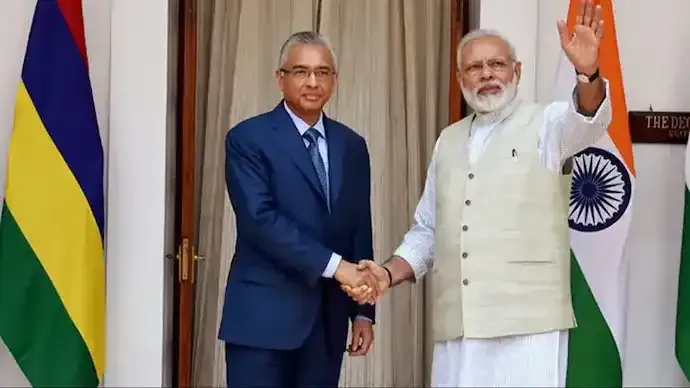

Mauritius may be a small island nation, but its national security strategy has long depended on an unusually close partnership with India. For decades, the country has appointed senior Indian officials as its National Security Advisers — a rare arrangement in global diplomacy. The recent appointment of former ITBP Director General Rahul Rasgotra has revived attention on why Mauritius continues this tradition, and whether this model will survive the new geopolitical realities emerging across the Indian Ocean.
Mauritius’ reliance on Indian security expertise dates back to 1974, when a defence agreement positioned New Delhi as its primary security guarantor, replacing Britain’s earlier strategic role. The partnership deepened considerably in the early 1980s, when fears of internal unrest and a possible coup pushed then–Prime Minister Anerood Jugnauth to seek India’s assistance. The still-debated “Operation Lal Dora” reinforced this trust, embedding India firmly into Mauritius’ security architecture.
Over the years, several senior Indian officers from RAW, IB, and the Indian Army — including Maj. Gen. J.N. Taimini, B.B. Nandy and Gurinder Singh — have shaped Mauritius’ intelligence networks, crisis-management systems, and maritime-surveillance capabilities. For Mauritius, India became a reliable partner capable of providing long-term stability and technical expertise; for India, Mauritius emerged as a strategically vital node in the Indian Ocean, supporting New Delhi’s maritime reach.

Rahul Rasgotra’s appointment marks a subtle evolution in this trend. Unlike earlier NSAs with deep intelligence backgrounds, Rasgotra’s experience centres on domestic security, border management, and hybrid threats, especially through his leadership of the ITBP and senior roles within the Intelligence Bureau. His expertise aligns with the changing risk landscape of the Indian Ocean, where traditional espionage concerns have expanded to include maritime competition, cyber vulnerabilities, and China’s assertive presence in the region.
Mauritius today finds itself navigating a delicate balance. While India remains its closest security partner — providing radar systems, hydrographic assistance, and maritime patrol support — China continues expanding its investments and diplomacy in the island nation. This dual alignment raises critical questions:
-
Can an NSA appointed from another country maintain full sovereignty in national security decisions?
-
How will Mauritius balance India’s expectations with its growing economic dependence on China?
-
Should the country begin developing its own long-term institutional capacity for independent security leadership?
As strategic rivalry deepens across the Indian Ocean, Mauritius may eventually need to reassess its long-established model. For now, however, India’s role remains central — both to Mauritius’ internal security and to New Delhi’s wider Indo-Pacific vision.





Conversation
Be kind and stay on topic. Comments are moderated; abuse, spam and personal attacks are removed. Report a problem