

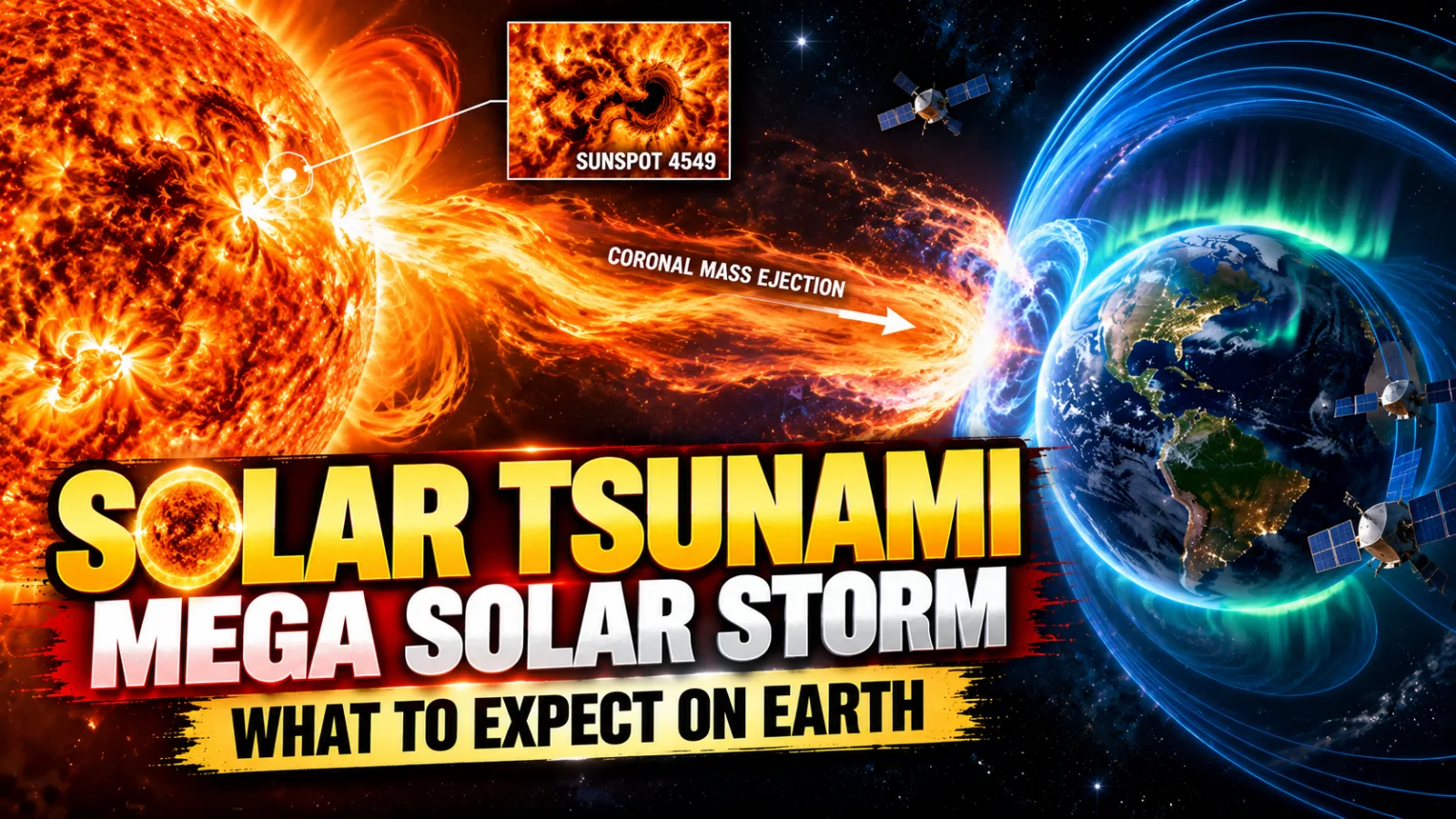

The solar tsunami Earth alert follows renewed activity from Sunspot 4549, which erupted on October 8, producing an M6.7-class solar flare, a Moreton wave and a coronal mass ejection (CME). Space weather forecasts indicate that multiple solar eruptions could interact with Earth's magnetic field on October 9 and October 11.
The incoming solar material could trigger geomagnetic storms ranging from G1, classified as minor, to G3, classified as strong. These disturbances may increase the chances of auroras appearing in regions that do not usually experience the colourful displays.
However, the actual impact will depend on the speed, density and magnetic orientation of the incoming material. Aurora sightings are not guaranteed.

What Is a Solar Tsunami?
A solar tsunami, scientifically known as a Moreton wave, is a large-scale disturbance that travels through the Sun's atmosphere following a powerful eruption. It carries a shock front through the solar atmosphere and can spread across a substantial portion of the Sun's visible surface.
The October 8 eruption from Sunspot 4549 produced what was described as a near-global disturbance. The wave moved through the Sun's atmosphere as a coronal mass ejection lifted away from the solar surface.
CMEs contain charged particles and magnetic fields. Depending on their speed, they can take anywhere from several hours to a few days to reach Earth.
Forecasts cited in the report suggest that the latest CME could graze Earth on October 11, potentially adding to the effects of two other incoming eruptions.
Could Geomagnetic Storms Affect Earth?
When a CME reaches Earth, its magnetic field can disturb the planet's magnetosphere, triggering a geomagnetic storm. Charged particles interacting with gases in the upper atmosphere can produce auroras, which may become visible farther from the polar regions during stronger events.
The effects are not limited to spectacular skies. Geomagnetic storms can interfere with satellites, navigation systems and high-frequency radio communications. Severe events can also affect electricity grids.
The forecast period could offer opportunities for aurora photography, with the nearly new Moon expected to leave relatively dark night skies.
What Happens Next?
Scientists will continue monitoring the incoming solar material to assess the likelihood and strength of geomagnetic activity. The direction of a CME's magnetic field is particularly important in determining how strongly it interacts with Earth's magnetic field.
While the forecast suggests the possibility of minor to strong geomagnetic storms, the final intensity and visibility of auroras remain uncertain.









Conversation
Be kind and stay on topic. Comments are moderated; abuse, spam and personal attacks are removed. Report a problem