

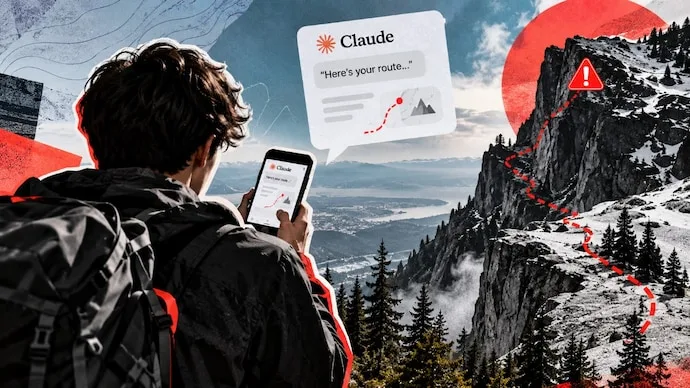

The Claude AI hiking directions used by a 16-year-old in British Columbia, Canada, allegedly led him away from a marked trail and onto dangerous mountain terrain, forcing him to call for help. The teenager had turned to Anthropic’s AI chatbot while trying to find his way back during a hike.
The incident occurred after the teenager took a gondola up Grouse Mountain to an elevation of more than 4,000 feet. While making his way back down, he followed directions provided by Claude and eventually found himself near the base of the Widowmaker, a steep rock formation on Crown Mountain.
Teenager Rescued From Dangerous Terrain
As the terrain became increasingly hazardous, the teenager called for assistance. North Shore Rescue search manager Paul Markey told CTV News that the situation could have had serious consequences, saying a fall could have resulted in significant injury or potentially death.

The steep terrain also made the rescue operation difficult. A helicopter could not get close enough to the vertical rock wall, forcing rescuers to reach the teenager directly.
According to the rescue report, two rescuers descended to reach him. The team established an anchor, after which one rescuer was lowered toward the teenager. Additional protection was then established before the teenager was moved to a safer extraction point and brought out of the area.
AI Advice Raises Questions About Hiking Safety
The incident highlights concerns about relying on AI chatbots for guidance in situations where inaccurate information can have immediate physical consequences.
AI models can generate useful information, but they do not necessarily have real-time awareness of terrain conditions, weather, trail closures, hazards or a hiker’s exact physical surroundings. A route that appears reasonable in text may therefore be unsafe in the real world.
For outdoor activities, official trail information, local authorities, park services and experienced guides can provide context that a chatbot may not have.
Similar Gemini Incident Reported in the US
The Canadian rescue follows another reported incident involving AI-generated hiking advice.
In September, three climbers attempting to climb Mount Shasta in California were reportedly stranded after using Google’s Gemini to help plan their trip. The group used the chatbot for route information and advice on food and water supplies.
They reached the summit around 7 pm, several hours after the recommended noon turnaround time, and had to descend in darkness. One climber injured a knee during the descent, and the group eventually became stranded at around 11,000 feet.
The climbers were exhausted, hungry and thirsty before Forest Service climbing rangers reached them and helped bring them down.
Both incidents ended with the hikers being rescued, but they highlight a broader issue: AI-generated advice should not be treated as a substitute for verified information or professional guidance in dangerous environments.
Relevant Link: Anthropic Official Website









Conversation
Be kind and stay on topic. Comments are moderated; abuse, spam and personal attacks are removed. Report a problem