

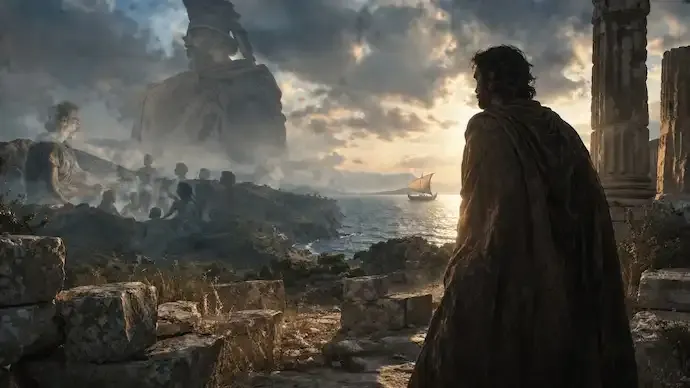

With Christopher Nolan's upcoming film The Odyssey bringing Homer's timeless epic back into global conversation, one fascinating question has resurfaced: Was Odysseus a real historical king, or is he one of history's greatest fictional heroes?
For nearly 3,000 years, historians, archaeologists and classicists have debated whether the legendary ruler of Ithaca truly existed. While archaeological discoveries have uncovered ancient sites linked to his legend, there is still no definitive evidence proving that Odysseus was a real person.
Who Was Odysseus?
In Homer's The Odyssey, Odysseus is the clever king of Ithaca who embarks on a perilous journey home after the Trojan War.

His voyage includes encounters with mythical creatures, powerful gods and supernatural challenges, making The Odyssey one of the most influential works of world literature.
Traditionally attributed to the ancient Greek poet Homer, the epic was composed around the 8th century BCE and continues to inspire books, films and academic research.
Is There Historical Evidence That Odysseus Existed?
Despite centuries of research, historians have not found any direct evidence confirming the existence of Odysseus.
There is currently:
- No confirmed palace belonging to Odysseus.
- No verified tomb.
- No contemporary inscription mentioning him as a historical ruler.
- No official records proving he governed Ithaca.
As a result, most scholars consider Odysseus a figure whose historicity remains unverified.
Archaeological Discoveries Keep the Mystery Alive
Although no evidence confirms Odysseus himself, archaeological excavations on Ithaca have uncovered intriguing discoveries linked to his legend.
Researchers have found:
- Ancient shrines connected to Odysseus.
- Religious sites where he may have been worshipped.
- Inscriptions bearing versions of his name.
- Evidence of an Odysseion, a sanctuary dedicated to the legendary hero.
These discoveries demonstrate that Odysseus held an important place in ancient Greek religious and cultural traditions.
However, historians caution that hero worship does not prove historical existence. Ancient civilizations often revered mythical figures without them necessarily being real individuals.
Could Odysseus Be Based on a Real Person?
Many scholars believe the answer may lie somewhere between history and mythology.
One popular theory suggests that Odysseus may have been inspired by:
- Bronze Age kings.
- Experienced sailors.
- Military leaders.
- Multiple historical figures whose stories gradually merged over generations.
Since Homer's epics originated through oral storytelling traditions, legends evolved long before they were written down, making it difficult to separate historical facts from literary imagination.
Why the Debate Continues
The enduring mystery surrounding Odysseus is part of what makes The Odyssey one of the world's greatest epics.
Questions that remain unanswered include:
- Was Ithaca exactly as Homer described?
- Did a real king inspire the legend?
- Were different historical personalities combined into a single heroic character?
- Or was Odysseus created entirely through mythology and oral tradition?
Without contemporary evidence, historians cannot provide a definitive answer.
Christopher Nolan's Film Renews Interest
Christopher Nolan's adaptation of The Odyssey has introduced the ancient Greek hero to a new generation of audiences.
Beyond its cinematic appeal, the film has reignited scholarly and public interest in one of history's oldest unanswered questions: whether the legendary king of Ithaca ever truly lived.
For now, Odysseus remains suspended between history, literature and mythology, continuing to captivate readers and researchers alike.
Key Highlights
- Christopher Nolan's The Odyssey has renewed interest in the mystery of Odysseus.
- No archaeological or historical evidence conclusively proves Odysseus existed.
- Excavations on Ithaca have uncovered shrines and inscriptions linked to his legend.
- Scholars believe Odysseus may represent a blend of historical figures and mythology.
- The debate over the legendary king continues nearly 3,000 years after Homer's epic.
FAQs
Was Odysseus a real historical king?
There is no definitive historical or archaeological evidence proving that Odysseus existed as a real king of Ithaca.
Who wrote The Odyssey?
The Odyssey is traditionally attributed to the ancient Greek poet Homer, who is also credited with writing The Iliad.
Why do some historians think Odysseus may have been real?
Some scholars believe the character may have been inspired by Bronze Age rulers or sailors whose stories evolved through centuries of oral tradition.
Has archaeology found evidence of Odysseus?
Archaeologists have discovered shrines, inscriptions and sites associated with Odysseus on Ithaca, but none conclusively prove he was a historical person.
Why is Christopher Nolan's film important?
The film has revived global interest in one of the oldest debates in classical history and introduced Homer's legendary hero to new audiences.








Conversation
Be kind and stay on topic. Comments are moderated; abuse, spam and personal attacks are removed. Report a problem