
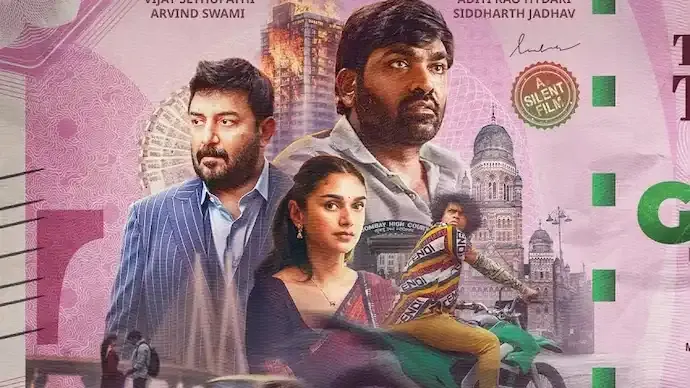
Cinema, in its purest form, was born without words. Long before sound became an inseparable part of storytelling, emotions were conveyed through expressions, movement, and silence. Drawing inspiration from that foundational era, Gandhi Talks, directed by Kishore Pandurang Belekar, embraces silence with conviction and clarity, creating an experience that feels both nostalgic and refreshingly modern.
Starring Vijay Sethupathi, Arvind Swami, and Aditi Rao Hydari, the film unfolds over two hours without a single spoken dialogue. Yet, at no point does it feel empty or overstretched. Instead, the narrative remains deeply immersive, relying on performance, framing, and music to communicate its ideas. The silence is intentional, expressive, and at times, profoundly moving.
Set in Mumbai — a city synonymous with noise, ambition, and relentless motion — the film’s quiet storytelling feels almost rebellious. The bustling metropolis becomes a backdrop for introspection, forcing viewers to slow down and observe rather than consume. As the film progresses, the absence of dialogue transforms into a meditative space, inviting reflection on one’s own relationship with chaos, ambition, and morality.
At its core, Gandhi Talks is a meditation on money and its grip on human values. The title itself is layered with irony. In a society where “paisa bolta hai” is more than just a phrase, the film literalises the idea by having characters speak not in currency notes, but in “Gandhis.” The familiar image of Mahatma Gandhi, once a symbol of moral authority, becomes a representation of power, survival, and social hierarchy. Through this lens, the film questions whether values still speak when money dominates every conversation.
Arvind Swami’s character represents privilege and excess. He begins the film with wealth, status, and emotional security, only to lose everything in rapid succession. Personal tragedy, legal troubles, and professional downfall strip him of his identity, exposing the fragility of material success. His descent is portrayed with restraint, making his vulnerability all the more affecting.
In contrast, Vijay Sethupathi’s Mahadev exists on the margins of society. Poverty defines his every decision. He struggles to care for his ailing mother, borrows electricity to survive, and cannot afford even the smallest comforts. Love, though genuine, proves insufficient in the face of economic desperation. As Mahadev navigates corruption and rejection, the film lays bare how morality often bends when survival is at stake.
When these two worlds collide, Gandhi Talks delivers its sharpest commentary: money governs everyone, regardless of where they begin. The intersection of wealth and want reveals how intentions are tested, compromised, and sometimes broken.
The film is filled with understated brilliance — from a tender balcony romance that replaces touch with imagination, to a robbery sequence that quietly contrasts innocence with experience. The background score complements the visuals with precision, knowing exactly when to lead and when to recede.
In an era dominated by noise, constant scrolling, and overstimulation, Gandhi Talks feels almost radical. It is calming, courageous, and deeply thought-provoking. The film may appeal to a niche audience, but its commitment to originality and emotional honesty makes it a work that deserves attention, appreciation, and preservation.






Conversation
Be kind and stay on topic. Comments are moderated; abuse, spam and personal attacks are removed. Report a problem