

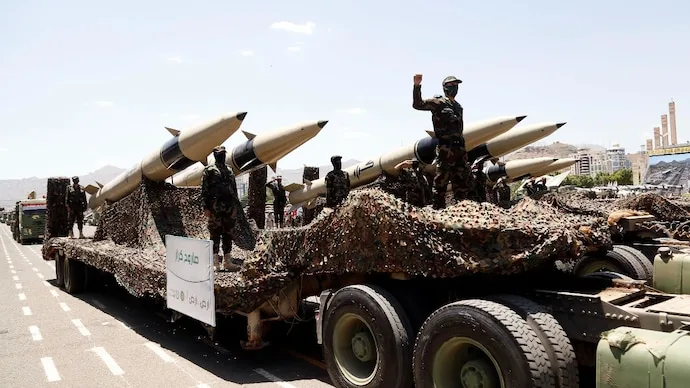

The Houthi missile arsenal has evolved beyond the image of a lightly equipped militia operating in Yemen. The Iran-aligned movement has developed a diverse range of ballistic missiles, cruise missiles and unmanned aerial vehicles (UAVs), creating a potential threat to Saudi Arabia and other regional targets.
The group’s expanding capabilities are attributed to a combination of Iranian weapons technology, foreign-made components and reported experiments with artificial intelligence tools. These developments have raised questions about how a movement operating in a country with limited economic resources can sustain increasingly sophisticated weapons programmes.
According to a February 2024 report by the US Defence Intelligence Agency (DIA), the Houthis possess several missile and drone systems with characteristics similar to Iranian designs.

Their reported arsenal includes the Sammad and Wa'id series of drones, the Burkan-3 ballistic missile and the Quds-4 cruise missile. The DIA estimated ranges of up to 1,800 kilometres for the Sammad, 2,500 kilometres for the Wa'id-2 and approximately 1,200 kilometres for the Burkan-3. The Houthis claim the Quds-4 can travel up to 2,000 kilometres.
Iran Provides Weapons Technology and Technical Expertise
Iranian assistance has reportedly played a significant role in expanding Houthi weapons capabilities. Support has included missiles, drones, components and technical knowledge that has helped the group assemble weapons locally.
A 2024 DIA assessment described Iranian-origin systems and components in the group's arsenal. According to analysis by the International Institute for Strategic Studies (IISS) published in April 2025, Iranian expertise, machinery and components have supported local assembly and production of systems including the Sammad-3 attack drone and some short-range ballistic missiles.
The Houthis nevertheless remain dependent on external supplies for certain specialised components, including guidance and propulsion systems. Advanced ballistic and cruise missiles require technologies that the group cannot independently manufacture in full.
Chinese Components Support Missile Production
Chinese-made components and industrial equipment have also drawn attention. A report published on October 14, citing Conflict Armament Research findings, said two shipments intercepted by Yemeni authorities in 2025 contained components from Chinese suppliers intended to support production of a version of Iran’s Kheibar Shekan ballistic missile.
The reported material included machined metal parts, stabilising fins, heat-resistant materials, tools and testing equipment.
Separately, the US Treasury has accused China-based firms Shenzhen Jinghon Electronics and Shenzhen Rion Technology of supplying dual-use or military-grade components connected to Houthi missile and drone production. Such allegations concern the supply chain and do not establish that every component from China is intended for military use.
Anthropic’s Claude AI Enters the Weapons Debate
Artificial intelligence has added another dimension to concerns about the group's technical capabilities. Anthropic reported in September that a cell of threat actors based in northern Yemen used Claude Code to assist with three weapons development programmes.
The reported projects included a guided rocket, a multistage ballistic missile with a stated range of 2,000 kilometres and a hypersonic glide vehicle. The actors reportedly used the tool to assist with guidance, navigation and control software, as well as flight simulations.
Anthropic said it found no evidence that the group had successfully deployed an operational weapon developed through this work. It reported that an attempted rocket test had failed, although the group had created an offline simulation toolkit.
Reports by the Associated Press and The Washington Post identified the actors as Houthis. The findings highlight potential misuse of AI tools, but do not establish that Claude independently designed or enabled a successful operational weapon.
Why This Matters for Saudi Arabia
Saudi Arabia has invested heavily in advanced military equipment, including F-15 fighter aircraft and Patriot air defence systems. However, defending against relatively inexpensive drones and missiles can create a difficult cost imbalance.
A Patriot interceptor can cost millions of dollars, while some one-way attack drones are considerably cheaper to manufacture. Even when air defences successfully intercept incoming weapons, repeated attacks can put pressure on interceptor stocks and defence budgets.
The Houthis’ combination of foreign technology, locally assembled weapons and comparatively low-cost drones therefore presents a persistent challenge for Riyadh. The extent of the threat depends on the weapons' actual capabilities, operational reliability and the effectiveness of Saudi Arabia’s defensive measures.
For official information on sanctions and proliferation concerns, visit the US Treasury Department.









Conversation
Be kind and stay on topic. Comments are moderated; abuse, spam and personal attacks are removed. Report a problem