

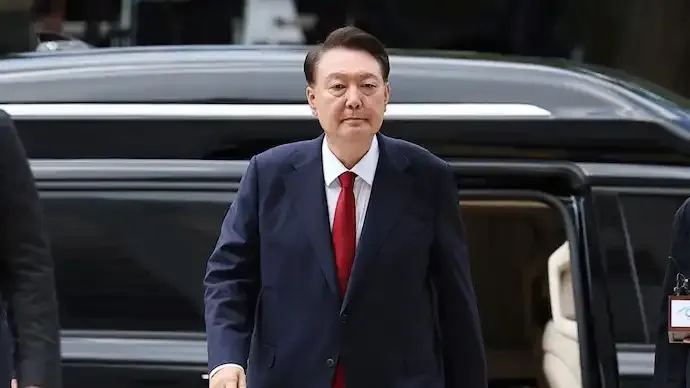

Former South Korean President Yoon Suk Yeol has been sentenced to life imprisonment after a court found him guilty of rebellion over his brief imposition of martial law in December 2024. The verdict marks a dramatic conclusion to one of the country’s most serious political crises in decades.
The Seoul court ruled that Yoon illegally mobilised military and police forces in an attempt to seize control of the opposition-led National Assembly of South Korea, arrest political leaders, and consolidate unchecked executive power for an extended period.
Martial Law Attempt Sparked National Crisis
The crisis began on December 3, 2024, when Yoon declared martial law in an effort to overcome legislative opposition. Troops were deployed to surround the National Assembly, preventing lawmakers from entering the building.

However, the decree lasted only about six hours. Legislators managed to break through the security blockade and unanimously voted to revoke the martial law order, forcing its withdrawal.
Judge Jee Kui-youn stated that the mobilisation of armed forces against democratic institutions constituted rebellion and posed a serious threat to constitutional governance.
Removal from Office and Criminal Proceedings
Following the incident, Yoon was impeached by lawmakers on December 14, 2024. He was formally removed from office by the Constitutional Court of Korea in April 2025. He has remained in custody since July 2025 while facing multiple criminal charges.
Earlier this year, he was sentenced to five years in prison in a separate case related to resisting arrest, falsifying documents connected to the martial law declaration, and bypassing required Cabinet procedures.
Court Rejects Death Penalty Demand
Prosecutors had sought the death penalty, arguing that Yoon’s actions threatened the foundations of South Korea’s democracy. However, analysts widely expected a life sentence, particularly as the attempted power grab did not result in casualties.
South Korea has not carried out an execution since 1997 and is widely considered to have a de facto moratorium on capital punishment.
Other Officials Also Convicted
The court also sentenced several former officials involved in enforcing the martial law order. Former Defence Minister Kim Yong Hyun received a 30-year prison sentence for his central role in planning the operation and mobilising military forces.
Former Prime Minister Han Duck-soo was sentenced in a separate case to 23 years in prison for attempting to legitimise the decree through procedural manipulation and falsifying official records. He has appealed the verdict.
Political Divisions and Public Reaction
As Yoon arrived at court, heavy police deployment surrounded the judicial complex. Supporters gathered to protest the verdict, while critics assembled nearby demanding harsher punishment.
Yoon, a conservative leader, had defended the martial law declaration as necessary to counter what he described as “anti-state forces” obstructing his agenda. Opponents argued that the move represented a direct assault on democratic institutions.
The life sentence underscores South Korea’s commitment to constitutional order and the rule of law, while highlighting the consequences of attempts to undermine democratic governance.



Conversation
Be kind and stay on topic. Comments are moderated; abuse, spam and personal attacks are removed. Report a problem