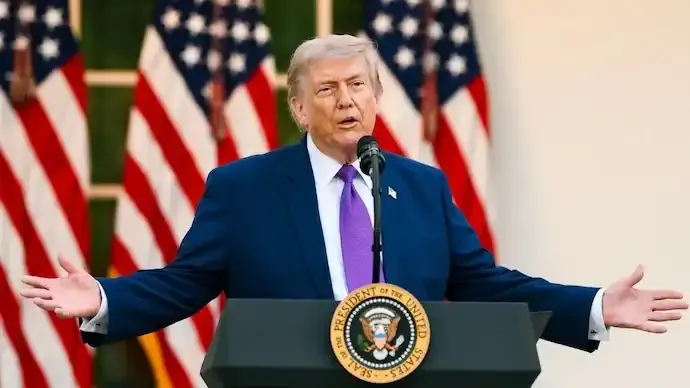
US President Donald Trump has sharply criticised the US Senate after lawmakers approved a resolution aimed at restricting further military action against Iran without explicit congressional authorisation.
The vote has exposed divisions within the Republican Party and intensified debate over presidential war powers, congressional oversight, and Washington's ongoing diplomatic engagement with Tehran.
In a strongly worded statement, Trump accused a group of Republican lawmakers of weakening America's negotiating position at a critical moment in relations with Iran.
What Triggered Trump's Anger?
The controversy began after the Senate passed a resolution seeking to limit future military action against Iran unless approved by Congress.
The measure is linked to longstanding debates in the United States regarding the balance of power between the presidency and Congress when it comes to military operations.
Supporters of the resolution argue that major military actions should require legislative approval, while opponents believe such restrictions can limit the President's flexibility during international crises.
Trump's Response
Reacting to the vote, Trump described the resolution as "poorly timed" and "meaningless."
The President argued that the Senate's action could undermine American leverage during ongoing diplomatic efforts involving Iran.
According to Trump, Iran was facing significant pressure and was in a weaker negotiating position when the Senate chose to move forward with the measure.
He also accused several Republican senators of damaging national interests by supporting the resolution.
What Is the War Powers Resolution?
The War Powers Resolution is a US law designed to regulate the President's ability to deploy military forces without congressional approval.
Key Objectives
-
Strengthen congressional oversight
-
Limit unilateral military action
-
Ensure legislative involvement in major conflicts
-
Maintain constitutional checks and balances
The law has been the subject of debate for decades, with different administrations interpreting its provisions in varying ways.
Why the Senate Vote Matters
The resolution reflects broader concerns among lawmakers regarding the possibility of military escalation involving Iran.
Supporters believe Congress should play a larger role in decisions that could lead to military conflict.
Issues at the Centre of the Debate
-
Presidential authority
-
Congressional powers
-
Military intervention
-
US-Iran relations
-
National security strategy
The vote highlights how foreign policy decisions often become deeply intertwined with domestic political debates.
Republican Divisions Come Into Focus
One of the most notable aspects of the Senate vote is the visible disagreement within the Republican Party.
While many Republicans continue to support Trump's foreign policy approach, some lawmakers have argued that congressional oversight remains essential regardless of which party controls the White House.
The disagreement illustrates differing views within the party regarding:
-
Executive authority
-
Military engagement
-
Foreign policy decision-making
-
Constitutional responsibilities
US-Iran Relations Remain Sensitive
The vote comes amid ongoing discussions and diplomatic efforts related to Iran.
Relations between Washington and Tehran have remained tense for years, shaped by disputes over:
-
Regional security
-
Sanctions
-
Nuclear activities
-
Military actions
-
Diplomatic negotiations
Any development affecting the balance of power between the White House and Congress can influence perceptions among international partners and adversaries.
Trump's Argument on Negotiating Leverage
Trump's central criticism is that public political divisions can weaken the United States during sensitive negotiations.
According to his view, demonstrating unity strengthens America's bargaining position.
Supporters of the President argue that limiting executive flexibility could reduce Washington's ability to respond quickly to evolving international developments.
Critics, however, contend that congressional oversight enhances accountability and prevents unnecessary military escalation.
Constitutional Debate Reignited
The Senate vote has revived one of the most enduring constitutional debates in American politics:
Who Should Decide on Military Action?
The US Constitution divides powers between:
-
The President, who serves as Commander-in-Chief
-
Congress, which holds authority over declarations of war and military funding
This balance has been debated throughout modern American history and continues to generate legal and political controversy.
What Happens Next?
Although the resolution has passed the Senate, its practical impact will depend on future political and legal developments.
Key questions include:
-
Whether additional legislative action follows
-
How the administration responds
-
The future of US-Iran negotiations
-
Potential judicial challenges
The issue is likely to remain a significant topic in Washington's foreign policy discussions.
Why This Story Matters
The dispute extends beyond a single Senate vote.
It touches on:
-
Presidential powers
-
Congressional authority
-
National security
-
US foreign policy
-
Relations with Iran
The outcome could influence how future administrations approach military operations and diplomatic negotiations.
Conclusion
Donald Trump's criticism of the Senate's Iran-related resolution has highlighted growing tensions over war powers, congressional oversight, and America's approach to Tehran. While supporters view the measure as an important constitutional safeguard, critics argue it may constrain the President during sensitive international negotiations. As US-Iran relations continue to evolve, the debate over military authority and foreign policy decision-making is likely to remain at the forefront of American politics.
FAQ SECTION
Q1. Why did Donald Trump criticise the Senate?
Trump opposed a Senate resolution that seeks to limit further military action against Iran without congressional approval.
Q2. What is the War Powers Resolution?
It is a US law intended to ensure congressional oversight of significant military actions.
Q3. Why is the vote important?
The resolution affects the balance of power between the President and Congress regarding military decisions.
Q4. How does this relate to Iran?
The measure concerns potential future US military action involving Iran.
Q5. Did Republicans support the resolution?
The vote revealed divisions within the Republican Party, with some members supporting the measure.
Q6. Does the resolution immediately stop military action?
The practical impact depends on future legal, political, and policy developments.