

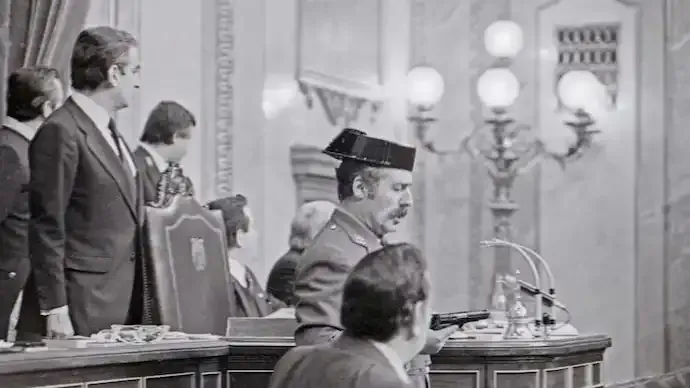

Antonio Tejero, the former Spanish lieutenant colonel who became the face of Spain’s failed 1981 military coup, has died at the age of 93. His passing closes a dramatic chapter in Spain’s transition from dictatorship to democracy.
Tejero died in the eastern Spanish town of Alzira, according to a statement issued by a law firm representing his family. His death coincided with the Spanish government’s publication of newly declassified documents related to the attempted coup — a symbolic moment tied to one of the most defining events in modern Spanish political history.
On February 23, 1981, Tejero led approximately 200 armed civil guards into Spain’s Parliament in Madrid in an effort to overturn the country’s young democratic system. The attempted coup came just six years after the death of dictator Francisco Franco, whose rule had shaped Spain for nearly four decades.

The dramatic incident unfolded as lawmakers were voting to confirm Leopoldo Calvo-Sotelo as prime minister. Tejero and his men stormed the chamber, firing shots into the air and ordering members of Parliament to lie on the floor. The images of legislators taking cover under desks were broadcast live across the country, leaving a lasting mark on Spain’s collective memory.
The coup attempt ultimately failed after then-King Juan Carlos I addressed the nation on television. In his speech, he firmly rejected the coup and ordered the armed forces to uphold the constitution and democratic order. His intervention is widely credited with safeguarding Spain’s fragile democracy at a critical moment.
The standoff inside Parliament lasted around 18 hours before the rebels surrendered. Tejero was later convicted of military rebellion and sentenced to 30 years in prison. He served 15 years and nine months before being released.
Following his release, Tejero largely stayed out of public life, dividing his time between southern Spain and Madrid. Over the decades, the 1981 coup attempt has remained a defining event in Spain’s democratic history, often referred to simply as “23-F,” marking the date of the uprising.
Tejero’s death has prompted renewed reflection on Spain’s post-Franco transition and the resilience of its democratic institutions. The recently declassified documents are expected to offer further insight into the political tensions and military manoeuvres that shaped the failed uprising.
More than four decades later, the 1981 coup remains a powerful reminder of the challenges Spain faced in consolidating democracy after authoritarian rule — and the decisive role played by constitutional leadership in defending it.






Conversation
Be kind and stay on topic. Comments are moderated; abuse, spam and personal attacks are removed. Report a problem