

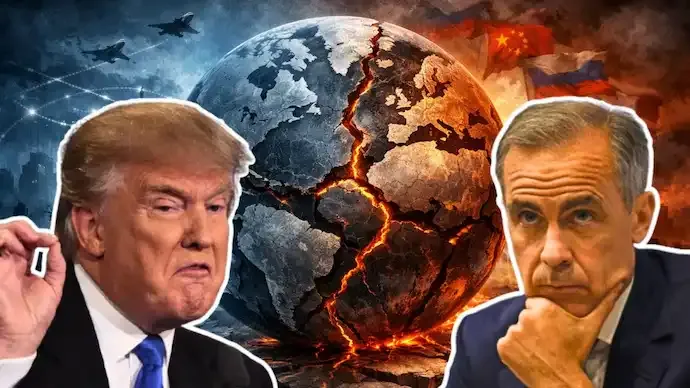

When Mark Carney took the stage at the World Economic Forum in Davos, it marked a dramatic shift in tone for a man who had spent decades operating at the heart of the global financial and political elite. No longer speaking as a technocrat or central banker, Carney, now Canada’s Prime Minister, delivered a pointed critique of what he described as a collapsing global order dominated by a single hegemon — a reference unmistakably aimed at the United States, led by Donald Trump.
Carney argued that the era of unchallenged American dominance was fading and that “middle powers” must now come together to shape a new global framework. On the surface, the diagnosis was difficult to dispute. Trade wars, sanctions diplomacy, and open threats against allies have indeed shaken confidence in the post-World War II order. Yet Carney’s argument carries a glaring contradiction: Canada was never a bystander to American hegemony. It was one of its most consistent beneficiaries and enablers.
Canada Was Not an Innocent Observer
For decades, Canada prospered as Washington’s closest strategic, economic, and cultural ally. Ottawa did not merely coexist with US power; it actively helped construct and sustain it. From the Cold War through the post-9/11 era, Canada aligned itself firmly within the Western bloc, backing American-led institutions, alliances, and military interventions that reshaped the world in Washington’s image.

Canada was a founding member of the United Nations in 1945 and played a central role in legitimising the US-led multilateral system that followed. It was also a founding member of North Atlantic Treaty Organization, stationing tens of thousands of troops in Western Europe for decades as part of NATO’s forward defence against the Soviet Union. Ottawa further integrated its security architecture with Washington by co-founding NORAD in 1958, effectively merging its air defence systems with US strategic planning.
Canada fought alongside American forces in the Korean War, supported US positions during the Vietnam era, and consistently backed Washington in international forums. Even its much-lauded peacekeeping role, particularly during the 1956 Suez Crisis, served to soften the image of a Western order anchored in American hard power rather than challenge its foundations.
Trump Changed the Equation — Not the History
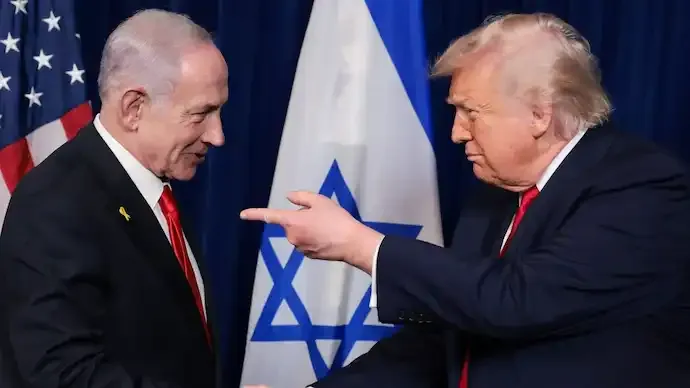
Carney’s rhetorical pivot is driven less by moral awakening than by political shock. Under Trump, the US–Canada relationship became openly transactional. Washington imposed sweeping tariffs on Canadian goods, with rates rising to 35 per cent on several non-energy imports by August 2025. Canada was pressured on border security, migration, and fentanyl trafficking, while Trump repeatedly mocked Ottawa by suggesting it could become America’s “51st state.”
Beyond North America, Trump’s posture toward allies — including threats of tariffs on European NATO members and warnings over Greenland — further rattled traditional partners. For Carney, these developments confirmed that old guarantees no longer held, even for America’s most loyal allies.
But to frame this as the collapse of a bargain that once worked for everyone is historically misleading. The US-led order delivered prosperity and security to countries like Canada, but it imposed severe costs on much of the Global South.
A ‘Rules-Based Order’ — For Whom?
Carney acknowledged in Davos that international rules were enforced selectively and that global institutions often operated with “varied rigour.” Yet Canada was instrumental in legitimising those very institutions. Ottawa played a key role at the 1944 Bretton Woods Conference, which gave birth to the International Monetary Fund and the World Bank — bodies that shaped the economic destinies of Asia, Africa, and Latin America through conditional lending and structural adjustment programmes.
While American leadership was central, Canadian support helped stabilise a system that many non-aligned nations experienced as coercive. Regime-change operations, sanctions, and proxy wars — from Iran and Guatemala to Chile and Congo — unfolded within an order that Canada consistently defended or quietly endorsed.
The Convenient Discovery of ‘Middle Powers’
Carney’s call for middle powers to unite offers a compelling vision in an era of US–China rivalry. But it also raises uncomfortable questions. Where was Canada when the Non-Aligned Movement, championed by countries like India, Egypt, and Indonesia, sought precisely such strategic autonomy? Ottawa chose sides then — and that choice brought Canadians decades of stability and prosperity.
Today, as Washington becomes unpredictable, Canada is rediscovering the language of autonomy and balance. Yet credibility matters. If a different administration takes office in the White House after Trump, will Ottawa return to its traditional role as America’s most dependable partner, abandoning the very middle-power coalition it now advocates?
Can Canada Lead What It Once Helped Break?
Carney is right that the old order is under strain. But acknowledging that truth without reckoning with Canada’s role in creating and sustaining that order risks turning his revolt into a hollow gesture. Leadership in a new global framework demands more than rhetorical distance from a superpower in decline; it requires historical honesty and sustained commitment.
The question is not whether the old order is broken. It is whether Canada — having helped build it — can now credibly claim the moral authority to replace it. And on that count, Carney’s Davos speech leaves as many doubts as it raises.




Conversation
Be kind and stay on topic. Comments are moderated; abuse, spam and personal attacks are removed. Report a problem