

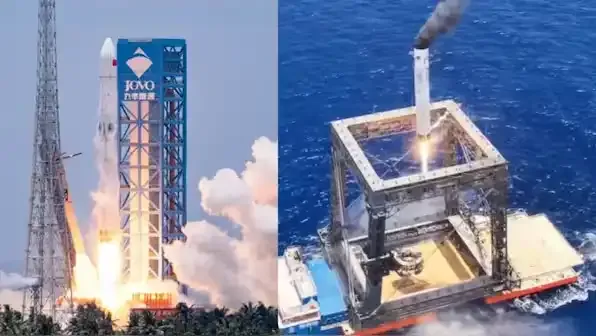

China has successfully completed the first controlled recovery of the first-stage booster of its Long March-10B rocket, marking a major breakthrough in the country's efforts to develop reusable launch systems.
The milestone was achieved following the maiden launch of the Long March-10B from Hainan Province, where the rocket successfully placed its payload into orbit before its first-stage booster returned to Earth and was recovered using a sea-based net capture platform. The achievement is China's first successful recovery of an orbital-class rocket booster and represents a significant advance in its reusable space programme.
China Achieves Historic Reusable Rocket Milestone
The successful mission marks the first time China has recovered the booster of an orbital-class carrier rocket in a controlled manner.

Following stage separation, the first-stage booster performed a guided descent and was captured by a floating offshore recovery platform equipped with a specially designed net system. Unlike conventional vertical landings on landing legs, the booster used landing hooks to latch onto the suspended net, reducing structural weight and increasing payload efficiency.
The second stage continued its mission, successfully delivering the payload into its planned orbit.
How the Recovery System Works
The Long March-10B employs a different recovery approach from other reusable rockets.
Instead of landing directly on deployable legs, the returning booster:
- Performs a controlled powered descent.
- Uses guidance systems to align with a floating recovery platform.
- Deploys specially designed landing hooks.
- Hooks into a tensioned net mounted on the sea-based platform.
According to the China Academy of Launch Vehicle Technology (CALT), this design simplifies the booster structure, reduces launch weight and allows greater flexibility during recovery operations.
A Major Step Towards Reusable Launch Systems
Reusable rockets have become one of the most important developments in modern spaceflight because they dramatically reduce launch costs.
Recovering and reusing expensive first-stage boosters allows space agencies and commercial operators to:
- Lower mission costs.
- Increase launch frequency.
- Improve sustainability.
- Expand satellite deployment capabilities.
China has identified reusable launch technology as a strategic priority as it works towards becoming a leading global space power by the end of the decade.
How It Compares With SpaceX
The achievement inevitably draws comparisons with SpaceX, which pioneered reusable orbital rocket operations.
In 2015, SpaceX became the first organisation to recover an orbital-class booster after launching its Falcon 9 rocket.
However, China's approach differs in one significant aspect.
SpaceX Recovery
- Booster lands vertically.
- Uses deployable landing legs.
- Touches down on drone ships or land-based pads.
Long March-10B Recovery
- Booster performs a controlled descent.
- Uses landing hooks instead of landing legs.
- Is captured by a floating sea-based net system.
While both systems aim to recover boosters for reuse, China's net-based capture method represents a distinct engineering solution.
Previous Recovery Attempts
China has been steadily developing reusable rocket technology over the past several years.
Previous attempts by Chinese launch providers to recover orbital-class boosters were unsuccessful, highlighting the technical complexity involved.
The Long March-10B mission therefore represents the country's first successful demonstration of a complete controlled recovery after an orbital launch.
About the Long March-10B Rocket
The Long March-10B is a reusable liquid-fuel launch vehicle developed for commercial and orbital missions.
Key Specifications
- Height: Approximately 63 metres
- Diameter: 5 metres
- Lift-off mass: Around 760 tonnes
- Lift-off thrust: Approximately 890 tonnes
- Payload capacity: Up to 16 tonnes to low-Earth orbit in reusable configuration
The rocket is designed to support commercial satellite launches while lowering mission costs through booster reuse.
Why This Matters for China's Space Programme
Reusable rockets are expected to play a central role in China's future space ambitions.
The technology will support:
- Larger satellite constellations.
- Commercial launch services.
- Lower-cost access to space.
- Future crewed lunar missions.
- Expansion of China's space industry.
Officials have indicated that the recovered booster is expected to fly again before the end of the year, demonstrating confidence in its reusability.
Global Space Race Intensifies
China's latest success reflects the growing competition in reusable launch technology.
The United States currently leads the field through SpaceX, while China is investing heavily in reusable systems developed by both state-owned organisations and private aerospace companies.
As launch costs continue to fall, reusable rockets are expected to become the industry standard for commercial and government missions alike.
Featured Snippet
China has successfully recovered the first-stage booster of its Long March-10B rocket using a sea-based net capture system after the rocket's maiden orbital launch. The achievement marks China's first successful recovery of an orbital-class rocket booster and a significant milestone in the country's reusable space programme.
Key Highlights
- China successfully recovered the Long March-10B first-stage booster.
- The booster was captured using a sea-based net recovery platform.
- It is China's first successful recovery of an orbital-class rocket booster.
- The Long March-10B successfully placed its payload into orbit.
- The recovery system uses landing hooks instead of landing legs.
- Reusable rockets are expected to reduce launch costs significantly.
- The recovered booster is expected to be reused on another mission later this year.
Conclusion
The successful recovery of the Long March-10B booster marks an important milestone in China's pursuit of reusable launch technology. By demonstrating a working sea-based recovery system, China has taken a significant step toward lowering launch costs and expanding its commercial and strategic space capabilities. While SpaceX remains the global leader in reusable rockets, this achievement highlights China's accelerating progress in one of the most competitive areas of modern aerospace technology.
FAQs
1. What did China achieve with the Long March-10B?
China successfully recovered the first-stage booster of the Long March-10B after its maiden orbital launch, marking its first controlled recovery of an orbital-class rocket booster.
2. How was the booster recovered?
The booster descended onto a floating offshore platform where landing hooks caught a specially designed net.
3. Why are reusable rockets important?
Reusable rockets significantly reduce launch costs, increase launch frequency and make space missions more economical.
4. How does China's system differ from SpaceX?
SpaceX lands boosters vertically on landing legs, while China's Long March-10B uses landing hooks to capture the booster in a floating net.
5. Where was the Long March-10B launched?
The rocket lifted off from Hainan Province in southern China.
6. How much payload can Long March-10B carry?
The reusable version can carry approximately 16 tonnes to low-Earth orbit.
7. Will the recovered booster be reused?
According to Chinese officials, the recovered booster is expected to fly again before the end of the year.
8. Why is this mission significant?
The mission demonstrates China's growing capability in reusable launch technology, an area considered crucial for future commercial spaceflight and deep-space exploration.



Conversation
Be kind and stay on topic. Comments are moderated; abuse, spam and personal attacks are removed. Report a problem