

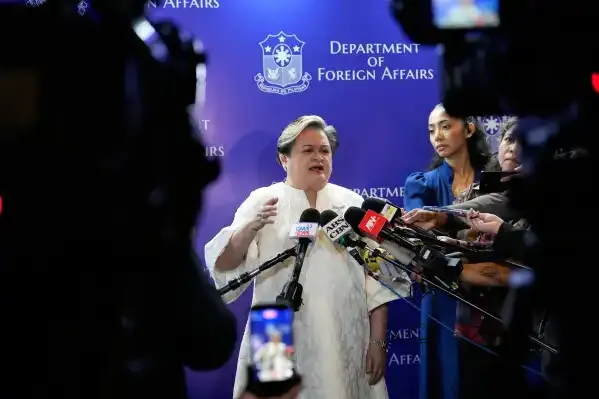

The Philippines has reaffirmed the importance of the landmark 2016 South China Sea arbitration ruling, describing it as a legally binding decision that continues to guide international maritime law, even as China once again rejected the verdict and maintained its sweeping territorial claims over the disputed waters.
The anniversary comes amid persistent tensions in one of the world's busiest and most strategically important waterways, where competing territorial claims have led to repeated confrontations involving coast guards, naval vessels and fishing fleets.
Philippines Reaffirms Landmark Arbitration Victory
Marking the anniversary of the July 12, 2016 ruling, Philippine officials reiterated that the arbitration award remains legally binding under international law.

Philippine Foreign Secretary Maria Theresa Lazaro compared the ruling to a "lighthouse," saying it provides legal guidance during periods of rising geopolitical tensions and competing maritime claims. She stressed that international law offers stability beyond shifting political interests.
The Philippines has consistently maintained that the ruling forms the legal foundation for protecting its maritime rights in the South China Sea.
China Again Rejects the Tribunal's Decision
Beijing once again dismissed the arbitration award, describing it as "illegal, null and void."
China has never recognised the tribunal's jurisdiction and continues to assert claims over most of the South China Sea despite the 2016 decision.
Chinese officials argue that the ruling does not affect what Beijing considers its historical sovereignty and maritime rights in the region.
What the 2016 Arbitration Ruled
The arbitration case was initiated by the Philippines in 2013 under the United Nations Convention on the Law of the Sea (UNCLOS).
On July 12, 2016, the tribunal ruled overwhelmingly in favour of the Philippines, concluding that:
- China had no legal basis to claim historic rights over most of the South China Sea through its "Nine-Dash Line."
- Several disputed maritime features did not generate extensive maritime zones under UNCLOS.
- The tribunal did not decide questions of sovereignty over islands or maritime boundaries between states.
The ruling is considered legally binding under UNCLOS, although the tribunal has no enforcement mechanism.
Why the South China Sea Matters
The South China Sea is one of the world's most strategically important maritime regions.
The sea:
- Carries trillions of dollars in global trade annually.
- Contains rich fishing grounds.
- Is believed to hold significant oil and natural gas reserves.
- Serves as a vital shipping route connecting East Asia with Europe and the Middle East.
Its importance has made it one of the Indo-Pacific's most closely watched geopolitical flashpoints.
Regional Disputes Continue
Several countries maintain overlapping territorial claims in the South China Sea.
Besides China and the Philippines, competing claims involve:
- Vietnam
- Malaysia
- Brunei
- Taiwan
Recent years have seen repeated confrontations involving coast guard vessels, fishing boats and maritime patrols, particularly between China and the Philippines.
International Support for the Ruling
The United States has repeatedly called on China to comply with the arbitration award.
Washington has also reiterated that its mutual defence treaty with the Philippines applies if Philippine armed forces, public vessels or aircraft come under an armed attack in the South China Sea.
Australia also used the anniversary to express concern over what it described as destabilising conduct in the disputed waters.
Fishermen Continue to Feel the Impact
Despite the legal victory secured in 2016, many Filipino fishermen say the situation at sea has changed little.
Communities that traditionally fished around Scarborough Shoal report continued restrictions and encounters with Chinese vessels, making access to long-used fishing grounds increasingly difficult.
For many coastal families, the tribunal's legal victory has not yet translated into practical improvements on the water.
Why the Anniversary Remains Significant
A decade after the arbitration ruling, the decision continues to shape regional diplomacy, maritime security and international legal debates.
While China maintains its position rejecting the award, the Philippines and many of its partners continue to cite the ruling as the principal legal framework governing maritime rights in the South China Sea.
The anniversary highlights the continuing gap between international legal decisions and geopolitical realities in one of Asia's most contested regions.
Featured Snippet
The Philippines has reaffirmed the 2016 South China Sea arbitration ruling as legally binding while China again rejected the decision. The tribunal ruled that Beijing had no legal basis for its sweeping historic rights claims under the UN Convention on the Law of the Sea, although China continues to reject the award.
Key Highlights
- The Philippines marked the anniversary of the 2016 South China Sea arbitration ruling.
- Manila reaffirmed the decision as legally binding under international law.
- China again rejected the tribunal's ruling.
- The 2016 award found no legal basis for China's historic rights claims under UNCLOS.
- The South China Sea remains one of the world's most disputed maritime regions.
- The United States and Australia reiterated support for the arbitration ruling.
- Filipino fishermen say access to disputed fishing grounds remains difficult.
Conclusion
Ten years after the landmark arbitration ruling, the South China Sea remains a focal point of geopolitical competition. While the Philippines continues to rely on the 2016 decision as the cornerstone of its legal position, China maintains its rejection of the award and its expansive maritime claims. With regional tensions persisting and international partners reaffirming support for the rules-based maritime order, the dispute remains unresolved despite the tribunal's historic judgment.
FAQs
1. What is the 2016 South China Sea ruling?
It is an arbitration award issued under UNCLOS that largely ruled in favour of the Philippines and found no legal basis for China's broad historic rights claims in the South China Sea.
2. Does China accept the ruling?
No. China continues to reject the arbitration award, calling it illegal and without legal effect.
3. What did the tribunal decide?
The tribunal concluded that China's historic rights claims exceeded what is permitted under UNCLOS. It did not decide sovereignty over islands or maritime boundaries.
4. Why is the South China Sea important?
It is a crucial global shipping route with valuable fisheries, energy resources and significant strategic importance.
5. Which countries claim parts of the South China Sea?
China, the Philippines, Vietnam, Malaysia, Brunei and Taiwan all have overlapping claims.
6. Why are tensions continuing?
China continues to enforce its maritime claims while neighbouring countries assert rights recognised under international law, leading to repeated confrontations.
7. Is the arbitration ruling legally binding?
Yes. The tribunal's award is legally binding under UNCLOS, although it has no direct enforcement mechanism.
8. What has the international community said?
Countries including the United States and Australia have repeatedly urged China to comply with the arbitration ruling.







Conversation
Be kind and stay on topic. Comments are moderated; abuse, spam and personal attacks are removed. Report a problem