

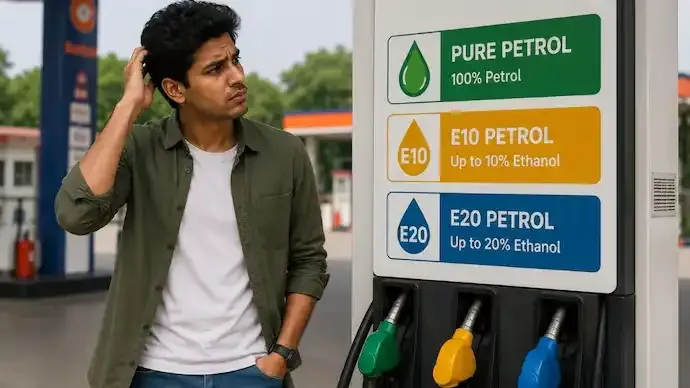

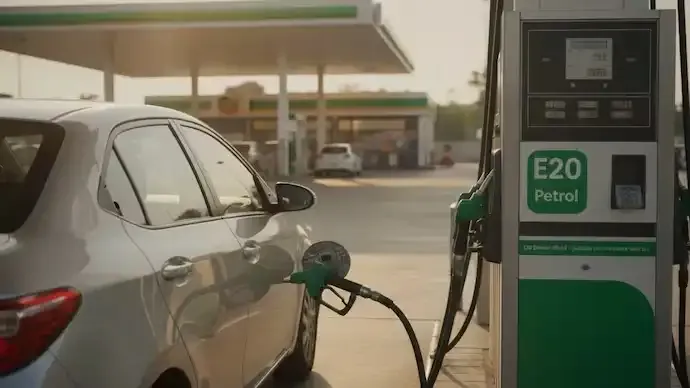
More than a year after E20 petrol was rolled out across India, questions about its impact on vehicle performance have resurfaced following a citizen survey that claimed many motorists were experiencing lower fuel efficiency and higher maintenance costs.
The debate has gained traction on social media, with some vehicle owners expressing concerns about whether ethanol-blended fuel can damage engines—particularly in older petrol vehicles.
In response, the Ministry of Petroleum and Natural Gas has reiterated that E20 petrol is scientifically tested, safe for approved vehicles and plays a key role in reducing India's dependence on imported crude oil.

Here's what E20 petrol is, why India adopted it and what the government says about the concerns surrounding engine performance and mileage.
What Is E20 Petrol?
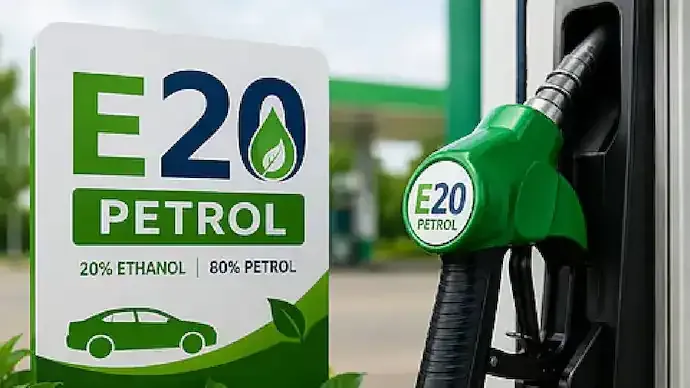
E20 petrol is a blend containing:
- 20% ethanol
- 80% petrol
Ethanol is a renewable biofuel produced primarily from agricultural feedstocks such as sugarcane, maize and surplus food grains.
The government's ethanol blending programme aims to:
- Reduce crude oil imports
- Improve energy security
- Lower vehicle emissions
- Support farmers by creating demand for ethanol feedstocks
India completed the nationwide rollout of E20 petrol in April 2025, several years ahead of its original target.
Why Has the Debate Resurfaced?
Fresh concerns emerged after a LocalCircles citizen survey suggested that many owners of petrol vehicles manufactured before 2023 believed their vehicles were delivering lower mileage after the wider adoption of E20 fuel.
According to the survey:
- 66% of respondents owning older petrol vehicles reported a drop in fuel efficiency of more than 10%.
- This was higher than a similar survey conducted earlier, where 45% of respondents had reported comparable concerns.
The survey has renewed discussions over whether older vehicles are fully compatible with higher ethanol blends.
Did India Rush the Transition to E20?
Government's Response: No
The Centre says India's ethanol blending programme has evolved gradually over more than two decades.
According to the government:
- Pilot projects began in 2001.
- The ethanol blending programme was formally launched in 2004.
- E5 fuel was introduced in several states by 2006.
- A broader policy framework was notified in 2013.
- The National Policy on Biofuels, 2018 accelerated ethanol production and expanded approved feedstocks.
Officials say the transition to E20 followed extensive consultations with automobile manufacturers, oil marketing companies and technical experts before nationwide implementation.
Why Can't Consumers Choose Between Pure Petrol, E10 and E20?
Government's Response: Maintaining Multiple Supply Chains Is Not Practical
Some motorists have questioned why fuel stations do not offer different ethanol blends, allowing consumers to choose.
The government argues that operating separate nationwide supply chains for:
- Pure petrol
- E10 petrol
- E20 petrol
would be logistically complex and economically expensive.
Officials point out that India's fuel distribution network includes:
- Over one lakh fuel stations
- Pipelines
- Depots
- Storage terminals
Maintaining parallel infrastructure for multiple fuel blends would significantly increase operational costs.
The government also notes that substantial investments have already been made to expand ethanol production infrastructure across the country.
Why Isn't E20 Petrol Cheaper?
Government's Response: The Objective Is Energy Security, Not Lower Pump Prices
Many consumers expected ethanol blending to reduce fuel prices.
However, the government says the programme's primary objective is not to make petrol cheaper.
Instead, it is designed to:
- Reduce dependence on imported crude oil
- Improve India's energy security
- Cut carbon emissions
- Increase farmers' income through ethanol production
Officials add that ethanol is procured at remunerative prices to ensure fair returns for farmers, meaning E20 does not necessarily cost less than conventional petrol.
Can E20 Petrol Damage Car Engines?
Government's Response: No Evidence of Widespread Damage
One of the most common concerns among motorists is whether E20 can damage engines or fuel systems, particularly in older vehicles.
The government says there is no widespread scientific evidence to support claims that E20 causes abnormal engine damage.
According to the clarification:
- E20 underwent extensive testing before rollout.
- Evaluations involved automobile manufacturers, the Automotive Research Association of India (ARAI), the Society of Indian Automobile Manufacturers (SIAM) and oil companies.
- Manufacturers continue to provide warranty support for E20-compatible vehicles.
Officials also state that millions of vehicles have been serviced without evidence of widespread corrosion or engine failures directly linked to E20 fuel.
Does E20 Reduce Mileage?
Government's Response: A Small Reduction Is Possible
Unlike claims circulating online, the government acknowledges that ethanol-blended fuel can result in a slight reduction in fuel economy.
According to its clarification:
- Some vehicles may experience a 3–5% decrease in mileage.
However, officials argue that E20 also offers several advantages, including:
- Higher octane rating
- Better combustion
- Smoother engine performance
- Reduced emissions
- Cleaner engine operation
The government maintains that these benefits outweigh the modest reduction in fuel efficiency.
Benefits of India's Ethanol Blending Programme
The Centre says the E20 initiative supports several long-term national objectives.
1. Reduced Crude Oil Imports
India imports a significant share of its crude oil requirements.
Increasing ethanol blending helps reduce dependence on imported fossil fuels.
2. Energy Security
Diversifying fuel sources strengthens India's long-term energy resilience.
3. Support for Farmers
Higher ethanol production creates additional demand for agricultural produce, generating new income opportunities for farmers.
4. Lower Carbon Emissions
Ethanol blending is expected to contribute to cleaner vehicle emissions compared with conventional petrol.
What Should Vehicle Owners Do?
The government has advised motorists to rely on information issued by official agencies rather than unverified claims circulating online.
Vehicle owners are encouraged to:
- Follow manufacturer recommendations.
- Use approved fuel grades.
- Service vehicles regularly.
- Refer to authorised service centres for compatibility-related queries.
Owners of older vehicles who experience performance issues should consult authorised workshops to determine whether the problem is fuel-related or caused by routine mechanical wear.
Featured Snippet
E20 petrol contains 20% ethanol and 80% petrol. The Indian government says the fuel is scientifically tested, safe for approved vehicles and essential for reducing crude oil imports. While some vehicles may experience a 3–5% drop in mileage, the Centre says there is no widespread evidence linking E20 to engine damage.
Key Highlights
- India completed the nationwide rollout of E20 petrol in April 2025.
- Fresh concerns emerged after a citizen survey reported lower mileage in older vehicles.
- The government says E20 is scientifically tested and safe.
- Officials acknowledge a possible 3–5% reduction in fuel economy.
- The programme aims to improve energy security and reduce crude oil imports.
- Ethanol blending is also intended to increase farmers' incomes and reduce emissions.
- Consumers are advised not to rely on unverified social media claims.
Conclusion
India's transition to E20 petrol marks a significant shift in the country's fuel policy, balancing energy security, environmental objectives and agricultural support. While concerns about mileage and older vehicles continue to be discussed, the government maintains that E20 has undergone extensive scientific evaluation and remains safe for approved vehicles.
For motorists, understanding manufacturer recommendations and relying on verified technical information will be essential as India continues its transition towards cleaner and more sustainable transport fuels.
FAQs
1. What is E20 petrol?
E20 petrol is a fuel blend containing 20% ethanol and 80% petrol.
2. Can E20 damage my car's engine?
The government says there is no widespread scientific evidence that E20 causes engine damage in compatible vehicles.
3. Does E20 reduce fuel mileage?
According to the government, some vehicles may experience a 3–5% reduction in fuel economy.
4. Why did India introduce E20 petrol?
The programme aims to reduce crude oil imports, improve energy security, lower emissions and support farmers through increased ethanol production.
5. Why isn't E20 petrol cheaper?
The government says ethanol blending focuses on energy security rather than reducing retail fuel prices.
6. Can I choose between E10 and E20 petrol?
The government says maintaining separate nationwide fuel distribution systems for multiple blends is not practical.
7. Has E20 been scientifically tested?
Yes. The Centre says E20 was evaluated with the involvement of automobile manufacturers, ARAI, SIAM and oil companies before nationwide rollout.
8. Should owners of older vehicles be concerned?
The government maintains that there is no evidence of widespread engine damage linked to E20. Vehicle owners should follow manufacturer guidance and consult authorised service centres if they have concerns.





Conversation
Be kind and stay on topic. Comments are moderated; abuse, spam and personal attacks are removed. Report a problem