The fatal Learjet crash that claimed the life of Maharashtra Deputy Chief Minister Ajit Pawar near Baramati Airport has once again brought India’s tabletop runways under scrutiny, reigniting a long-standing debate within aviation circles about whether such elevated airstrips inherently increase risk.
The aircraft went down during its final moments of landing, barely a few hundred metres from the edge of the elevated runway, killing all five people on board. Baramati Airport is one of India’s six tabletop runways, a category that includes Kozhikode, Mangaluru, Lengpui, Shimla and Pakyong. These runways are built on plateaus, often surrounded by steep drops, leaving little margin for error during landing or take-off.
Tabletop runways have previously been associated with major aviation disasters. The 2020 crash of an Air India Express aircraft at Kozhikode airport killed 21 people after the plane overshot the runway amid heavy rain and poor visibility. A decade earlier, a similar overrun at Mangaluru claimed 158 lives. In both cases, investigations cited pilot error as the primary cause, while also acknowledging that the tabletop design worsened the consequences.
However, aviation experts caution against drawing immediate conclusions about the Baramati crash based solely on runway design. A senior pilot familiar with operations at the airstrip said that a tabletop runway, in principle, is no different from any other runway if operational limits are respected.
“What ultimately matters is the runway length, touchdown point and visibility,” the pilot said. “A runway doesn’t become dangerous just because it’s elevated. The real danger comes when approach criteria are violated.”
At the time of the crash, visibility at Baramati was reportedly around 3,000 metres, significantly lower than the recommended minimum of 5,000 metres for safe visual approaches. Experts noted that attempting to descend below circuit altitude without adequate visual reference could be a critical error.
Another aviation specialist, Commander Naveen Pandita, highlighted the psychological and visual challenges unique to tabletop runways. He explained that pilots approaching elevated strips can experience the “black hole effect,” a visual illusion that makes the runway appear closer or higher than it actually is, particularly in low visibility or flat lighting conditions.
“If pilots rely on visual cues instead of strictly following instruments, the risk increases dramatically,” Pandita said. “On a tabletop runway, there is no buffer zone. Overshoot, and there is nothing but a drop.”
The absence of advanced landing aids such as an Instrument Landing System (ILS) at Baramati Airport further complicated the approach. Experts also pointed out that smaller business jets, like the Learjet involved, approach at higher speeds and lack the braking capability and thrust reversers of larger commercial aircraft, making precision even more critical.
While familiarity with the airfield can help pilots manage these risks, aviation professionals stress that tabletop runways demand stricter discipline, better weather margins and enhanced simulator training.
As investigators analyse flight data, cockpit voice recordings and wreckage patterns, experts agree on one point: tabletop runways amplify the consequences of mistakes but do not cause crashes by themselves. The final findings will determine whether weather conditions, pilot decision-making, aircraft performance or airport infrastructure played the decisive role in the Baramati tragedy.
Prev Article
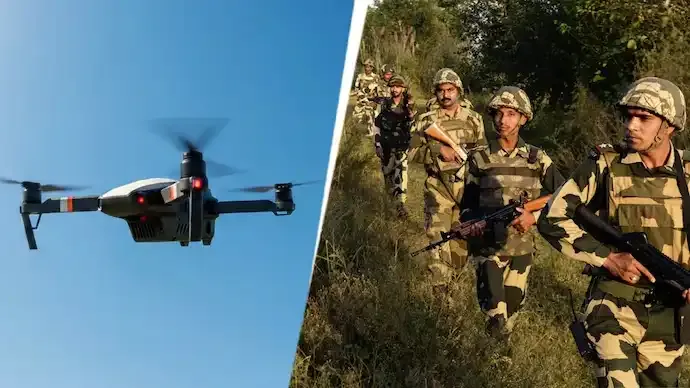
Pakistani Drone Spotted Near Jammu Border Again, BSF Opens Fire in Samba
Next Article
Kerala Kumbh Mela Returns After 250 Years Ahead of Assembly Elections