

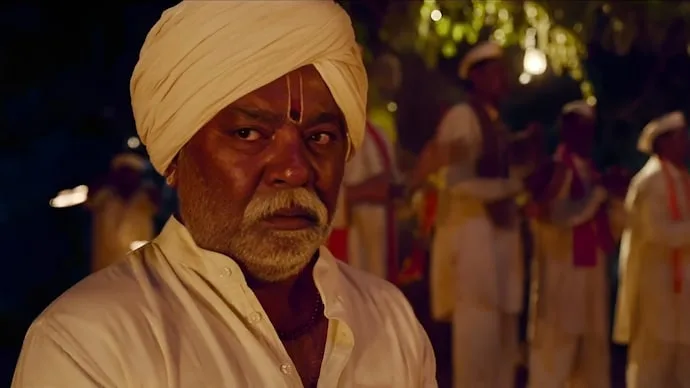

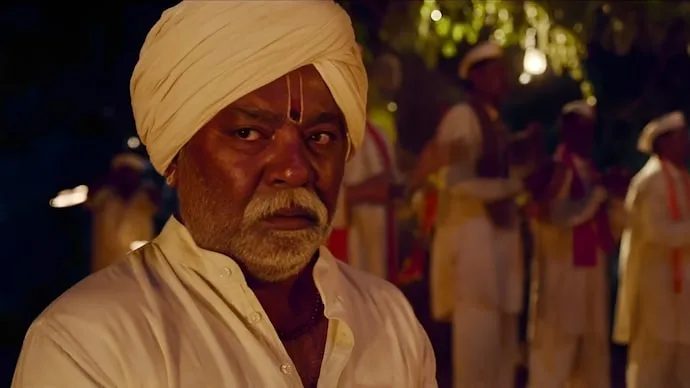
The Gondhal movie review reveals a Marathi drama that uses a traditional Maharashtrian Jagran Gondhal ceremony to explore desire, faith, patriarchy and the abuse of power. Directed by Santosh Davakhar, the film unfolds during a wedding where family secrets and village hierarchies gradually come to the surface.
Released on October 9, 2026, Gondhal begins with an approximately 25-minute continuous shot following Bhivaba (Kishor Kadam), an elderly folk performer, and his young grandson Vishnu (Dhruv Thoke) as they walk towards a wedding by lantern light.
Through the boy’s questions about the ritual, their sacred lamp and his absent mother, the opening introduces the traditions and beliefs that shape the story. The ceremony is believed to invite Lord Khanderaya to remove obstacles from the newlyweds’ lives. As the narrative progresses, however, the film raises questions about the people creating those obstacles.

Performances Bring the Village Drama to Life
The wedding brings together Suman (Ishita Deshmukh), her groom Anandrao (Yogesh Sohoni), the powerful village chief’s son Sarjerao (Nishad Bhoir) and the intimidating Patil (Suresh Vishwakarma).
Kishor Kadam anchors the drama with a restrained performance as Bhivaba, giving the story an emotional centre. Ishita Deshmukh is equally effective as Suman, a woman struggling to make her own choices in a society where others exercise control over her life.
Yogesh Sohoni brings an appealing innocence to Anandrao, while Nishad Bhoir portrays Sarjerao’s entitlement and arrogance. Suresh Vishwakarma adds menace as the village chief, whose authority exposes the darker side of the local power structure.
Music and Folk Traditions Strengthen the Film
Ilaiyaraaja’s music works particularly well during the Gondhal ceremony. The live singing, energetic percussion and crowd reactions create some of the film’s most absorbing sequences.
The ritual is more than a cultural backdrop. It brings the community together while exposing the tensions, desires and fears hidden beneath the celebrations. The film deserves credit for placing a Maharashtrian folk tradition at the centre of its narrative.
Where Gondhal Falls Short
Despite its strong atmosphere and performances, Gondhal struggles with its screenplay. Some developments feel convenient rather than organically driven by the characters, reducing the emotional impact of important moments.
The pacing is another weakness. While the extended ritual sequences establish the setting and build tension, their repetition occasionally slows the story. A tighter edit could have maintained the cultural richness without weakening the central conflict.
The final stretch builds suspense, but not every twist lands effectively. The film raises important questions about faith, masculinity, social status and women’s autonomy, although some of these themes remain underdeveloped.
Gondhal Movie Review: Final Verdict
Gondhal is an atmospheric rural drama that stands out for its folk setting, strong performances and exploration of power hidden behind tradition. Its uneven writing and slow pacing prevent it from fully realising its ambition, but the film retains a distinct identity.
It will appeal most to viewers willing to engage with a deliberate, character-driven story rooted in Maharashtrian culture.
At its heart, Gondhal asks an unsettling question: if a ritual is meant to remove obstacles, what happens when the people themselves become the obstacle?





Conversation
Be kind and stay on topic. Comments are moderated; abuse, spam and personal attacks are removed. Report a problem