
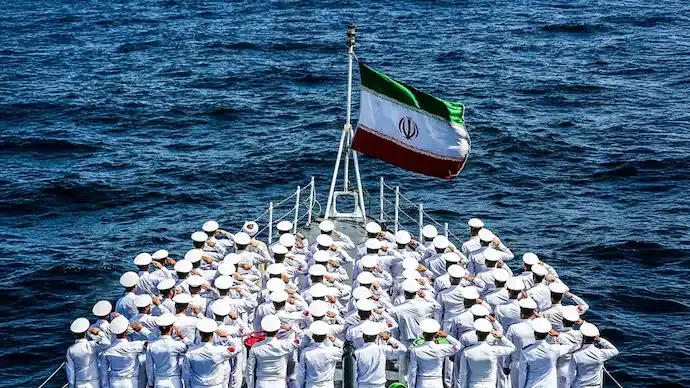
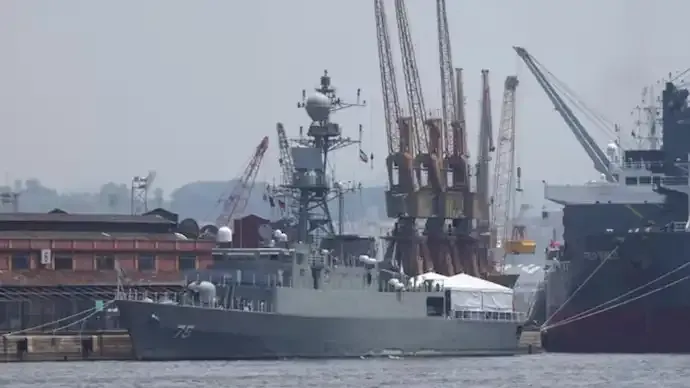
The sinking of the Iranian warship IRIS Dena in the Indian Ocean has triggered a wide debate about India’s authority and responsibility in the region. The warship was torpedoed by a US submarine near Sri Lanka while returning from naval exercises in India, bringing the ongoing conflict involving Iran closer to India’s strategic neighbourhood.
The incident has raised an important question: Does the Indian Ocean belong to India simply because it carries the country’s name?
While the Indian Ocean is the only ocean named after a country, international maritime law makes it clear that it is not owned or controlled by any single nation.
Where the IRIS Dena Incident Happened
The Iranian frigate IRIS Dena had recently taken part in international naval activities in Visakhapatnam before beginning its return journey. On March 4, the warship was attacked about 40 nautical miles south of Galle in Sri Lanka, an area considered international waters for navigation purposes.
Because the strike occurred outside India’s maritime jurisdiction, experts say India had no legal responsibility for the incident.
However, the location of the attack in the broader Indian Ocean region has triggered discussion about India’s strategic role in the waters surrounding the subcontinent.
Why the Indian Ocean Is Named After India
The Indian Ocean gets its name largely because of India’s geographic position. The Indian peninsula extends deep into the ocean, placing the country at the centre of major maritime routes connecting Asia, Africa and Australia.
Historically, trade routes passing through the region were closely linked with the Indian subcontinent, which contributed to the naming of the ocean.
Despite this historical association, the Indian Ocean remains a shared global maritime space governed by international law.
India’s Maritime Jurisdiction Explained
Under the United Nations Convention on the Law of the Sea (UNCLOS), countries have limited rights over waters surrounding their coastline. India’s authority extends through several maritime zones.
India’s territorial sea stretches up to 12 nautical miles (about 22 kilometres) from its coastline. Within this zone, India exercises full sovereignty similar to its land territory.
Beyond this lies the contiguous zone, which extends up to 24 nautical miles from the coast. In this area, India can enforce laws related to customs, immigration and sanitation.
The most significant maritime zone is the Exclusive Economic Zone (EEZ), which extends up to 200 nautical miles (about 370 kilometres) from India’s coast.
Within its EEZ, India has exclusive rights to explore and use natural resources such as oil, gas, minerals and fish.
Overall, India’s EEZ covers about 2.3 million square kilometres, making it one of the largest maritime economic zones in the world.

Where International Waters Begin
Beyond the 200-nautical-mile EEZ lies the high seas, which are considered international waters. No country has sovereignty over these areas, and all nations are allowed to navigate, conduct research, and operate ships under international regulations.
Even within a country’s EEZ, other nations retain the right to navigate and operate military vessels as long as they do not interfere with the coastal state’s resource activities.
Because the IRIS Dena incident occurred outside India’s EEZ, the area falls under international maritime norms.
Strategic Importance of the Indian Ocean
Although India does not control the entire Indian Ocean, the region remains extremely important for its security and economy.
More than 90 percent of India’s trade by volume travels through sea routes in the Indian Ocean. The region also contains critical maritime chokepoints that connect global shipping lanes.
India maintains a strong naval presence in the region through aircraft carriers, submarines and bases located in the Andaman and Nicobar Islands.
These deployments are designed to monitor maritime activity and ensure security across important shipping routes.
Debate Over India’s Strategic Role
The sinking of the IRIS Dena has led some analysts to question how the incident affects India’s image as a stabilising force in the region.
India has been promoting initiatives such as SAGAR (Security and Growth for All in the Region) and MAHASAGAR, which aim to strengthen cooperation and security in the Indian Ocean Region.
These policies position India as a leading partner in maintaining stability across the broader Indo-Pacific.
While India had no legal responsibility in the IRIS Dena incident, the event highlights how conflicts in other regions can quickly impact the strategic waters surrounding the Indian subcontinent.
The debate also reinforces the reality that although the Indian Ocean carries India’s name, its waters remain part of a shared global maritime system governed by international law.




Conversation
Be kind and stay on topic. Comments are moderated; abuse, spam and personal attacks are removed. Report a problem