Shopping cart
Your cart empty!


Your cart empty!
Terms of use dolor sit amet consectetur, adipisicing elit. Recusandae provident ullam aperiam quo ad non corrupti sit vel quam repellat ipsa quod sed, repellendus adipisci, ducimus ea modi odio assumenda.
Lorem ipsum dolor sit amet consectetur adipisicing elit. Sequi, cum esse possimus officiis amet ea voluptatibus libero! Dolorum assumenda esse, deserunt ipsum ad iusto! Praesentium error nobis tenetur at, quis nostrum facere excepturi architecto totam.
Lorem ipsum dolor sit amet consectetur adipisicing elit. Inventore, soluta alias eaque modi ipsum sint iusto fugiat vero velit rerum.
Sequi, cum esse possimus officiis amet ea voluptatibus libero! Dolorum assumenda esse, deserunt ipsum ad iusto! Praesentium error nobis tenetur at, quis nostrum facere excepturi architecto totam.
Lorem ipsum dolor sit amet consectetur adipisicing elit. Inventore, soluta alias eaque modi ipsum sint iusto fugiat vero velit rerum.
Dolor sit amet consectetur adipisicing elit. Sequi, cum esse possimus officiis amet ea voluptatibus libero! Dolorum assumenda esse, deserunt ipsum ad iusto! Praesentium error nobis tenetur at, quis nostrum facere excepturi architecto totam.
Lorem ipsum dolor sit amet consectetur adipisicing elit. Inventore, soluta alias eaque modi ipsum sint iusto fugiat vero velit rerum.
Sit amet consectetur adipisicing elit. Sequi, cum esse possimus officiis amet ea voluptatibus libero! Dolorum assumenda esse, deserunt ipsum ad iusto! Praesentium error nobis tenetur at, quis nostrum facere excepturi architecto totam.
Lorem ipsum dolor sit amet consectetur adipisicing elit. Inventore, soluta alias eaque modi ipsum sint iusto fugiat vero velit rerum.
Do you agree to our terms? Sign up
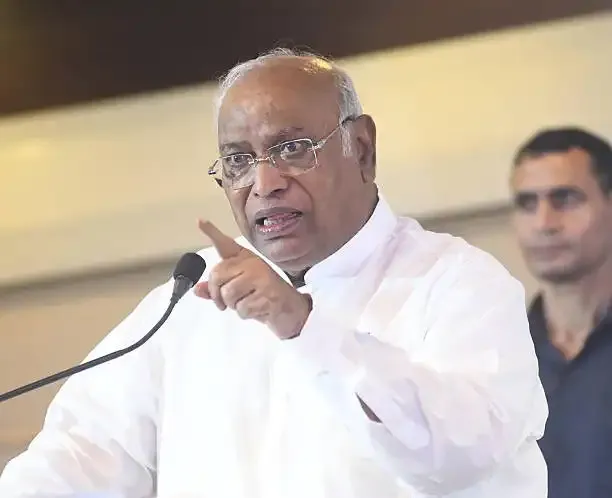
A renewed political confrontation has erupted after Congress President Mallikarjun Kharge openly called for a nationwide ban on the Rashtriya Swayamsevak Sangh (RSS), reigniting one of India’s most enduring ideological rivalries. The statement, made during a recent address, has triggered sharp reactions across the political spectrum, with the BJP accusing the Congress of attempting to vilify the cultural and nationalist organization for electoral gains.
Kharge clarified that his statement was a personal opinion, but the political implications have been far-reaching. He argued that the RSS has historically influenced policies that undermine communal harmony and democracy, calling it a source of growing polarization in Indian society. “I personally believe the RSS should be banned in this country,” Kharge said, asserting that its ideology was incompatible with the principles of secularism enshrined in the Constitution.
The remarks come amid renewed debates over the historical role of Sardar Vallabhbhai Patel, whose legacy both the Congress and BJP have long sought to claim. Congress leaders maintain that it was Patel, India’s first Home Minister, who banned the RSS in 1948 following Mahatma Gandhi’s assassination, citing threats to public order. BJP leaders, however, have countered this narrative by accusing the Congress of selective memory, pointing out that the ban was later lifted after investigations found no direct involvement of the RSS in the crime.
Prime Minister Narendra Modi, while addressing party workers, criticized the Congress for what he termed “historical distortion” and “political opportunism.” The BJP maintains that the RSS has played a vital role in nation-building, character development, and cultural preservation. The party further accuses the Congress of targeting the organization to deflect attention from internal leadership disputes and electoral setbacks.
Political analysts suggest that Kharge’s statement is a calculated move to consolidate Congress’s secular base and challenge the BJP’s ideological dominance ahead of the upcoming elections. However, this approach also risks deepening polarization at a time when both parties are striving to appeal to centrist voters.
The controversy has reignited the larger debate on the relationship between politics, ideology, and national identity. While the Congress continues to portray the RSS as an ideological threat to democracy, the BJP frames the organization as the custodian of India’s cultural ethos.
As the election season intensifies, Kharge’s remarks are expected to amplify existing political tensions, setting the stage for another round of fierce ideological and electoral confrontation between the country’s two largest national parties.
54
Published: Oct 31, 2025

All India Story is your trusted source for comprehensive and up-to-the-minute news coverage across India. Bringing you the latest on politics, business, technology, entertainment, sports, and more, we are dedicated to keeping you informed with accurate, engaging, and insightful stories from every corner of the nation.