



A leaked Pentagon assessment has raised serious concerns about the United States’ ability to prevail in a potential military conflict with China, particularly over Taiwan. The classified analysis, known as the “Overmatch Brief,” concludes that America’s long-standing military and industrial advantages are eroding rapidly, leaving Washington vulnerable to a decisive defeat if reforms are not urgently implemented.
Prepared by the Pentagon’s Office of Net Assessment and first reported by The New York Times, the document draws on internal war games and simulations. It warns that US forces could be overwhelmed not through prolonged attrition, but through speed, scale and saturation tactics employed by China’s rapidly modernising military.
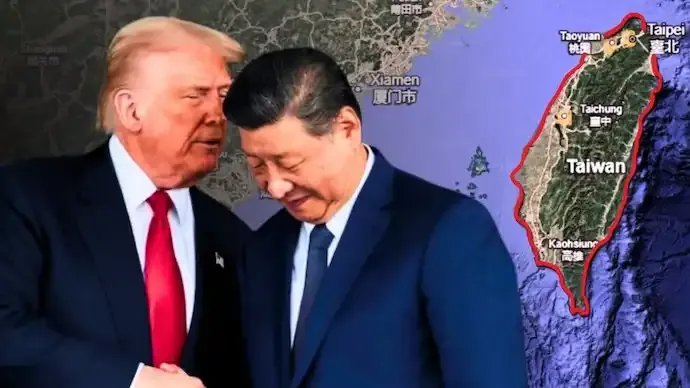
Taiwan at the centre of risk
The report highlights Taiwan as the most likely flashpoint. Beijing considers the self-ruled island a breakaway province and has repeatedly stated its intention to achieve reunification. According to the assessment, Chinese forces are rehearsing scenarios involving missile strikes, naval blockades and cyber attacks designed to isolate Taiwan before outside powers can respond.

China’s growing capabilities to target US satellites, forward bases and aircraft carriers are identified as a major vulnerability. The report notes that the US relies heavily on small numbers of expensive, high-tech platforms, while China fields large volumes of cheaper, mass-producible systems, including drones, missiles and hypersonic weapons.
Industrial capacity gap
One of the starkest warnings relates to defence manufacturing. The US industrial base is described as brittle and slow, with ageing shipyards, limited production lines and dependence on a narrow set of contractors. In a high-intensity conflict, critical munitions such as long-range anti-ship missiles could be exhausted within days.
By contrast, China’s defence industry is assessed to be operating at near wartime capacity, capable of producing missiles, drones and other systems at a scale far exceeding that of the United States.
Cyber and modern warfare risks
The report also flags cyber warfare as a major threat. Malware and network disruptions could cripple US logistics and bases before conventional combat even begins. Lessons from recent conflicts, including the war in Ukraine, underline how cheap, scalable technologies like drones can neutralise traditional military advantages when deployed rapidly and in large numbers.
Strategic implications beyond Taiwan
The findings carry implications across the Indo-Pacific. The report notes that while the US has leaned on India as a strategic counterweight to China, Pakistan’s deepening alignment with Beijing complicates regional calculations. With Islamabad economically and militarily dependent on China, US influence in South Asia faces growing constraints.
For India, the assessment reinforces the importance of strategic autonomy, while for Washington it raises broader questions about the credibility of US security guarantees worldwide.
Call for urgent reform
The Overmatch Brief calls for a fundamental shift in US defence planning, including:
-
Greater reliance on mass-producible systems such as drones
-
Faster integration of artificial intelligence
-
Multi-year defence procurement on a wartime footing
-
Deeper industrial coordination with allies
-
Defence spending above 3% of GDP
The report’s conclusion is stark: technological sophistication alone no longer guarantees military superiority. Without urgent reform, the United States risks falling behind a rival preparing for conflict at scale and speed.








Conversation
Be kind and stay on topic. Comments are moderated; abuse, spam and personal attacks are removed. Report a problem