

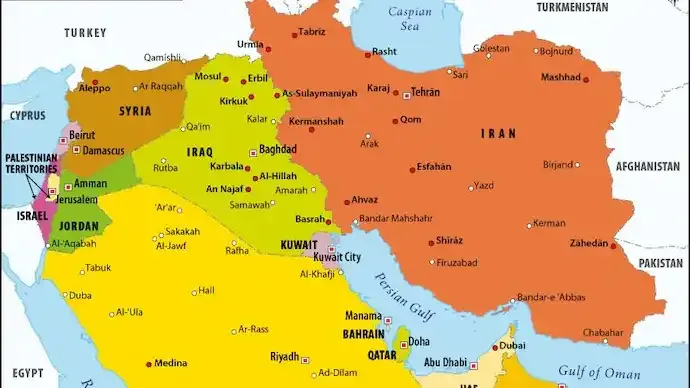

The ongoing 2026 US-Israel-Iran war has once again pushed the Middle East into the center of global attention. As tensions escalate and military actions spread across the region, one common misunderstanding continues to appear in discussions and reports: many people assume that the Middle East and the Gulf countries are the same. In reality, they are two different geographical and political concepts.
Understanding this distinction is increasingly important because it affects global security, diplomacy, and energy markets. The countries involved in the conflict, as well as those trying to maintain stability, play very different roles depending on whether they belong to the broader Middle East or the smaller Gulf bloc.
What Is the Middle East?
The Middle East is a vast region that includes more than 18 countries spread across Western Asia and parts of North Africa. It stretches geographically from Egypt in the west to Iran in the east, and from Turkey in the north to Yemen in the south.

The region includes Arab countries such as Saudi Arabia, Jordan, Iraq, and Syria, but it also contains influential non-Arab states like Israel, Iran, and Turkey. In some definitions, Cyprus is included as well, and occasionally Sudan or Afghanistan may be considered part of the broader Middle Eastern sphere.
Historically, the Middle East has been shaped by centuries of political, religious, and cultural developments. From the legacy of the Ottoman Empire to the rise of Arab nationalism and modern geopolitical rivalries, the region remains one of the most complex in the world.
Religion plays a major role in shaping political dynamics, with Islam being the dominant faith. Differences between Sunni and Shia communities often influence regional alliances and conflicts. The region is also home to some of the world’s largest oil reserves, making it central to global energy supply.
Today, more than 400 million people live across the Middle East. However, the region shows major economic differences. Countries like Israel are known for advanced technology sectors, while others, such as Yemen, face serious economic and humanitarian challenges.
Who Are the Gulf Countries?
The term “Gulf countries” usually refers to the six members of the Gulf Cooperation Council (GCC). This regional alliance was created in 1981 to strengthen economic and security cooperation among neighboring states along the Persian Gulf.
The GCC includes:
Saudi Arabia
United Arab Emirates
Qatar
Kuwait
Bahrain
Oman
All six countries are monarchies and are located along the Persian Gulf coastline. Together, they hold a significant share of the world’s oil resources, controlling around 40 percent of global oil reserves and producing roughly 30 percent of the world’s oil supply.
These countries are also strategically important due to the presence of major international military facilities, including key US bases. Because of their geographic location and economic importance, any regional conflict directly affects them.
Recent missile strikes targeting infrastructure and airports in Gulf states have demonstrated how closely the current conflict is affecting these nations.
Why the Difference Matters in the Current Conflict
The difference between the Middle East and the Gulf countries becomes clearer when examining their roles in the ongoing conflict.
The Middle East as a whole includes countries directly involved in military actions or geopolitical rivalry. Israel has conducted air and missile strikes, while Iran has responded with attacks and strategic warnings. Other countries, such as Jordan, have taken defensive actions to intercept projectiles crossing their airspace.
Meanwhile, the Gulf Cooperation Council states have largely focused on regional coordination and security. They have strengthened air defense systems, increased military readiness, and issued diplomatic warnings while trying to avoid being drawn directly into large-scale warfare.
The Broader Use of the Word “Gulf”
Sometimes the word “Gulf” is used more loosely to include nearby countries such as Iraq, Yemen, or even Iran. However, this broader usage can create confusion.
The naming dispute between “Persian Gulf” and “Arabian Gulf” also reflects the political sensitivity surrounding the region. Despite these variations, the Gulf Cooperation Council remains the most widely recognized definition of Gulf countries.
In the context of the 2026 conflict, understanding the difference between the wider Middle East and the Gulf bloc is essential. The distinction helps explain strategic decisions, military alignments, and diplomatic responses shaping the current crisis.






Conversation
Be kind and stay on topic. Comments are moderated; abuse, spam and personal attacks are removed. Report a problem