

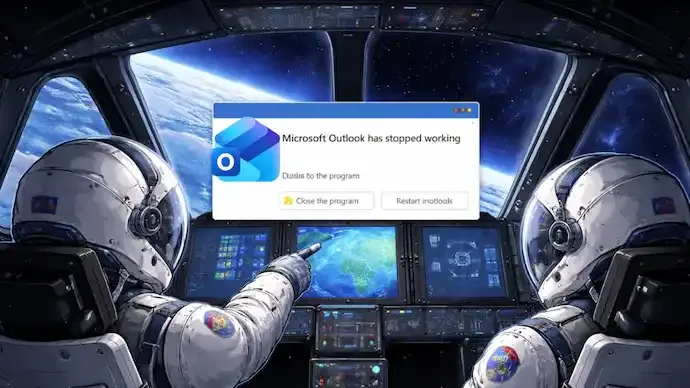

The historic Artemis II mission, marking humanity’s return to a crewed lunar journey after nearly 50 years, encountered an unexpected but surprisingly relatable issue shortly after launch. Despite the mission’s advanced technology and billion-dollar investment, astronauts faced a basic problem—they were unable to send emails using Microsoft Outlook.
The mission, which began on April 1, 2026, is a 10-day journey around the Moon and represents a major milestone in space exploration. However, the email glitch highlighted that even the most advanced missions are not immune to everyday technical issues.
NASA Crew Encounters Communication Issue
Just hours after a successful launch, the Artemis II crew attempted to use Microsoft Outlook for communication but found the system unresponsive. While the spacecraft systems were functioning normally, the issue was limited to the email platform, creating a temporary disruption in routine communication.

The situation required immediate attention, as communication plays a crucial role in mission coordination and updates between astronauts and ground control.
Tech Support From Earth Steps In
To resolve the issue, the crew had to rely on support teams back on Earth. Engineers and technical experts worked to diagnose the problem remotely and guide the astronauts through troubleshooting steps.
This incident highlights the importance of ground support systems in space missions, where even minor technical glitches can require coordinated problem-solving across vast distances.
Microsoft Outlook Issue Shows Human Side of Space Missions
The glitch involving Microsoft Outlook, a widely used email platform on Earth, added a human element to the otherwise complex and high-tech mission. It served as a reminder that astronauts, despite operating in space, still depend on familiar tools and technologies.
Such incidents also demonstrate how modern space missions integrate everyday software systems alongside advanced aerospace technology.
Artemis II: A Major Step in Lunar Exploration
The Artemis II mission is a significant step in NASA’s long-term plans for lunar exploration and future missions to Mars. Carrying four astronauts, the mission aims to test systems and capabilities required for sustained human presence beyond Earth.
Despite the minor setback, the mission continues as planned, with all critical systems operating smoothly.
Importance of Robust Systems in Space Missions
The Outlook glitch underscores the need for reliable and resilient communication systems in space exploration. As missions become more complex, ensuring seamless integration between software and hardware becomes increasingly important.
NASA and its partners are expected to analyze the issue to prevent similar occurrences in future missions, ensuring smoother operations in upcoming space endeavors.







Conversation
Be kind and stay on topic. Comments are moderated; abuse, spam and personal attacks are removed. Report a problem