

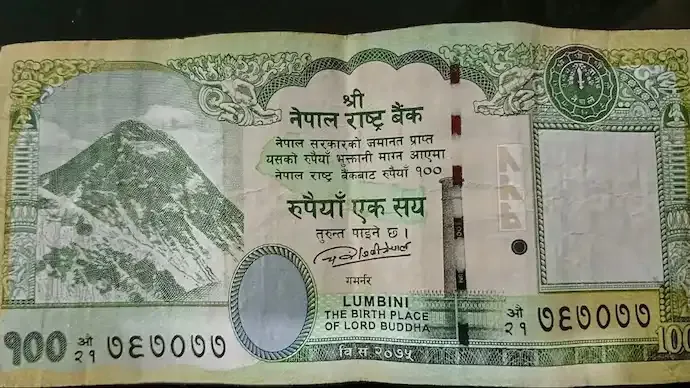

Nepal’s central bank has issued a new Rs 100 banknote featuring a controversial revised map that includes Kalapani, Lipulekh and Limpiyadhura — territories India maintains are part of its sovereign boundary. The updated note, released by the Nepal Rastra Bank (NRB) on Thursday, has revived long-standing diplomatic sensitivities between the two neighbours.
The banknote carries the signature of former NRB Governor Maha Prasad Adhikari and is dated 2081 BS (2024). The NRB clarified that the updated map had already been present in the earlier version of the Rs 100 note and has now been revised in line with the Nepal government's official political map adopted in 2020.
The 2020 Map Dispute
In May 2020, the then K P Sharma Oli government unveiled a new political map claiming Lipulekh, Kalapani and Limpiyadhura as Nepalese territory. The map was swiftly endorsed by Nepal’s Parliament.

India strongly rejected the move, calling it a “unilateral act” and an “artificial enlargement” of territorial claims that holds no legal basis. New Delhi has consistently maintained that all three regions fall within Indian territory, referencing long-standing administrative control and historical agreements.
Features of the New Rs 100 Banknote
The revised banknote includes several visual elements alongside the disputed map:
-
Mt Everest printed on the left side
-
Watermark of Rhododendron, Nepal’s national flower
-
A faint green map of Nepal in the background
-
The Ashoka Pillar with the inscription “Lumbini, the birthplace of Lord Buddha”
-
A horned rhino on the reverse side
-
Security thread and an embossed tactile dot for visually impaired users
The NRB confirmed that among Nepal's various currency denominations, only the Rs 100 note carries the national map.
India-Nepal Border Context
Nepal shares over 1,850 km of open border with India, touching five Indian states — Sikkim, West Bengal, Bihar, Uttar Pradesh and Uttarakhand. The Kalapani region, situated at the India–Nepal–China tri-junction, has been a point of dispute for decades.
The issuance of the new banknote once again brings the boundary disagreement into public focus, even as both nations continue formal diplomatic channels to resolve outstanding issues.






Conversation
Be kind and stay on topic. Comments are moderated; abuse, spam and personal attacks are removed. Report a problem