


The Paraguay bank collapse has triggered one of the country's most serious financial and political crises, leaving nearly three million customers struggling to access their savings. The failure of Ueno Bank has also put hundreds of millions of dollars in public funds at risk and resulted in the impeachment of President Santiago Peña.
The digital lender, controlled by the Grupo Vazquez business conglomerate, was placed under the control of Paraguay's central bank on November 3 after regulators identified a sharp deterioration in its financial position.
The intervention disrupted banking operations and triggered protests, criminal investigations and political action against Peña, who previously worked as an economist with the International Monetary Fund (IMF).

How Ueno Bank Became a Major Financial Institution
Ueno Bank expanded rapidly after Grupo Vazquez acquired Financiera El Comercio in 2021. The institution developed into Financiera Ueno before launching its digital banking brand in February 2022.
Its expansion continued through the acquisition and merger of Vision Banco in 2024, helping it build a customer base of approximately three million people.
The bank reportedly administered around $850 million in public funds, including money belonging to state institutions and pension-related bodies.
What Led to the Bank's Collapse?
The central bank's intervention followed concerns about Ueno's capital adequacy, asset quality and lending practices.
Investigators reportedly identified poorly documented transactions and loans to companies linked to Grupo Vazquez. Central bank inspectors had raised concerns about risky insider lending, including loans allegedly exceeding legal limits and lacking adequate collateral.
After regulators adjusted the bank's accounts, its capital reportedly fell to less than half the legally required minimum.
The government subsequently approved a state guarantee mechanism to compensate depositors. Initial payments to customers with smaller accounts reportedly began on November 5, while pensioners and public institutions also faced uncertainty over their funds.
Peña Impeached After Political Fallout
The financial crisis became a political controversy because of Peña's previous association with Grupo Vazquez. He had reportedly held a stake in the conglomerate before selling it in March 2025. Peña has denied investing directly in Ueno Bank or engaging in wrongdoing.
Another controversial appointment involved Carlos Carvallo, who previously headed Financiera Ueno before becoming president of Paraguay's central bank under Peña.
Following the bank's collapse, opposition lawmakers initiated impeachment proceedings. Peña announced his resignation on November 5, saying he wanted to protect the country's stability and democratic institutions.
However, lawmakers proceeded with impeachment rather than accepting his resignation. On November 6, the Senate unanimously impeached him, removing him from office. Vice-President Pedro Alliana was sworn in as his successor and is expected to serve until August 2028.
Criminal Investigations and Public Protests Continue
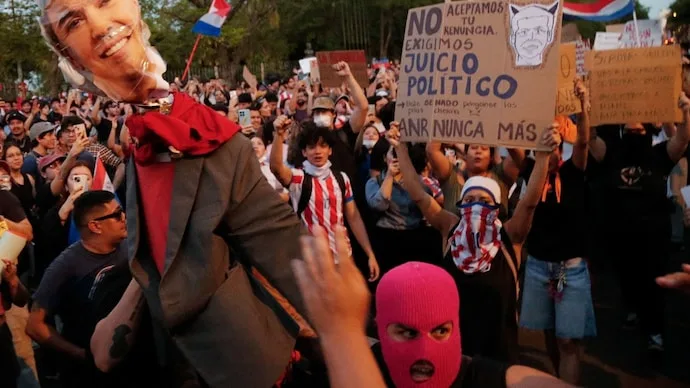
The collapse sparked demonstrations in the capital, Asuncion, where depositors demanded access to their savings. The crisis also raised concerns among retirees, workers and employees of Ueno and associated businesses.
Prosecutors have pursued criminal investigations involving alleged breach of trust, fraud and other possible offences. Twenty-seven bank officials and associates were reportedly charged, while several executives faced detention orders.
Peña's removal has also affected his eligibility for a lifetime Senate seat and the associated parliamentary protections. Authorities are continuing investigations into possible misconduct, while Peña has denied wrongdoing.
The crisis has left Paraguay facing two major challenges: restoring confidence in its banking system and addressing the political and legal consequences of the collapse.
Read more: All India Story







Conversation
Be kind and stay on topic. Comments are moderated; abuse, spam and personal attacks are removed. Report a problem