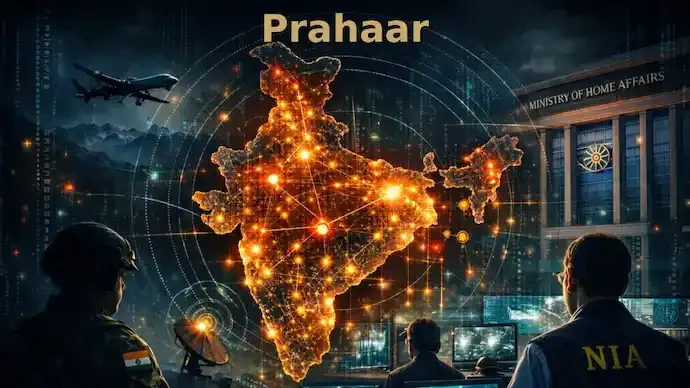
India has unveiled Prahaar, its first comprehensive National Counter-Terrorism Policy and Strategy, marking a major shift in how the country plans to combat terrorism in the coming years. Introduced by the Ministry of Home Affairs on February 23, 2026, Prahaar aims to bring together intelligence, law enforcement, technology and international cooperation under a unified national framework.
The strategy is designed to strengthen India’s ability to detect, prevent and respond to terror threats by creating a coordinated system involving both central and state agencies.
Prahaar reflects the evolution of India’s counter-terrorism doctrine, shaped by decades of security challenges across different regions of the country.
Evolution of India’s Counter-Terrorism Approach
India’s counter-terrorism policies have developed over time in response to various security threats and major attacks.
From insurgency in Punjab during the 1980s, militancy in Jammu and Kashmir, to major urban attacks such as the 2008 Mumbai terror attacks, each episode has influenced the country’s security policies.
These incidents highlighted the need for a stronger and more coordinated national strategy to prevent and respond to terrorism.
Prahaar is intended to address those gaps by providing a single strategic framework for counter-terrorism efforts across the country.
Intelligence-Led Disruption at the Core
One of the central pillars of Prahaar is intelligence-driven counter-terrorism operations.
The policy emphasises early detection of threats through improved intelligence sharing between agencies. Security institutions are expected to collaborate more closely to identify suspicious activities and neutralise threats before they escalate into attacks.
By focusing on prevention rather than reaction, the strategy aims to reduce the likelihood of large-scale terrorist incidents.
Strengthening Legal and Investigative Frameworks
Prahaar also stresses the importance of strong legal mechanisms to prosecute terror-related crimes effectively.
The policy proposes improved coordination between investigative agencies, prosecutors and courts to ensure faster and more effective handling of terror cases.
Strengthening the legal framework is considered essential for deterring extremist networks and ensuring accountability for acts of terrorism.
Uniform Counter-Terror Capabilities Across States
Another important objective of Prahaar is to standardise counter-terrorism capabilities across Indian states.
Security preparedness can vary significantly between regions. The new strategy aims to ensure that states have consistent resources, training and operational protocols to respond to terror threats.
This includes improved training for police forces, better coordination with national security agencies and modernised response mechanisms.
Technology and Surveillance in Modern Security
The policy places strong emphasis on technology-driven surveillance and data analysis.
Advanced tools such as artificial intelligence, digital monitoring systems and data integration platforms are expected to support intelligence gathering and threat detection.
Security agencies are likely to rely increasingly on technology to track suspicious networks, analyse communication patterns and monitor potential threats.
Expanding Global Cooperation
Prahaar also recognises the importance of international collaboration in counter-terrorism.
Terror networks often operate across borders, making global intelligence sharing essential. The strategy encourages stronger partnerships with international agencies and governments to track terror financing, extremist networks and cross-border threats.
Such cooperation is expected to strengthen India’s ability to respond to global security challenges.
A Comprehensive National Security Framework
With Prahaar, India is attempting to create a holistic and proactive counter-terrorism framework that combines intelligence, law enforcement, technology and diplomacy.
The policy represents a shift from isolated responses to a coordinated national strategy aimed at preventing attacks before they occur.
As security threats continue to evolve, Prahaar is expected to play a key role in shaping India’s future counter-terrorism efforts.
Prev Article
Madhya Pradesh Horror: Man Arrested After Teen Killed With Hammer in Damoh
Next Article
US Says ‘America First’ in India Trade Deal, Won’t Repeat China Mistakes