


New Delhi, November 10 — Hours after a devastating explosion outside Delhi’s Red Fort Metro Station killed 10 people and injured 24 others, authorities have placed the entire National Capital Region (NCR) under high alert. Security has been dramatically intensified at Indira Gandhi International (IGI) Airport, Delhi Metro, and railway stations, following fears that the blast may be linked to a wider terror plot.
According to officials, the explosion occurred near Gate No. 1 of the Red Fort Metro Station around 6:52 pm, when a car — believed to be a Hyundai i20 with a Haryana registration — burst into flames after halting at a traffic light.
The area, located just minutes from one of India’s most iconic monuments, turned into a scene of chaos as fire engulfed multiple vehicles. Forensic experts later confirmed that traces of chemical accelerants were found at the site, though the exact cause of the blast remains under investigation.

Delhi Airport and Metro on Alert
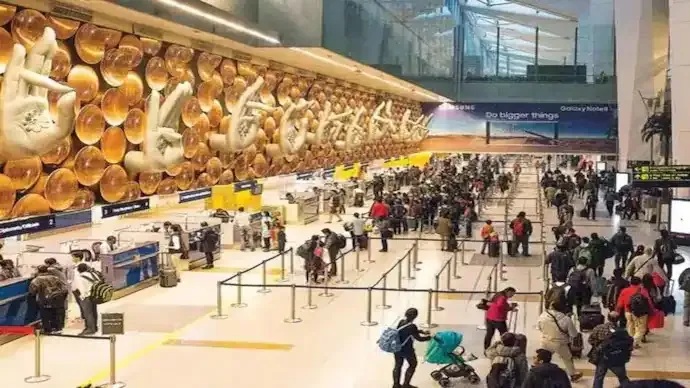
Soon after the explosion, the Central Industrial Security Force (CISF) raised the alert level across all terminals at IGI Airport, deploying additional personnel for round-the-clock surveillance. CISF Director General Nina Singh confirmed that “every access point, terminal, and baggage zone is under enhanced monitoring,” with dog squads and quick reaction teams (QRTs) on standby.
“Passenger screening has been intensified and patrol frequency doubled. There is no disruption to flight schedules, but movement will be slower due to detailed checks,” said a senior airport official.
The Delhi Metro Rail Corporation (DMRC) has also stepped up security at key stations, including Kashmere Gate, Rajiv Chowk, Jama Masjid, and Lal Quila, deploying more CISF units and advanced explosive detection devices.
Meanwhile, all railway stations in Delhi and NCR — including New Delhi, Old Delhi, Anand Vihar, and Nizamuddin — are operating under a heightened state of vigilance. Teams from the Government Railway Police (GRP) and Railway Protection Force (RPF) have been conducting random baggage checks, while sniffer dogs and metal detectors sweep platforms and waiting areas.
Officials confirmed that train services have not been suspended, but passengers have been urged to arrive early to accommodate enhanced screening procedures.
National Security Grid Activated
The Ministry of Home Affairs (MHA) has directed all CISF-guarded installations — including airports, metros, power plants, and government complexes — to remain on high alert for the next 72 hours.
Union Home Minister Amit Shah said the government is “monitoring the situation continuously” and that “every angle — from terror links to technical failure — is being thoroughly investigated.”
Sources within the National Investigation Agency (NIA) revealed that the blast coincides with the recent busting of an interstate terror module, where authorities seized 2,900 kg of suspected ammonium nitrate — a compound frequently used in improvised explosives. Investigators are examining whether remnants found near the Red Fort blast site share chemical similarities.
Security Tightened Nationwide
The explosion’s impact has been felt across the country. Uttar Pradesh, Haryana, Kolkata, and Mumbai have also gone on high alert.
In Uttar Pradesh, Chief Minister Yogi Adityanath ordered all district police chiefs to conduct checks in crowded areas and monitor border transit routes. ADG (Law & Order) Amitabh Yash confirmed that smart city command centres are assisting police with real-time surveillance.
Haryana has reinforced security around Delhi’s borders and deployed checkpoints on highways leading to the capital. In Kolkata, police intensified searches at railway stations and malls, while Mumbai Police increased patrols at Gateway of India and CST station.
Capital on Edge
For Delhiites, the explosion has rekindled memories of past attacks — from the 2000 Red Fort assault to the 2005 Sarojini Nagar bombings. Experts warn that despite improved intelligence infrastructure, the capital remains vulnerable due to its dense population and symbolic landmarks.
As investigators continue to examine whether the Red Fort blast was an accident or a planned act of terror, Delhi stands under the watchful eye of its security forces. Every terminal, platform, and metro gate now bears the weight of vigilance — a reflection of a city that refuses to be caught off guard again.









Conversation
Be kind and stay on topic. Comments are moderated; abuse, spam and personal attacks are removed. Report a problem