Shopping cart
Your cart empty!


Your cart empty!
Terms of use dolor sit amet consectetur, adipisicing elit. Recusandae provident ullam aperiam quo ad non corrupti sit vel quam repellat ipsa quod sed, repellendus adipisci, ducimus ea modi odio assumenda.
Lorem ipsum dolor sit amet consectetur adipisicing elit. Sequi, cum esse possimus officiis amet ea voluptatibus libero! Dolorum assumenda esse, deserunt ipsum ad iusto! Praesentium error nobis tenetur at, quis nostrum facere excepturi architecto totam.
Lorem ipsum dolor sit amet consectetur adipisicing elit. Inventore, soluta alias eaque modi ipsum sint iusto fugiat vero velit rerum.
Sequi, cum esse possimus officiis amet ea voluptatibus libero! Dolorum assumenda esse, deserunt ipsum ad iusto! Praesentium error nobis tenetur at, quis nostrum facere excepturi architecto totam.
Lorem ipsum dolor sit amet consectetur adipisicing elit. Inventore, soluta alias eaque modi ipsum sint iusto fugiat vero velit rerum.
Dolor sit amet consectetur adipisicing elit. Sequi, cum esse possimus officiis amet ea voluptatibus libero! Dolorum assumenda esse, deserunt ipsum ad iusto! Praesentium error nobis tenetur at, quis nostrum facere excepturi architecto totam.
Lorem ipsum dolor sit amet consectetur adipisicing elit. Inventore, soluta alias eaque modi ipsum sint iusto fugiat vero velit rerum.
Sit amet consectetur adipisicing elit. Sequi, cum esse possimus officiis amet ea voluptatibus libero! Dolorum assumenda esse, deserunt ipsum ad iusto! Praesentium error nobis tenetur at, quis nostrum facere excepturi architecto totam.
Lorem ipsum dolor sit amet consectetur adipisicing elit. Inventore, soluta alias eaque modi ipsum sint iusto fugiat vero velit rerum.
Do you agree to our terms? Sign up
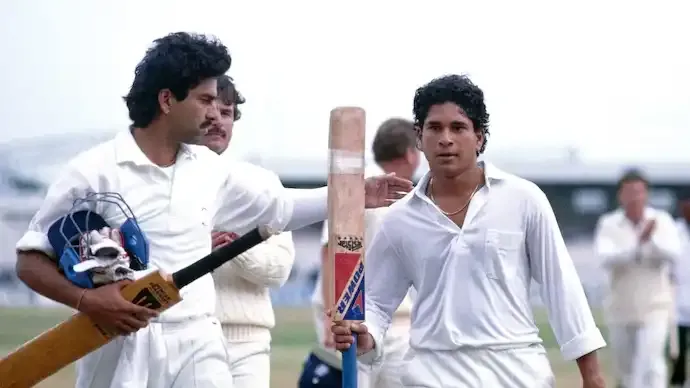
Sachin Tendulkar’s century at Perth during India’s 1991–92 tour of Australia remains one of the most remarkable Test innings played by a teenager in the history of cricket. On a surface notorious for extreme pace, uneven bounce and visible cracks, an 18-year-old Tendulkar produced a display of composure and technical excellence that announced his arrival on the world stage.
The innings came at the WACA Ground, a venue feared by visiting batters for its raw speed and unpredictable behaviour. Facing an Australian pace attack featuring Craig McDermott, Merv Hughes and Paul Reiffel, Tendulkar stood firm when most batters struggled simply to survive. India were already under pressure in the series, and the conditions in Perth offered little respite.
Former India cricketer Pravin Amre, who was the team’s 12th man and Tendulkar’s roommate on that tour, later recalled the innings as one of the finest he had ever witnessed. Speaking on a televised cricket programme, Amre highlighted how extraordinary the effort was given Tendulkar’s age and experience. According to him, the Perth hundred stood out even among Tendulkar’s many iconic centuries.
The pitch itself became part of cricketing folklore. Deep cracks ran across the surface, making batting a test of courage and judgement. Amre recalled that the cracks were so wide that Tendulkar placed his bat inside one and it stood upright—a vivid illustration of how treacherous the wicket was. On such a surface, where the ball could rear sharply or keep low without warning, Tendulkar’s calm presence at the crease was striking.
Batting with maturity well beyond his years, Sachin Tendulkar scored 114 runs off 161 deliveries, finding the boundary 16 times. Rather than forcing shots, he relied on a tight defensive technique, soft hands and precise shot selection. He trusted his judgement outside the off stump and capitalised whenever the bowlers erred in length, turning a hostile environment into a platform for a defining performance.
India’s batting lineup struggled throughout the tour, repeatedly exposed by Australia’s fast bowlers. Against that backdrop, Tendulkar’s century stood out as a rare example of resilience and adaptability. It was not merely the volume of runs that impressed observers, but the manner in which he absorbed pressure and adapted his game to the demands of the conditions.
Although India went on to lose the five-match series 4–0, Tendulkar finished as the team’s highest run-scorer, amassing 368 runs at an average of 46.00, including two centuries. The Perth knock, in particular, signalled that India had found a batter capable of thriving in the most demanding overseas conditions.
That innings also laid the foundation for Tendulkar’s long-term success in Australia. Across 20 Tests on Australian soil, he would eventually score 1,809 runs at an average of 53.20, with six centuries and seven half-centuries, including a career-best 241 not out.
Decades later, the Perth hundred continues to be remembered as a defining chapter in Tendulkar’s early career—an innings where an 18-year-old conquered one of cricket’s toughest stages and showed that he belonged among the game’s elite.
72
Published: Jan 03, 2026

All India Story is your trusted source for comprehensive and up-to-the-minute news coverage across India. Bringing you the latest on politics, business, technology, entertainment, sports, and more, we are dedicated to keeping you informed with accurate, engaging, and insightful stories from every corner of the nation.