

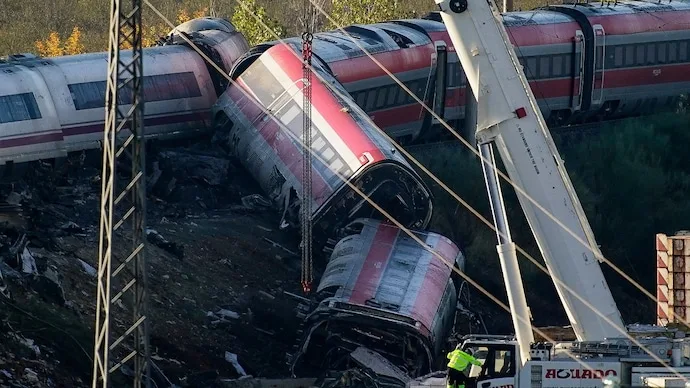

The Spain train crash death toll has risen to 69 after rescuers discovered human remains while searching through the wreckage of a deadly high-speed railway collision in the central province of Toledo. Emergency teams continued recovery operations on Thursday as cranes lifted damaged carriages and authorities worked to establish the circumstances behind the accident.
Regional leader Emiliano García-Page confirmed the revised death toll and said recovery operations were continuing, particularly around a carriage that remained overturned.
The crash has also intensified public concerns about railway safety, with questions being raised over infrastructure investment, signalling systems and operational procedures.

69 Dead, Dozens Still Hospitalised
Emergency workers continued searching the damaged trains after Wednesday's collision. Cranes worked through the night to lift sections of the wreckage, while recovery teams removed what appeared to be a body wrapped in a blanket from one of the carriages.
Among those killed was Fátima Báñez, a former Spanish labour minister who chaired the social and corporate responsibility arm of the country's employers' association.
Spain's Foreign Ministry said information available so far indicated that 42 foreign citizens from seven countries were involved in the accident. One foreign national was reported dead and at least seven injured.
Authorities said 57 injured passengers remained in hospital.
Railway Safety Debate Intensifies as Drivers Continue Strike
The disaster has renewed scrutiny of Spain's railway network, which operates Europe's longest high-speed rail system.
Train drivers proceeded with a previously planned strike to demand greater investment in railway safety. The SEMAF union called for stronger safety measures and improved systems to prevent similar accidents.
The state-run rail operator Renfe reported significant disruption to services. Passengers affected by cancellations or changes were offered free ticket changes or cancellations.
The latest accident has also raised concerns because another fatal incident occurred in January involving the same rail companies on the same railway line.
Signal Failure Under Investigation
Transport Minister Óscar Puente said the Wednesday accident occurred after several trains stopped because of a signal failure.
According to his explanation, a Renfe train was subsequently authorised to continue at normal speed despite a stationary Iryo-operated train ahead.
The government has described the decision to authorise the Renfe train to proceed as inexplicable. However, the precise sequence of events remains subject to investigation.
Railway unions have blamed insufficient investment and a lack of commitment to safety improvements. Puente rejected claims that Spain's railway system was generally unsafe, describing it as reliable while acknowledging the limitations of equipment and human action.
More Than 800 Personnel Deployed for Rescue Operations
Spain's Interior Ministry said more than 800 military and police personnel were involved in the emergency response. The operation included over 200 vehicles, three helicopters, drones, mounted units, search dogs and a mobile command post.
A judge in Toledo also established a two-kilometre exclusion zone around the crash site, restricting access to emergency, security, healthcare and judicial personnel.
The government declared three days of national mourning. Prime Minister Pedro Sánchez visited Toledo and said authorities were working to support victims and their families while investigating every detail of the tragedy.
Pope Leo also conveyed condolences to the families of those killed and expressed support for injured passengers and rescue workers.
The collision has disrupted political campaigning ahead of Spain's November 29 snap election, with leaders of the country's two main parties suspending campaign events.
For official updates, visit the Spanish Government website.






Conversation
Be kind and stay on topic. Comments are moderated; abuse, spam and personal attacks are removed. Report a problem