



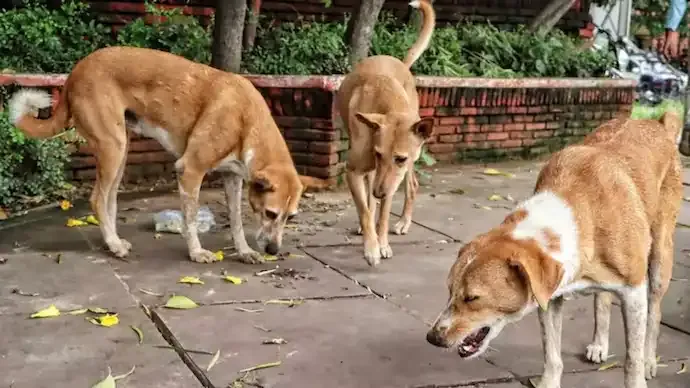
The Supreme Court of India on Thursday resumed its hearing on petitions related to the growing stray dog menace across urban India, with a three-judge bench sharply questioning the failure of civic authorities to implement existing laws and court directions.
The bench, comprising Justice Vikram Nath, Justice Sandeep Mehta, and Justice NV Anjaria, made it clear that public safety cannot be compromised in the name of selective compassion.
Court Highlights Road Accidents, Not Just Dog Bites
During the proceedings, the bench underlined that fatalities linked to stray animals are not limited to dog bite incidents alone. It observed that stray dogs and other animals roaming freely on roads are a major cause of traffic accidents, posing serious risks to commuters.

The judges remarked that no one can predict an animal’s behaviour, noting that it is impossible to assess whether a dog is in a mood to attack or not. Emphasising preventive governance, the court reiterated that “prevention is better than cure” and stressed the need for proactive action rather than reactive measures after tragedies occur.
Civic Bodies Pulled Up for Non-Compliance
The Supreme Court expressed dissatisfaction over the lack of compliance by municipal corporations with earlier directions. In November last year, the apex court had ordered that stray dogs be removed from sensitive public spaces such as schools, hospitals, bus terminals, sports complexes and railway stations, and relocated to designated shelters.
Despite these clear instructions, the bench noted that civic authorities across cities have failed to enforce the directives on the ground, resulting in continued risks to pedestrians, students and patients.
“The roads must be clear of stray animals,” the bench observed, adding that public infrastructure cannot be left vulnerable due to administrative apathy.
Heated Debate Between Animal Welfare and Public Safety
The hearing also saw arguments from senior advocates representing animal welfare groups, who cautioned against the blanket removal of stray dogs from urban areas. One of the submissions warned that abrupt removal could lead to a so-called “vacuum effect”, potentially increasing rodent populations.
In a pointed yet light-hearted remark, the bench responded that cats naturally control rodents and questioned how many dogs should be allowed to roam hospital corridors. The court made it clear that while animal welfare is important, it cannot override human safety concerns.
Senior advocates also pushed for a scientific population control mechanism, advocating the CSVR model — Capture, Sterilise, Vaccinate and Release — as a long-term solution. The bench, however, indicated that even scientific models require strict implementation and accountability, which has been missing so far.
Court Questions Selective Animal Advocacy
The judges also questioned why legal arguments focus disproportionately on dogs, asking whether concerns extend to other animals such as goats and chickens. The observation underscored the court’s discomfort with what it viewed as selective empathy, especially when human lives are repeatedly lost or endangered.
Hearing to Continue, Civic Accountability Under Scanner
The Supreme Court is examining multiple applications seeking either modification or strict enforcement of its earlier orders. The bench made it clear that civic bodies cannot escape responsibility by citing policy gaps or emotional arguments.
As the hearing continues, the case has become a larger test of urban governance, public safety, and the balance between animal rights and human life — with the apex court signalling that administrative negligence will no longer be tolerated.






Conversation
Be kind and stay on topic. Comments are moderated; abuse, spam and personal attacks are removed. Report a problem