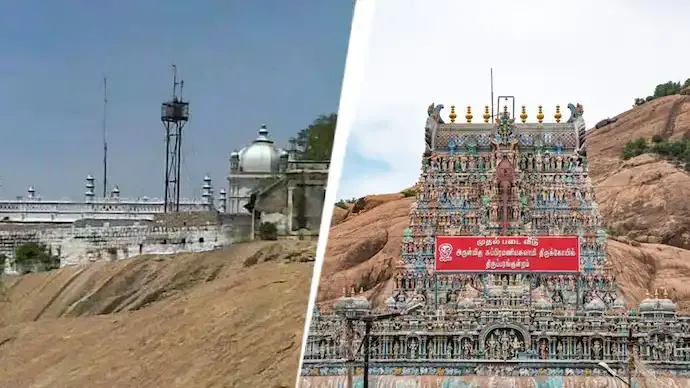
Former Madras High Court judge Justice S S Sundar has raised serious concerns over the recent judicial order related to Thiruparankundram hill in Madurai, warning that it could potentially trigger communal disharmony and disturb public peace across Tamil Nadu.
Justice Sundar criticised the single-judge order permitting the lighting of the Karthigai Deepam lamp near a dargah at Thiruparankundram, stating that the ruling appeared to be issued in haste despite explicit law-and-order warnings flagged by the State government and enforcement agencies. He questioned how a constitutional court could allow what effectively amounted to the introduction of a new religious practice in a sensitive, disputed area.
Highlighting constitutional limitations, Justice Sundar said that while Article 25 guarantees the freedom to practise religion, such rights are not absolute and remain subject to public order, morality and health. He stressed that courts must exercise restraint, particularly when adjudicating matters involving disputed facts and competing religious claims.
Justice Sundar noted that it was undisputed that there had been no historical custom or established practice of lighting the Karthigai Deepam at the location in question. He expressed concern that a writ petition under Article 226 was entertained to decide issues that should have been examined under statutory mechanisms, including proceedings under the Hindu Religious and Charitable Endowments Act.
Criticising the reasoning of the order, the former judge pointed out that even the temple administration had opposed lighting the lamp outside its customary location. He questioned how a court could override both the State’s law-and-order assessment and the temple authority’s position, particularly when prior courts had rejected similar pleas on multiple occasions.
Justice Sundar further objected to the interpretation that lighting the lamp was necessary to assert temple ownership over the site. He said such reasoning travelled far beyond judicial review and risked converting courts into arbiters of property and religious dominance, which should be settled through civil proceedings.
The controversy revolves around Thiruparankundram hill, a site that houses both the Arulmigu Subramania Swamy Temple and the Hazrat Sultan Sikandar Badshah Dargah. Demands to light the ceremonial lamp near a stone pillar known as the Deepathoon have been raised by certain groups, despite objections from the State, temple authorities and the dargah management.
The Tamil Nadu government has refused to implement the order, citing serious law-and-order concerns after clashes between police and protestors. The State has also argued that the Deepathoon pillar does not belong to Hindu religious usage and has historical associations with Jain traditions, supported by archaeological references.
Justice Sundar warned that judicial interventions in such sensitive matters, without careful consideration of ground realities, could aggravate communal tensions. He remarked that courts should focus on preserving social harmony rather than introducing decisions that risk destabilising peace.
The dispute has since escalated into a major legal and political flashpoint, drawing attention to the delicate balance between religious freedom, property rights and public order in pluralistic societies.
Prev Article
Bihari Girls Available for Marriage at Rs 25,000: BJP Minister’s Husband Sparks Nationwide Outrage
Next Article
RSS Not Paramilitary, Not BJP’s Wing: Mohan Bhagwat Rejects Political Label