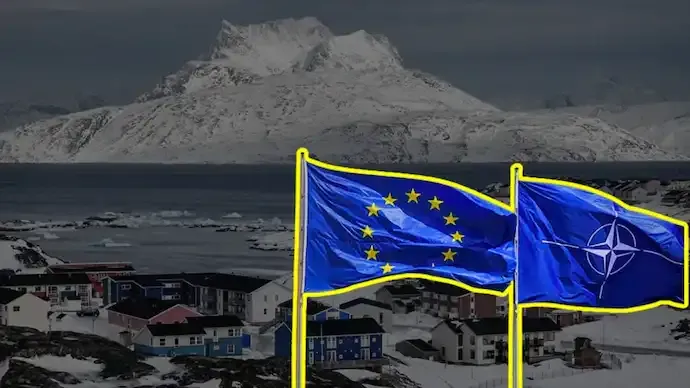
US President Donald Trump has reportedly admitted that he may have acted on incorrect intelligence regarding recent European troop deployments to Greenland, following days of heightened tensions between Washington and its European allies. The acknowledgment came after Trump reacted sharply to what he believed was a sudden military buildup in the Arctic region, triggering fresh tariff threats against several European nations.
According to a media report, Trump made the admission during a phone conversation with British Prime Minister Keir Starmer on Sunday. During the call, Starmer reportedly criticised Trump’s decision to impose new trade tariffs on European countries, including the United Kingdom, over their support for Greenland and Denmark.
Trump is said to have conceded that the information he received about the troop movements may have been inaccurate, admitting he had been given “bad information” about the nature and intent of the European deployments.
British officials later confirmed that the United States had been informed in advance by Danish diplomats about the troop movement. A Danish source further clarified that the deployment had been pre-coordinated within existing European and US military frameworks, including NATO structures, contradicting claims that the move was unilateral or provocative.
Despite these prior communications, Trump announced a 10 per cent tariff on imports from Denmark, Finland, France, Germany, the Netherlands, Norway, Sweden, and the UK, set to take effect from February 1. He also warned that the tariffs could rise to 25 per cent from June if European countries continued to resist US demands related to Greenland.
The tariff announcement triggered swift reactions across the 27-member European Union, exposing growing transatlantic strains. European leaders accused Washington of escalating tensions by linking trade penalties to a geopolitical dispute involving a sovereign Danish territory.
European diplomats quoted in the report suggested that the decision to send Danish and NATO troops to Greenland for joint exercises may have unintentionally aggravated the situation. Instead of merely reinforcing NATO’s Arctic presence, the move appears to have reinforced Trump’s perception that Denmark-led operations could independently manage regional security — undermining his argument that US control of Greenland is essential for global stability.
European Troop Presence in Greenland
Over the past week, several European countries have deployed small contingents of military personnel to Greenland amid rising tensions sparked by Trump’s repeated remarks about annexing the territory.
Denmark currently maintains around 150 military and civilian personnel at its Joint Arctic Command. According to Danish Foreign Minister Lars Lokke Rasmussen, approximately 200 US troops are already stationed in Greenland, which has a population of about 57,000.
Germany has sent a 13-member reconnaissance team via Copenhagen, accompanied by Danish personnel. France has deployed around 15 mountain warfare specialists, Sweden has sent three officers, Norway two, while the UK, the Netherlands, and Finland have each dispatched one or two personnel. These deployments are widely described as preparatory steps for larger NATO exercises scheduled later this year.
EU Considers ‘Trade Bazooka’ Response
In response to Trump’s tariff threats, the EU is now considering activating its powerful Anti-Coercion Instrument (ACI), often referred to as the bloc’s “trade bazooka.” The mechanism would allow Brussels to impose counter-tariffs, restrict US access to the European Single Market, and block American companies from bidding on EU contracts.
EU leaders are set to meet in Brussels later this week to discuss potential retaliation, including a proposed tariff package covering up to €93 billion worth of US imports. If approved, the measures could automatically come into force after a six-month suspension period.
As geopolitical tensions over Greenland intensify, Trump’s admission of faulty intelligence has raised fresh questions about decision-making in Washington and the risks of escalating economic conflict based on misread security signals.