

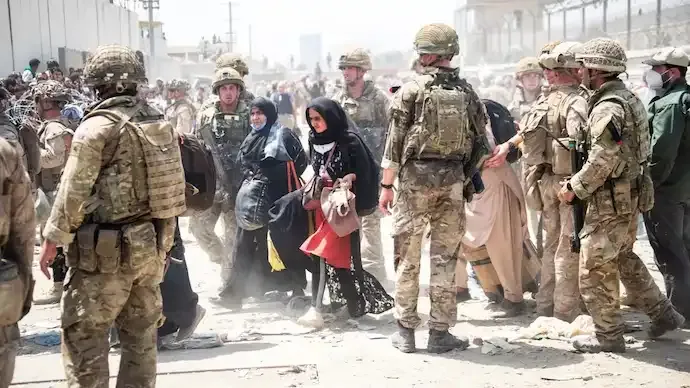

US President Donald Trump has sparked widespread anger among European veterans and allied nations after claiming that Nato troops largely stayed away from the front lines during the two-decade-long war in Afghanistan. The remarks have triggered strong rebuttals from military families and defence experts, who say historical data paints a very different picture of Nato’s role in the conflict.
Speaking recently, Trump asserted that while Nato countries had sent troops to Afghanistan, they were positioned “a little back” and largely avoided direct combat. The statement has been met with outrage, particularly in Europe, where thousands of soldiers served — and many lost their lives — alongside American forces following the September 11 attacks.
After 9/11, the United States invoked Article 5 of the North Atlantic Treaty Organization, marking the first and only time in its history that the collective defence clause was activated. This meant an attack on one member was treated as an attack on all. Nato allies subsequently joined the US-led invasion of Afghanistan in 2001 to dismantle al-Qaeda and remove the Taliban from power.

Between 2001 and 2014 — when formal combat operations ended — Nato forces fought across some of Afghanistan’s most volatile regions. At the peak of the war in 2011, nearly 140,000 Nato troops were deployed in the country, with the US providing the largest contingent. However, data shows that European allies carried a disproportionate burden when casualties are measured against population size and troop strength.
According to compiled military records, nearly 3,500 foreign soldiers were killed during the conflict. While the US suffered the highest number of fatalities in absolute terms — 2,456 troops — several smaller Nato countries endured losses that were comparable on a per-capita basis. The United Kingdom lost 457 personnel, Canada 159, France 90, Germany 62, Italy 53 and Poland 44. Denmark, with a population far smaller than many US states, lost around 50 soldiers — a death rate nearly equivalent to that of the US when adjusted for population.
Crucially, Nato troops were not confined to rear positions. Allied forces operated in high-intensity combat zones including Kandahar, Helmand, Herat, Kabul, Mazar-e-Sharif and eastern provinces bordering Pakistan. Helmand province, a Taliban stronghold and epicentre of the insurgency, was initially secured largely by British and Danish troops, with US reinforcements arriving years later.
Military analysts and defence historians have consistently noted that British, Canadian, Danish and Estonian troops were among those facing some of the fiercest fighting in southern Afghanistan. Studies indicate that British and Canadian forces faced combat risks at nearly twice the rate of US troops when assessed as a proportion of their peak deployments.
Beyond Nato casualties, Afghan forces paid an even higher price. Former Afghan president Ashraf Ghani stated in 2019 that more than 45,000 Afghan security personnel had been killed since 2014 alone, underscoring the immense human cost of the conflict.
Trump’s remarks come at a sensitive moment in transatlantic relations, already strained by disputes involving Greenland and burden-sharing within Nato. Critics argue that diminishing allied sacrifices undermines decades of military cooperation and disrespects the families of soldiers who fought and died on Afghan soil.
Data from the war leaves little doubt: Nato allies were not spectators. They fought on the front lines, suffered heavy losses, and played a decisive role in one of the longest conflicts in modern history.






Conversation
Be kind and stay on topic. Comments are moderated; abuse, spam and personal attacks are removed. Report a problem