
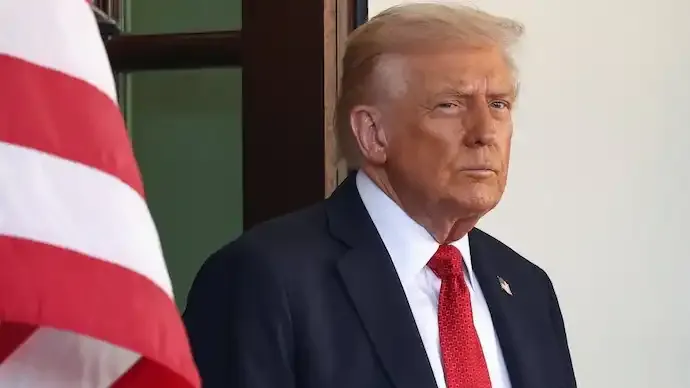
Former U.S. President Donald Trump has announced that he will not attend the upcoming Supreme Court oral arguments on the legality of his global tariff policy, citing a desire to avoid drawing attention away from the historic case.
The Supreme Court is set to deliberate on Wednesday whether Trump exceeded his executive authority when he imposed sweeping tariffs under the 1977 International Emergency Economic Powers Act (IEEPA) — a law originally intended to handle national emergencies related to foreign threats.
Trump Defends His Tariff Policy
Speaking aboard Air Force One after a weekend in Florida, Trump said he initially wanted to attend the hearing but reconsidered.
“I wanted to go so badly,” he stated. “But I don’t want to do anything that might deflect from the importance of this decision. It’s not about me — it’s about our country.”
He defended his use of tariffs as vital for national security and economic fairness, arguing that foreign nations had long exploited the U.S. in trade agreements.
“If we don’t have tariffs, we don’t have national security,” Trump added. “We were being abused by many countries — including China — for years. Tariffs have restored balance and brought tremendous security to our nation.”
Supreme Court to Examine Presidential Powers
At the heart of the case is whether Trump’s interpretation of presidential authority under the IEEPA went beyond legal limits. He is the first president to invoke this 1977 law to impose such wide-ranging trade restrictions.
Critics, including several U.S. states and business groups, have argued that Trump’s actions disrupted global trade, raised costs for American consumers, and violated constitutional checks on executive power.
Trump, however, insists that tariffs boosted U.S. markets and strengthened the nation’s economy, calling them a key pillar of his “America First” trade policy.
Global and Domestic Implications
The Supreme Court’s decision could have far-reaching implications for future administrations and U.S. trade policy. A ruling that limits presidential powers under IEEPA may redefine how the U.S. government uses economic tools in times of geopolitical or trade conflict.
Trump cautioned that any attempt to curb presidential authority to impose tariffs could lead to what he described as the “ruination of our nation.”
The hearing marks a pivotal moment for U.S. trade policy, as justices weigh the balance between executive power and congressional oversight in global economic matters.



Conversation
Be kind and stay on topic. Comments are moderated; abuse, spam and personal attacks are removed. Report a problem