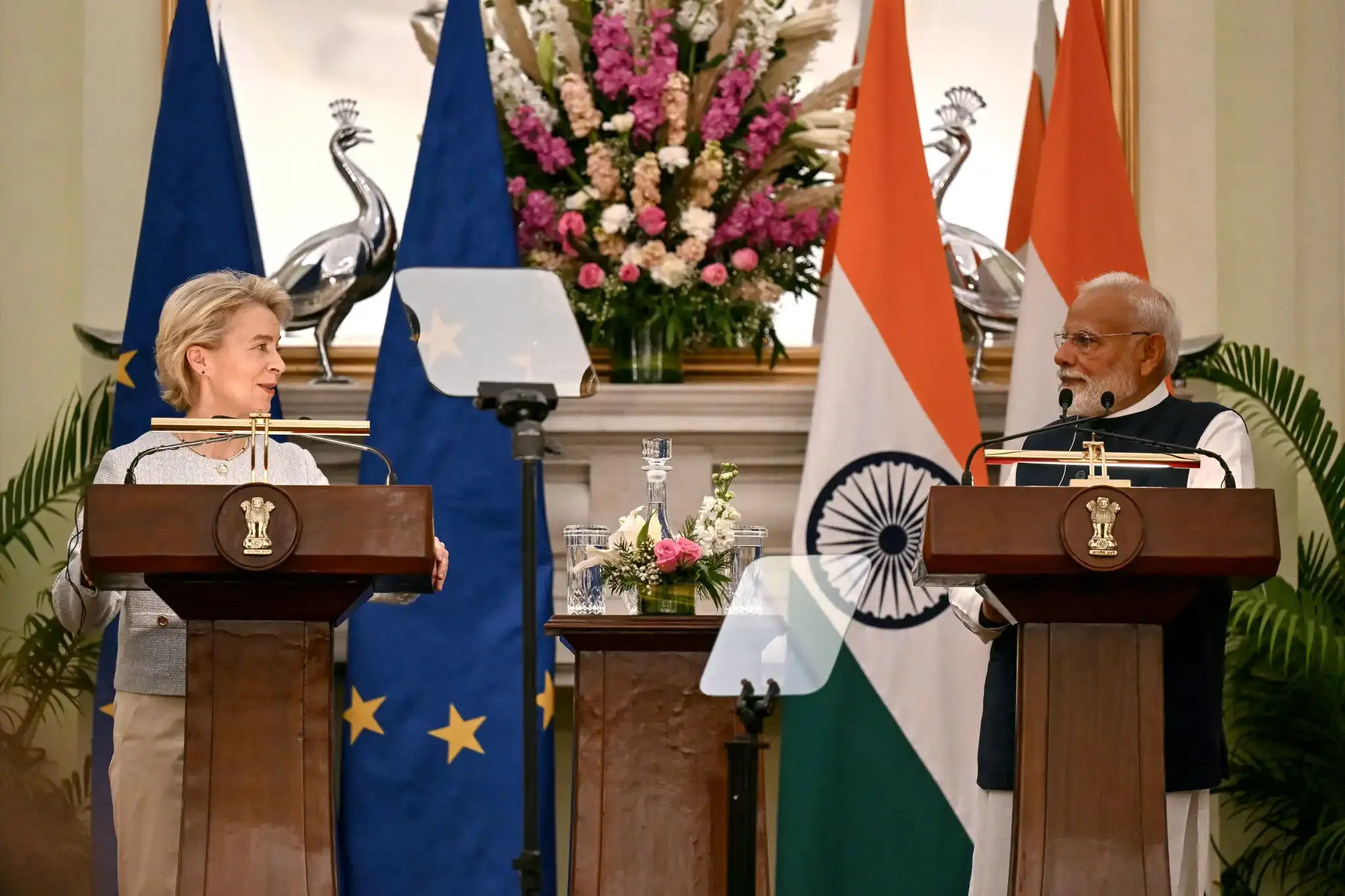
India and the European Union are standing at a decisive moment in their economic relationship, with negotiations for a comprehensive Free Trade Agreement nearing completion after nearly two decades of talks. European Commission President Ursula von der Leyen, who is in India for a high-level summit, said both sides are “on the cusp of a historic trade agreement,” signalling a breakthrough that could significantly reshape bilateral and global trade flows.
Speaking during the India-EU summit engagements, von der Leyen underlined the strategic scale of the partnership, noting that while some procedural steps remain, the political will to conclude the agreement is firmly in place. Often described by policymakers as the “mother of all deals,” the proposed pact is expected to unlock new growth opportunities across manufacturing, services, technology and green energy sectors.
The India-EU Free Trade Agreement brings together two major economic blocs with a combined GDP of approximately $23.4 trillion, accounting for nearly one-third of global exports. Once finalised, the pact is expected to create one of the world’s largest and most influential trade partnerships, at a time when global commerce is undergoing rapid realignment due to geopolitical tensions and protectionist policies in key markets.
For India, the agreement is projected to significantly boost exports in labour-intensive sectors such as textiles, garments, leather and footwear, where Indian producers are expected to gain greater tariff-free or preferential access to European markets. In parallel, the deal is likely to expand opportunities for India’s IT, digital services, consulting and professional services sectors by easing regulatory barriers and improving market access across the EU.
European companies, on the other hand, are expected to benefit from improved access to India’s fast-growing consumer market, particularly in areas such as automobiles, clean technology, machinery, medical devices and high-end manufacturing. The agreement also aims to strengthen supply chains, reduce dependence on single-source markets, and encourage sustainable trade practices.
Indian officials have described the pact as balanced and forward-looking, emphasising that it aligns economic growth with strategic autonomy. The deal is expected to be accompanied by parallel frameworks on investment protection, mobility of skilled professionals, and cooperation on emerging technologies, including artificial intelligence, semiconductors and clean energy transitions.
Beyond economics, the FTA is being viewed as a strategic statement. At a time when global trade norms are under strain, the India-EU partnership signals a shared commitment to rules-based commerce, democratic values and open markets. Analysts say the agreement could serve as a template for future trade arrangements between major democracies.
Once formally announced, the agreement will move into a legal and ratification phase, requiring approvals from India’s Union Cabinet and the European Parliament. If timelines remain on track, the pact could begin to take effect in the near future, ushering in a new chapter in India-EU relations.
As von der Leyen noted during her visit, the agreement is not just about tariffs or trade volumes, but about shaping a long-term partnership capable of influencing global economic stability in an increasingly fragmented world.
Prev Article
Rajiv Gowda Arrested After Abusing Woman Civic Official Over Illegal Banner Row
Next Article
Plane Crash Near Baramati During Landing Attempt Involving Maharashtra Deputy CM