
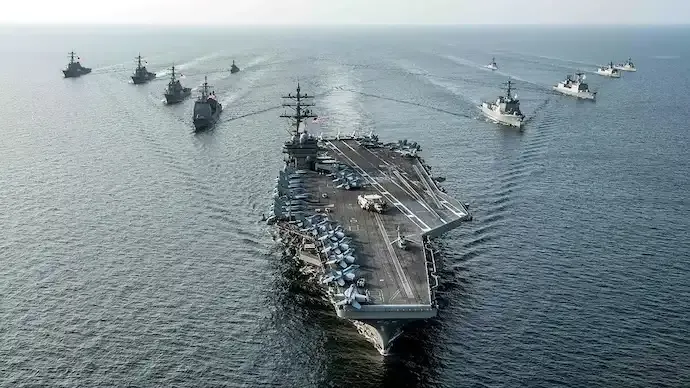
Speculation over a potential US military strike on Iran has intensified after the United States Navy’s Abraham Lincoln carrier strike group entered Middle East waters, marking a significant escalation in Washington’s military posture in the region. The deployment comes amid heightened tensions between the United States and Iran, raising questions over whether airstrikes could be imminent.
The aircraft carrier and its accompanying warships were redirected from operations in the Indo-Pacific and have now entered the area of responsibility of the United States Central Command. The carrier transited the Strait of Malacca earlier this month, escorted by multiple guided-missile destroyers, before moving westward toward the Middle East.
US military officials have described the deployment as a move aimed at promoting regional security and stability. However, the scale and timing of the naval buildup have fuelled widespread speculation that Washington is positioning itself for possible military action against Tehran.
Trump Signals Pressure but Stops Short of Action
President Donald Trump has linked the expanded military presence to pressure on Iran over its handling of nationwide protests that erupted in late December. The unrest and subsequent crackdown have drawn sharp international criticism, prompting Washington to increase both diplomatic and military pressure.
Trump has said the deployment was ordered “just in case,” emphasising that the goal was deterrence rather than immediate conflict. At the same time, he acknowledged that the movement of assets gives the United States decisive strike options should the situation deteriorate.
The President has repeatedly warned that Iran would face consequences if mass executions were carried out or if peaceful demonstrators were killed. While Trump later suggested that Iranian authorities had paused planned executions, officials in Tehran have denied the claim, adding to the uncertainty surrounding the situation.
Expanded US Military Footprint Near Iran
The arrival of the Abraham Lincoln strike group significantly boosts the US military presence in the region, bringing thousands of additional personnel within operational range of Iran. It also marks the first time in months that a US aircraft carrier has entered Middle Eastern waters, underlining the seriousness of the escalation.
In parallel, the Pentagon has reportedly moved additional assets closer to Iran, including fighter aircraft and military transport flights. These deployments expand Washington’s operational flexibility, allowing rapid response across air, sea and missile domains.
Military analysts note that a carrier strike group provides the United States with a wide range of options, from intelligence gathering and surveillance to precision airstrikes, without requiring immediate basing access in the region.
Regional Fears of Escalation
Iran’s leadership has warned that any attack on its territory would be met with force, raising fears of a broader regional conflict. The Middle East remains on edge, with concerns that even limited strikes could trigger retaliation against US bases or allies.
The situation recalls previous US military buildups, when missile defence systems and naval assets were deployed in anticipation of Iranian responses following earlier confrontations. Those episodes underscored how quickly tensions can spiral into direct exchanges.
Diplomatic Door Left Ajar
Despite the heightened military posture, Washington has indicated that diplomacy remains an option. US officials have said Iran is aware of the conditions required to resume talks and that the door to engagement has not been fully closed.
However, the simultaneous show of force and diplomatic messaging has created strategic ambiguity, a tactic often used to pressure adversaries while avoiding explicit red lines.
As the Abraham Lincoln strike group settles into Middle East waters, attention remains fixed on Washington’s next move. Whether the deployment serves purely as a deterrent or becomes a prelude to military action will likely depend on developments in Iran and the broader regional response in the coming days.



Conversation
Be kind and stay on topic. Comments are moderated; abuse, spam and personal attacks are removed. Report a problem