Shopping cart
Your cart empty!


Your cart empty!
Terms of use dolor sit amet consectetur, adipisicing elit. Recusandae provident ullam aperiam quo ad non corrupti sit vel quam repellat ipsa quod sed, repellendus adipisci, ducimus ea modi odio assumenda.
Lorem ipsum dolor sit amet consectetur adipisicing elit. Sequi, cum esse possimus officiis amet ea voluptatibus libero! Dolorum assumenda esse, deserunt ipsum ad iusto! Praesentium error nobis tenetur at, quis nostrum facere excepturi architecto totam.
Lorem ipsum dolor sit amet consectetur adipisicing elit. Inventore, soluta alias eaque modi ipsum sint iusto fugiat vero velit rerum.
Sequi, cum esse possimus officiis amet ea voluptatibus libero! Dolorum assumenda esse, deserunt ipsum ad iusto! Praesentium error nobis tenetur at, quis nostrum facere excepturi architecto totam.
Lorem ipsum dolor sit amet consectetur adipisicing elit. Inventore, soluta alias eaque modi ipsum sint iusto fugiat vero velit rerum.
Dolor sit amet consectetur adipisicing elit. Sequi, cum esse possimus officiis amet ea voluptatibus libero! Dolorum assumenda esse, deserunt ipsum ad iusto! Praesentium error nobis tenetur at, quis nostrum facere excepturi architecto totam.
Lorem ipsum dolor sit amet consectetur adipisicing elit. Inventore, soluta alias eaque modi ipsum sint iusto fugiat vero velit rerum.
Sit amet consectetur adipisicing elit. Sequi, cum esse possimus officiis amet ea voluptatibus libero! Dolorum assumenda esse, deserunt ipsum ad iusto! Praesentium error nobis tenetur at, quis nostrum facere excepturi architecto totam.
Lorem ipsum dolor sit amet consectetur adipisicing elit. Inventore, soluta alias eaque modi ipsum sint iusto fugiat vero velit rerum.
Do you agree to our terms? Sign up

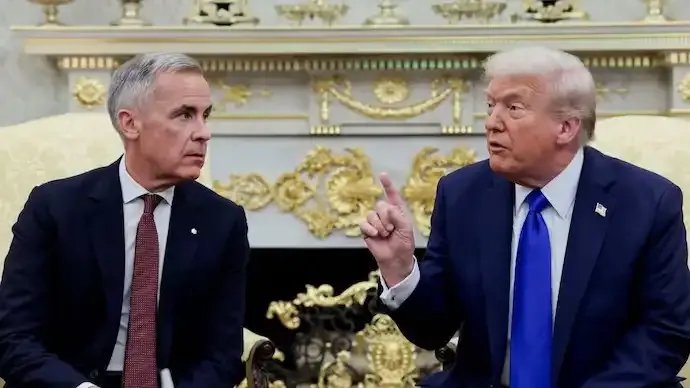
Canadian Prime Minister Mark Carney has ruled out the possibility of pursuing a free trade agreement with China, moving to calm tensions after a sharp warning from US President Donald Trump over Ottawa’s recent engagement with Beijing. Carney’s remarks came a day after Trump threatened to impose sweeping 100 per cent tariffs on Canadian goods if Canada moved closer to a comprehensive trade deal with China.

Addressing the issue, Carney clarified that Canada has no intention of negotiating a free trade agreement with China or any other non-market economy. He emphasised that Canada remains bound by its commitments under the trilateral trade pact with the United States and Mexico, which includes provisions requiring advance notification and consultation before entering such agreements.
Carney said recent interactions with Beijing were narrowly focused on resolving specific trade disputes rather than expanding market access. According to him, Ottawa’s engagement aimed to stabilise trade relations that had deteriorated over the past two years due to retaliatory tariff measures on both sides.
Trump’s warning followed reports suggesting Canada was recalibrating its trade posture toward China. In a series of strongly worded social media posts, the US leader accused Beijing of undermining Canada’s economy and cautioned Ottawa against becoming a conduit for Chinese goods entering the American market. Trump claimed that closer Canada–China trade ties would damage Canadian businesses and social stability, while also threatening punitive tariffs if Ottawa proceeded with any formal agreement.
While Trump’s initial rhetoric was confrontational, his tone later shifted, focusing criticism more squarely on China rather than directly targeting Canada. Nevertheless, the episode has highlighted growing sensitivities within North American trade relations, particularly as discussions around the future of regional trade arrangements gather pace.
Canada’s current stance follows a period of escalating trade tensions with China. In 2024, Ottawa imposed steep tariffs on Chinese electric vehicles, as well as on steel and aluminium products, aligning closely with US policy. Beijing responded with retaliatory duties on key Canadian exports, including agricultural and seafood products, prompting negotiations to ease the standoff.
Earlier this month, Canada adjusted its tariff framework during high-level discussions with China, reducing duties on certain Chinese electric vehicles in exchange for lower tariffs on Canadian agricultural exports. Carney stressed that this adjustment does not signal a broader opening of the Canadian market. Instead, it introduces a capped import system designed to limit volumes and protect domestic industries.
Under the revised framework, Chinese electric vehicle imports will be subject to an annual quota, starting at a limited number and gradually increasing over several years, while remaining a small fraction of Canada’s overall vehicle market. Carney noted that the approach aims to balance trade stability with safeguards for local manufacturers and workers.
The US administration has expressed concern that Canada could become a backdoor for Chinese goods entering the American market. Senior US officials have warned that such a development would undermine the spirit of the existing North American trade agreement, which is expected to come up for renegotiation in the near future.
The dispute also unfolds against a backdrop of broader geopolitical friction between Trump and Carney. Differences over global trade, alliance dynamics, and US pressure on allies have added strain to bilateral relations. Carney, speaking at international forums, has positioned Canada as part of a group of middle powers seeking collective action in an increasingly competitive global order.
By firmly rejecting a China free trade deal, Carney has signalled Canada’s intent to maintain alignment with its North American partners while managing a complex economic relationship with Beijing through limited, issue-specific engagement rather than sweeping trade integration.
63
Published: Jan 26, 2026

All India Story is your trusted source for comprehensive and up-to-the-minute news coverage across India. Bringing you the latest on politics, business, technology, entertainment, sports, and more, we are dedicated to keeping you informed with accurate, engaging, and insightful stories from every corner of the nation.