

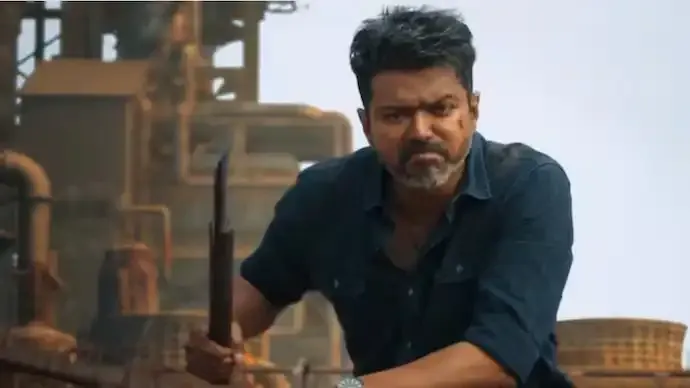

The trailer of Vijay’s upcoming film Jana Nayagan has ignited an unexpected and wide-ranging debate across social media platforms. While fans were busy dissecting every frame, an unmissable detail caught collective attention — a visible AI watermark believed to be linked to Google’s Gemini AI tool. The discovery quickly turned into a meme fest, but it also triggered a serious conversation about whether Indian cinema is already stepping into an AI-engineered era.
As Jana Nayagan prepares for its theatrical release on January 9, the controversy has shifted focus from the film’s political narrative to the larger implications of artificial intelligence in mainstream filmmaking. Industry professionals suggest that this moment may not be a scandal but a signal of changing production realities at the highest level of cinema.
Visual effects supervisor Debdoot Ghosh of Nube Cirrus believes the appearance of AI tools in a high-profile trailer reflects experimentation rather than a creative compromise. According to him, AI adoption is becoming unavoidable as filmmakers explore new technologies to meet mounting expectations. He points out that big-budget films often lead technological transitions, and Vijay’s film embracing new tools could be viewed as setting a benchmark rather than lowering standards.

Editors and VFX professionals note that large-scale productions operate under extreme pressure, with tight schedules, multiple stakeholders and little room for delays. In such scenarios, AI tools are increasingly seen as support systems rather than shortcuts. Film editor Prakhar Khare explains that while AI-assisted techniques such as dialogue dubbing, background replacement and frame-level enhancements are being tested, the industry is still in a trial phase rather than a full transformation.
The visible watermark, however, has raised questions about oversight. Experts speculate that its presence could be the result of rushed deadlines or incomplete shots that required quick fixes. In trailer production, even minor delays can have cascading effects on marketing schedules. Ghosh suggests that a director dissatisfied with a scene or facing time constraints may opt for AI-assisted solutions that can achieve results in hours instead of weeks.
Concerns about AI replacing VFX artists have also resurfaced. Industry veterans dismiss this fear as exaggerated, comparing AI’s arrival to earlier technological shifts such as CGI, motion capture and virtual production. According to professionals, creativity, judgement and storytelling remain firmly human-driven, with AI acting as an additional tool rather than a replacement.
Another common misconception is that AI significantly reduces costs. Experts clarify that while AI may not drastically cut expenses, it saves valuable time — a critical factor in big-budget filmmaking where time directly translates to money.
What began as a social media talking point has now forced Indian cinema into a conversation it can no longer avoid. The Jana Nayagan trailer episode highlights how technology is quietly integrating into creative workflows, not as a futuristic concept but as a present-day reality. AI may still be experimental, but its appearance in a superstar-led film suggests that Indian cinema has already crossed a threshold — not towards replacement, but towards reinvention.







Conversation
Be kind and stay on topic. Comments are moderated; abuse, spam and personal attacks are removed. Report a problem