


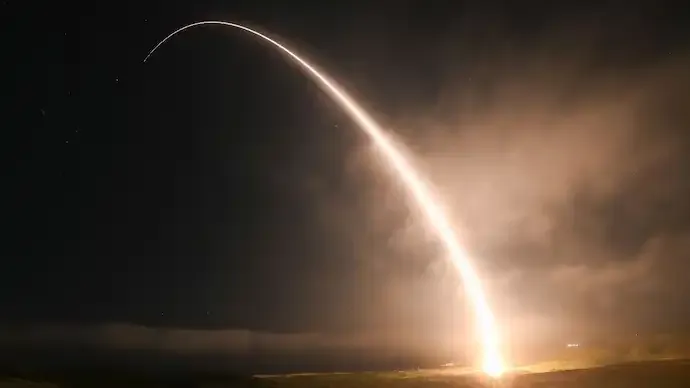
The United States recently carried out a test launch of its powerful Minuteman III nuclear-capable missile, drawing global attention as tensions continue during the ongoing conflict involving Iran. The missile, often referred to as the “doomsday missile,” is one of the most important components of the US nuclear deterrence system.
The intercontinental ballistic missile (ICBM) was launched from Vandenberg Space Force Base in California during a routine unarmed test. After launch, the missile travelled thousands of kilometres before reaching its target area in the Marshall Islands in the Pacific Ocean.
While the launch was part of a regular military evaluation programme, the test has raised widespread curiosity about what the Minuteman III missile actually is, how it works, and whether such weapons could lead to catastrophic global consequences.

What Is the Minuteman III Missile?
The Minuteman III is an intercontinental ballistic missile designed to carry nuclear warheads across continents. Developed during the Cold War era, the missile was created to strengthen the United States’ homeland defence and nuclear deterrence strategy.
The weapon is stored inside fortified underground silos, which protect it from enemy attacks and allow it to remain ready for launch at any time. Each missile is controlled from underground launch centres where two authorised personnel must simultaneously activate the launch sequence.
This two-person control system ensures that no single individual can launch the missile independently.
The Minuteman III is capable of travelling over 9,600 kilometres and can reach speeds of approximately Mach 23, which equals about 28,000 kilometres per hour. At such speeds, it can strike targets across continents in less than 30 minutes.
How the Missile Works
Once a launch order is issued, the Minuteman III is propelled from its underground silo using a solid-fuel rocket engine. Within minutes, the missile climbs high into the atmosphere before separating into stages as it accelerates toward its target.
After reaching its peak trajectory, the missile travels through space before re-entering the Earth’s atmosphere. The nuclear warhead is contained in a protective re-entry vehicle, which is designed to withstand extreme heat and pressure during the descent.
The warhead then moves toward its designated target at extremely high speeds before detonating.
Some versions of ballistic missiles can carry multiple independently targetable re-entry vehicles (MIRVs), allowing a single missile to strike several targets during one launch.
Why It Is Called the ‘Doomsday Missile’
The nickname “doomsday missile” is connected to the broader US nuclear command system that enables the launch of such weapons even during catastrophic scenarios.
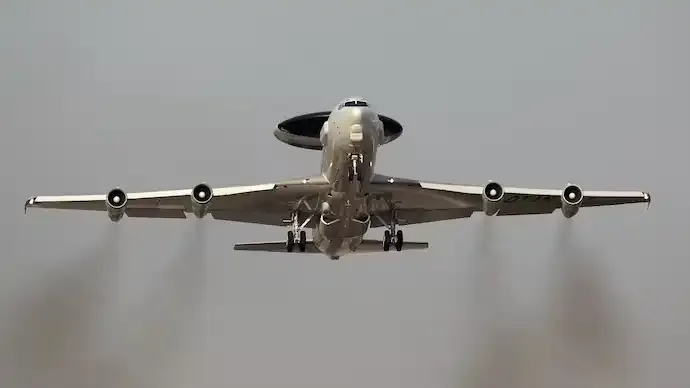
In the recent test, the missile launch was coordinated with support from a specialised command aircraft often referred to as a “doomsday plane.” This aircraft acts as a flying command centre that can transmit launch orders to nuclear forces if ground communication systems are destroyed during a major conflict.
The system ensures that national leadership can maintain control of nuclear forces even under extreme conditions.
This concept forms the foundation of nuclear deterrence, which is based on the idea that the threat of massive retaliation prevents countries from launching nuclear attacks in the first place.
Destructive Power of Nuclear Weapons
The nuclear warheads that ballistic missiles can carry are among the most destructive weapons ever created.
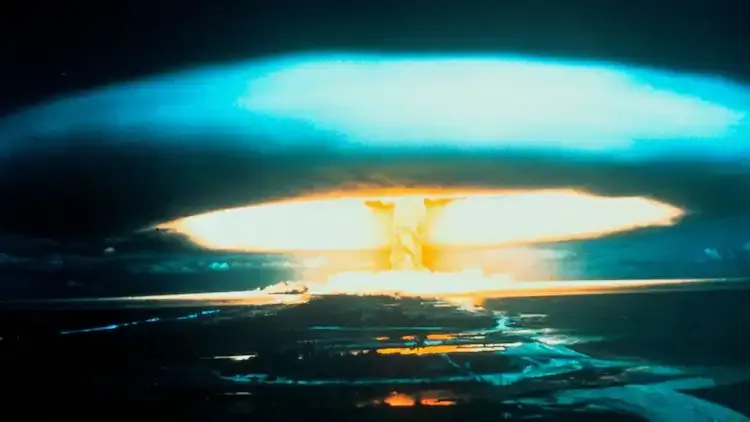
When a nuclear weapon detonates, it produces an intense fireball reaching millions of degrees Celsius, followed by a powerful shockwave capable of destroying buildings and infrastructure across large areas. The explosion is often accompanied by the formation of a mushroom cloud rising high into the atmosphere.
Such blasts can devastate entire cities within seconds.
Despite their destructive potential, Minuteman III missiles have never been used in actual combat, and all launches so far have been part of testing and evaluation programmes.
Could It Trigger a Nuclear Winter?
One of the biggest concerns surrounding nuclear weapons is the possibility of a nuclear winter. This phenomenon could occur if multiple nuclear explosions cause widespread fires that send enormous amounts of smoke and soot into the upper atmosphere.
The particles could block sunlight, dramatically lowering global temperatures and disrupting agriculture around the world. Scientists warn that even a limited nuclear exchange between countries could potentially trigger this scenario.
Future of the Minuteman III System
The Minuteman III has been in service since the late 1970s and remains a central element of the United States’ land-based nuclear defence system. Currently, about 400 missiles remain on active alert in underground silos across states such as Montana, Wyoming, and North Dakota.
The US military plans to eventually replace the system with a newer missile programme known as Sentinel, although delays mean the Minuteman III could remain operational until around 2050.
While the recent launch was a routine test, it highlights the continuing role of nuclear deterrence in modern military strategy and reminds the world of the immense destructive power that such weapons possess.






Conversation
Be kind and stay on topic. Comments are moderated; abuse, spam and personal attacks are removed. Report a problem